
Pulp Fiction, 1925 · page 180 of 196
Adventure Magazine Cover — page 180: what you’re looking at
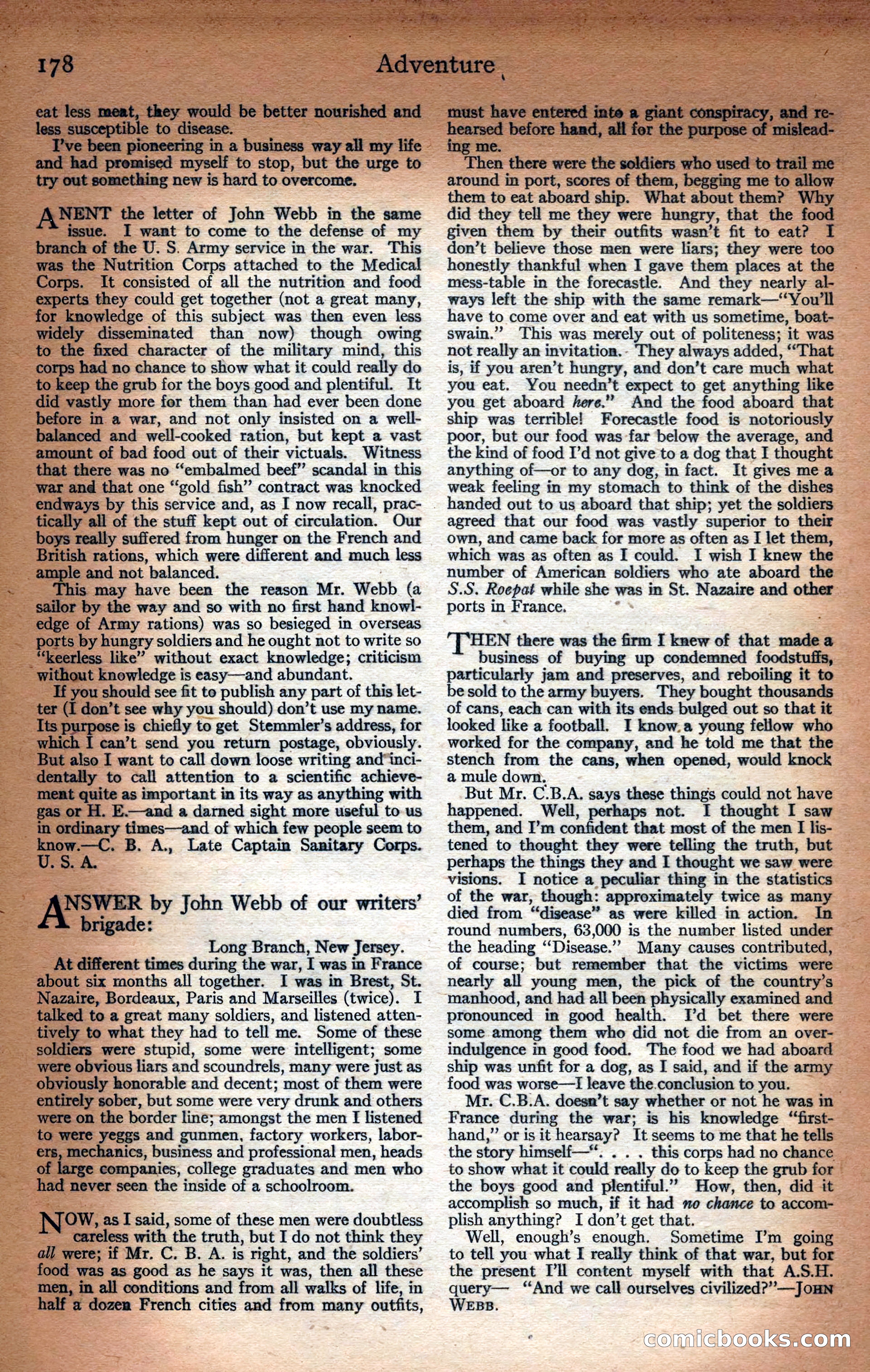
A restored page from Pulp Fiction, 1925. Page through the whole issue in the reader above.
📄 Transcribed text from this page (OCR, searchable)
Machine-transcribed from the original scan — historical spelling and the odd misread are preserved.
: f 178 PL cat less mont they would be better nourished and less susceptible to disease. I’ve been pioneering in a business way all my life and had premised myself to stop, but the urge to try out something new is hard to overcome. ANENT the letter of John Webb in the same issue. I want to come to the defense of my branch of the U. S. Army service in the war. This was the Nutrition Corps attached to the Medical Corps. It consisted of all the nutrition and food experts they could get together (not a great many, for knowledge of this subject was then even less widely disseminated than now) though owing to the fixed character of the military mind, this corps had no chance to show what it could really do to keep the grub for the boys good and plentiful. It did vastly more for them than had ever been done before in a war, and not only insisted on a well- balanced and well-cooked ration, but kept a vast amount of bad food out of their victuals. Witness that there was no “embalmed beef”’ scandal in this war and that one “gold fish” contract was knocked endways by this service and, as I now recall, prac- tically all of the stuff kept out of circulation. Our boys really suffered from hunger on the French and British rations, which were different and much less ample and not ‘balanced. This may have been the reason Mr. Webb (a sailor by the way and so with no first hand knowl- edge of Army rations) was so besieged in overseas ports by hungry soldiers and he ought not to write so “keerless like” without exact knowledge; criticism without knowledge is easy—and abundant. Tf you should see fit to publish any part of this let- ter (I don’t see why you should) don’t use my name. Its purpose is chiefly to get Stemmler’s address, for which I can’t send you return postage, obviously. But also I want to call down loose writing and"inci- dentally to call attention to a scientific achieve- ment quite as important in its way as anything with gas or H. E.—and a darned sight more useful to us in Ordinary times—and of which few people seem to ee — B. A., Late Captain Sanitary Corps. os Shee by John Webb of our writers’ brigade: Long Branch, New Jersey. At different times during the war, I was in France about six months all together. I was in Brest, St. Nazaire, Bordeaux, Paris and Marseilles (twice). I talked to a great many soldiers, and listened atten- tively to what they had to tell me. Some of these soldiers were stupid, some were intelligent; some were obvious liars and scoundrels, many were just as obviously honorable and decent; most of them were entirely sober, but some were very drunk and others were on the border line; amongst the men [f listened to were yeggs and gunmen, factory workers, labor- €rs, mechanics, business and professional men, heads of large companies, college graduates and men who had never seen the inside of a schoolroom. Now: as I said, some of these men were doubtless careless with the truth, but I do not think they all were; if Mr. C. B. A. is right, and the soldiers’ food was as good as he says it was, then all these men, in all conditions and from all walks of life, in half a dozen French cities and from many outfits, must have entered inte a giant conspiracy, and re- a all for the purpose of mislead- me Then there were the soldiers who used to trail me around in port, scores of them, begging me to allow them to eat aboard ship. What about them? Why did they tell me they were hungry, that the food given them by their outfits wasn’t fit to eat? I don’t believe those men were liars; they were too honestly thankful when I gave them places at the mess-table in the forecastle. And they nearly al ways left the ship with the same remark—“You'll have to come over and eat with us sometime, boat- swain.” This was merely out of politeness; it was not really an invitation.- They always added, ‘“That is, if you aren’t hungry, and don’t care much what you eat. You needn’t expect to get anything like you get aboard kere.” And the food aboard that ship was terrible! Forecastle food is notoriously poor, but our food was far below the average, and the kind of food I’d not give to a dog that I thought anything of—or to any dog, in fact. It gives mea weak feeling in my stomach to think of the dishes _ handed out to us aboard that ship; yet the soldiers agreed that our food was vastly superior to their own, and came back for more as often as I let them, which was as often as I could. I wish I knew the number of American soldiers who ate aboard the S.S. Roepat while she was in St. Nazaire and other ports in France. HEN there was the firm I knew of that madea business of buying up condemned foodstuffs, particularly jam and preserves, and reboiling it to be sold to the army buyers. They bought thousands of cans, each can with its ends bulged out so that it looked like a football. I know.a young fellow who worked for the company, and he told me that the stench from the cans, when opened, would knock a mule down. But Mr. C.B.A. says these things could not have happened. Well, perhaps not. I thought I saw them, and I’m confident that most of the men I lis- tened to thought they were telling the truth, but perhaps the things they and I thought we saw were visions. I notice a peculiar thing in the statistics of the war, though: approximately twice as many died from “disease” as were killed in action. In round numbers, 63,000 is the number listed under the heading ‘‘Disease.’’ Many causes contributed, of course; but remember that the victims were nearly all young men, the pick of the country’s manhood, and had all been physically examined and pronounced in good health. I’d bet there were some among them who did not die from an over- indulgence in good food. The food we had aboard ship was unfit for a dog, as I said, and if the army food was worse—I leave the.conclusion to you. Mr. C.B.A. doesn’t say whether or not he was in France during the war; is his knowledge “first- hand,” or is it hearsay? It seems to me that he tells the story himself—*. . . . this corps had no chance to show what it could really do to keep the grub for the boys good and plentiful.” How, then, did it accomplish so much, if it had mo chance to accom- plish anything? I don’t get that. Well, enough’s enough. Sometime I’m going to tell you what I really think of that war, but for the present I'll content myself with that A.S.H. query— “And we call ourselves civilized?” —JouN WEBB. comicbooks.com ae ane ~ - Fee