
Pulp Fiction, 1925 · page 188 of 196
Adventure Magazine Cover — page 188: what you’re looking at
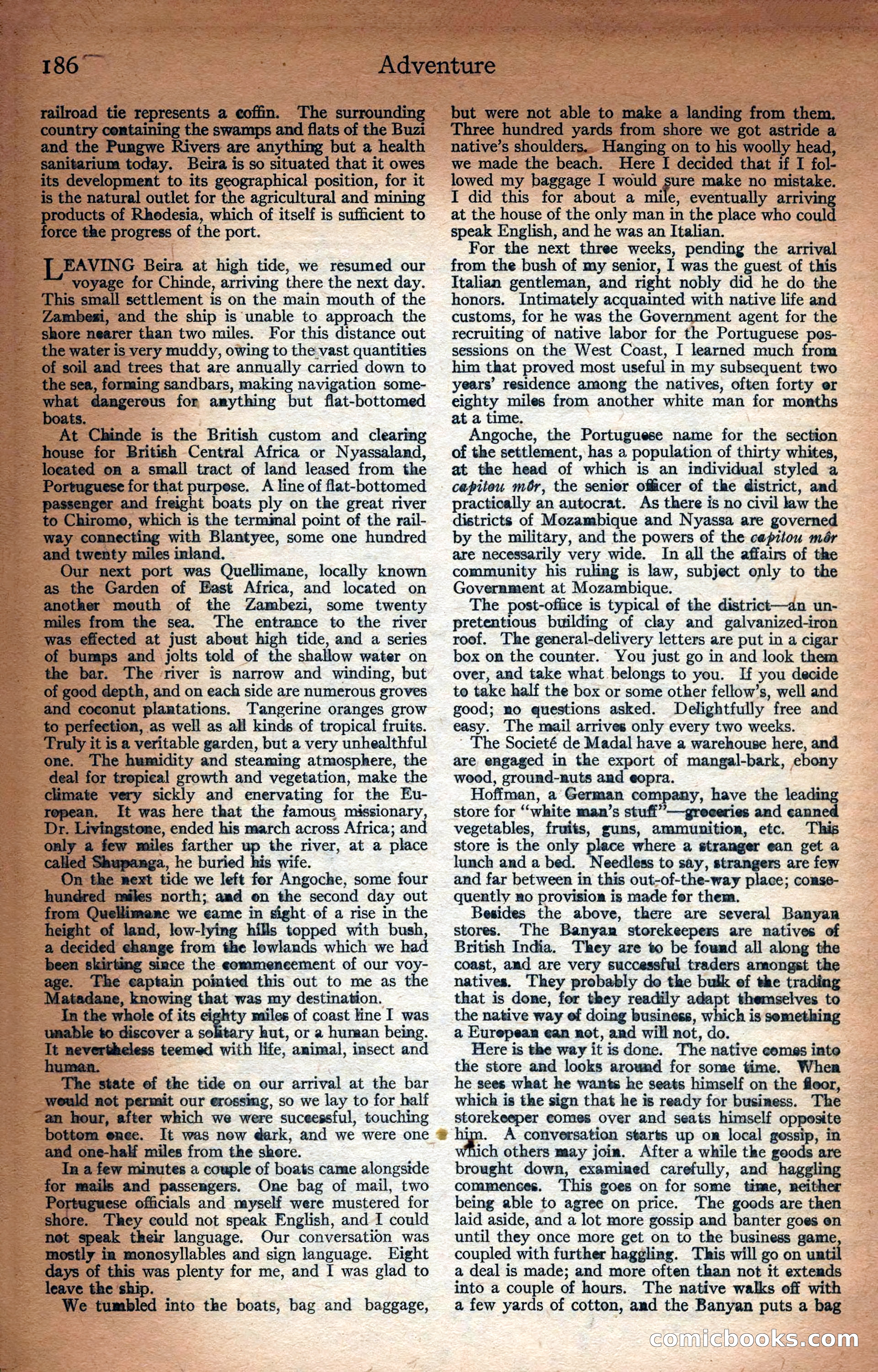
A restored page from Pulp Fiction, 1925. Page through the whole issue in the reader above.
📄 Transcribed text from this page (OCR, searchable)
Machine-transcribed from the original scan — historical spelling and the odd misread are preserved.
Pe atk en 186 railroad tie represents a coffin. The surrounding country containing the swamps and flats of the Buzi and the Pungwe Rivers are anything but a health sanitarium today. Beira is so situated that it owes its development to its geographical position, for it is the natural outlet for the agricultural and mining products of Rhodesia, which of itself is sufficient to force the progress of the port. _ LEAVING Beira at high tide, we resumed our voyage for Chinde, arriving there the next day. This small settlement is on the main mouth of the Zambesi, and the ship is unable to approach the "shore nearer than two miles. For this distance out the water is very muddy, owing to the vast quantities of soil and trees that are annually carried down to _ the sea, forming sandbars, making navigation some- a dangerous fon amything but flat-bottomed ts. At Chinde is the British custom and clearing house for British Central Africa or Nyassaland, loeated om a small tract of land leased from the Portuguese for that purpese. A line of flat-bottomed passenger and freight boats ply on the great river to Chiromo, which is the terminal point of the rail- Way comnecting with Blantyee, some one hundred and twenty miles inland. Our next port was Quellimane, locally known as the Garden of East Africa, and located on another mouth of the Zambezi, some twenty miles from the sea. The entrance to the river Was efiected at just about high tide, and a series of bumps and jolts told of the shallow water on the bar. The river is narrow and winding, but of good depth, and on each side are numerous groves and coconut plantations. Tangerine oranges grow to perfection, as well as all kinds of tropical fruits. ‘Truly it is a veritable garden, but a very unhealthful one. The humidity and steaming atmosphere, the deal for tropical growth and vegetation, make the climate very sickly and enervating for the Eu- nm. It was here that the famous missionary, Dr. Livingstone, ended his march across Africa; and only a few miles farther up the river, at a place called Shupanga, he buried his wife. On the next tide we left for Angoche, some four hundred miles north; amd on the second day out from Quellimane we came in sight of a rise in the height of land, low-lying hills topped with bush, a decided change from the lowlands which we had been skirting since the commencement of our voy- age. The captain poimied this out to me as the Matadane, knowing that was my destination. In the whole of its ty miles of coast ine I was unable to discover a solitary hut, or a human being. Tt nevertheless teemed with life, animal, insect and human. The state of the tide on our arrival at the bar weuld not permit our erossing, so we lay to for half an hour, after which we were suceessful, touching bottom enee. It was now dark, and we were one and one-half miles from the shore. In a few minutes a couple of boats came alongside ag Mails and passengers. One bag of mail, two ese officials and myself were mustered for sh re. They eould not speak English, and I could net speak their language. Our conversation was mostly in monosyllables and sign language. Eight days of this was plenty for me, and I was glad to leave the ship. We tumbled into the boats, bag and baggage, Adventure but were not able to make a landing from them. Three hundred yards from shore we got astride a native’s shoulders... Hanging on to his woolly head, we made the beach. Here I decided that if I fol- lowed my baggage I mone: ure make no mistake. I did this for about a mile, eventually arri at the house of the only man in the place who tir speak English, and he was an Italian. For the next three weeks, pending the arrival from the bush of my senior, I was the guest of this Italian gentleman, and right nobly did he do the honors. Intimately acquainted with native life and customs, for he was the Government agent for the recruiting of native labor for the Portuguese pes- sessions on the West Coast, I learned much from him that proved most useful in my subsequent two years’ residence among the natives, often forty er eighty miles from another white man for months at a time. Angoche, the Portuguese name for the section of the settlement, has a population of thirty whites, at the head of ‘which is an individual styled a capitou mér, the senier officer of the district, and practically an autocrat. As there is no civil law the districts of Mozambique and Nyassa are governed by the military, and the powers of the capiiou mér are necessarily very wide. In all the affairs of the community his ruling is law, subject only to the Government at Mozambique. The post-office is typical of the district—an un- pretentious building of clay and galvanized-iron roof. The general-delivery letters are put in a cigar box on the counter. You just go in and look them over, and take what belongs to you. If you decide to take half the box or some other fellow’s, well and good; mo questions asked. Delightfully free and easy. The mail arrives only every two weeks. The Societé de Madal have a warehouse here, and are engaged in the export of mangal-bark, ebony wood, ground-nuts and eopra. Hoffman, a German company, have the pias store for “white man’s stuff”—greeeries and cann vegetables, fruits, guns, ammunition, etc. This store is the only place where a stranger ean get a lunch and a bed. Needless to say, strangers are few and far between in this out-of-the-way place; conse- quently no provision is made for them. Besides the above, there are several Banyan stores. The Banyan storekeepers are natives of British India. They are to be found all along the coast, amd are very successful traders amongst the natives. They probably do the bulk ef the trading that is done, for they readily adapt themselves to the native way ef doing business, which is something a Eurepean ean not, and will not, do. Here is the way itis done. The native comes into the store and looks arownd for some time. When he sees what he wants he seats himself on the floor, which is the sign that he is ready for business. The storekeeper comes over and seats himself opposite - 3 A conversation starts up om local gossip, in ich others may join. After a while the goods are brought down, examined carefully, and haggling commences. This goes on for some time, neither being able to agree on price. The goods are then laid aside, and a lot more gossip and banter goes en until they once more get on to the business gam coupled with further haggling. This will go on until a deal is made; and more often than not it extends into a couple of hours. The native walks off with a few yards of cotton, and the Banyan puts a bag CORMIC OOO <Sarerey aa