
Pulp Fiction, 1925 · page 189 of 196
Adventure Magazine Cover — page 189: what you’re looking at
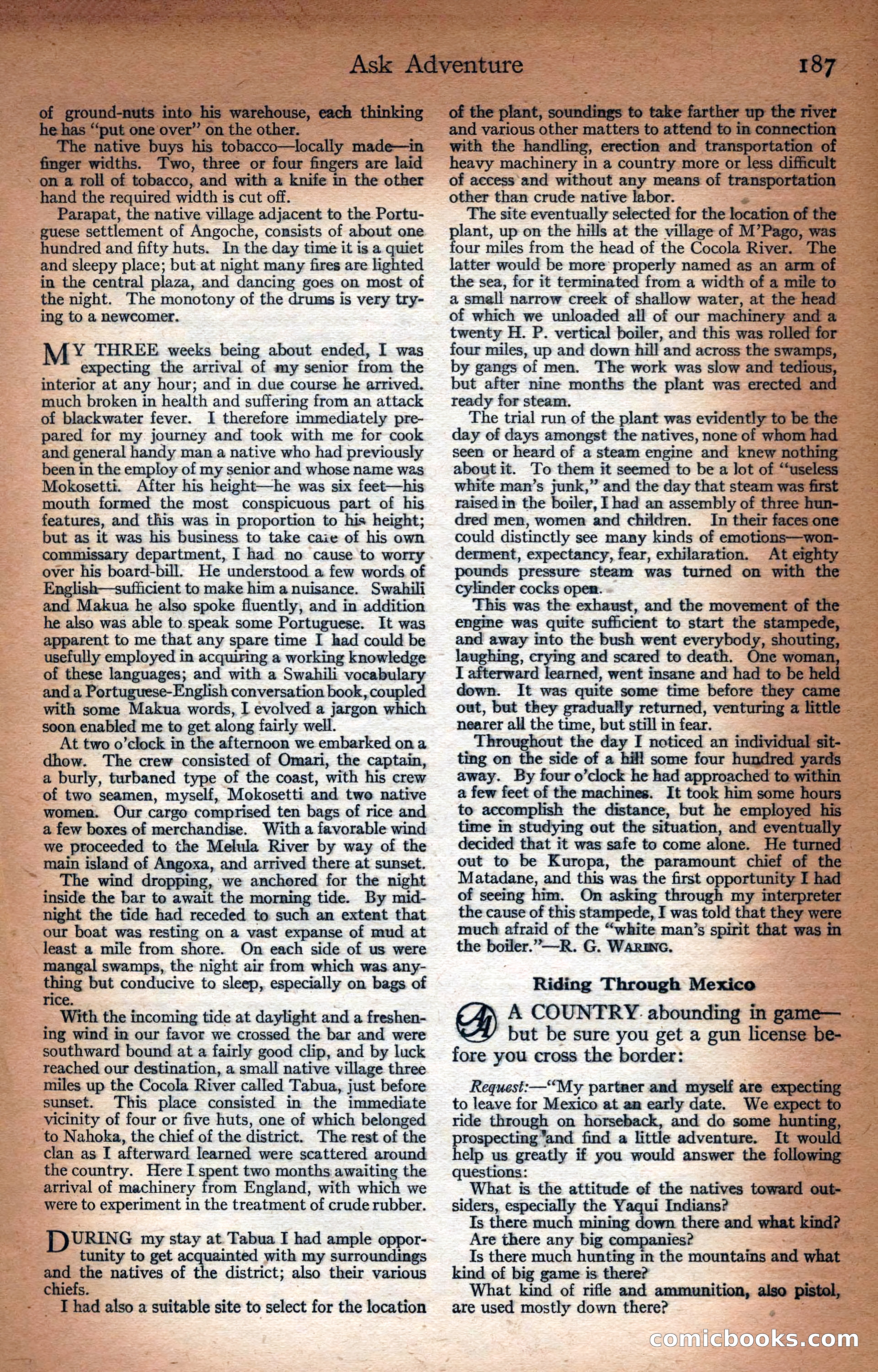
A restored page from Pulp Fiction, 1925. Page through the whole issue in the reader above.
📄 Transcribed text from this page (OCR, searchable)
Machine-transcribed from the original scan — historical spelling and the odd misread are preserved.
Ask Adventure of ground-nuts into his warehouse, each thinking he has “put one over” on the other. The native buys his tobacco—locally made—in finger widths. Two, three or four fingers are laid on a roll of tobacco, and with a knife in the other hand the required width is cut off. Parapat, the native village adjacent to the Portu- guese settlement of Angoche, consists of about one hundred and fifty huts. In the day time it is a quiet and sleepy place; but at night many fires are lighted in the central plaza, and dancing goes on most of the night. The monotony of the drums is very try- ing to a newcomer. MY THREE weeks being about ended, I was expecting the arrival of my senior from the interior at any hour; and in due course he arrived. much broken in health and suffering from an attack of blackwater fever. I therefore immediately pre- pared for my journey and took with me for cook and general handy man a native who had previously been in the employ of my senior and whose name was Mokosetti. After his height—he was six feet—his mouth formed the most conspicuous part of his features, and this was in proportion to his height; but as it was his business to take caie of his own commissary department, I had no cause to worry over his board-bill. He understood a few words of English—sufficient to make him a nuisance. Swahili and Makua he also spoke fluently, and in addition he also was able to speak some Portuguese. It was apparent to me that any spare time I had could be usefully employed in acquiring a working knowledge of these languages; and with a Swahili vocabulary and a Portuguese-English conversation book, coupled with some Makua words, I evolved a jargon which soon enabled me to get along fairly well. At two o’clock in the afternoon we embarked ona dhow. The crew consisted of Omari, the captain, a burly, turbaned type of the coast, with his crew of two seamen, myself, Mokosetti and two native women. Our cargo comprised ten bags of rice and a few boxes of merchandise. With a favorable wind we proceeded to the Melula River by way of the main island of Angoxa, and arrived there at sunset. e wind dropping, we anchored for the night inside the bar to await the morning tide. By mid- night the tide had receded to such an extent that our boat was resting on a vast expanse of mud at least a mile from shore. On each side of us were mangal swamps, the night air from which was any- thing but conducive to sleep, especially on bags of rice. With. the incoming tide at daylight and a freshen- ing wind in our favor we crossed the bar and were southward bound at a fairly good clip, and by luck reached our destination, a small native village three miles up the Cocola River called Tabua, just before sunset. This place consisted in the immediate vicinity of four or five huts, one of which belonged to Nahoka, the chief of the district. The rest of the clan as I afterward learned were scattered around the country. Here I spent two months awaiting the atrival of machinery from England, with which we were to experiment in the treatment of crude rubber. URING my stay at Tabua I had ample oppor- tunity to get acquainted with my surroundings a natives of the district; also their various chiefs. - Thad also a suitable site to select for the location 187 of the plant, ene to take farther up the river and various other matters to attend to in connection with the handling, erection and transportation of heavy machinery in a country more or less difficult of access and without any means of transportation other than crude native labor. The site eventually selected for the location of the plant, up on the hills at the village of M’Pago, was four miles from the head of the Cocnil River. The latter would be more properly named as an arm of the sea, for it terminated from a width of a mile to a smell narrow creek of shallow water, at the head of which we unloaded all of our machinery and a twenty H. P. vertical boiler, and this was rolled for four miles, up and down hill and across the swamps, by gangs of men. The work was slow and tedious, but after nine months the plant was erected and ready for steam. The trial run of the plant was evidently to be the day of days amongst the natives, none of whom had seen or heard of a steam engine and knew nothing about it. To them it seemed to be a lot of “useless white man’s junk,” and the day that steam was first raised in the boiler, I had an assembly of three hun- dred men, women and children. In their faces one could distinctly see many kinds of emotions—won- derment, expectancy, fear, exhilaration. At eighty pounds pressure steam was turned on with the cylinder cocks open. This was the exhaust, and the movement of the engine was quite sufficient to start the stampede, and away into the bush went everybody, shouting, laughing, crying and scared to death. One w I afterward learned, went insane and had to be held down. It was quite some time before they came out, but they gradually returned, venturing a little - nearer all the time, but still in fear. Throughout the day I noticed an individual sit- ting on the side of a hill some four hundred yards away. By four o’clock he had approached to within a few feet of the machines. It took him some hours to accomplish the distance, but he employed his time in studying out the situation, and eventually decided that it was safe to come alone. He turned out to be Kuropa, the paramount chief of the Matadane, and this was the first opportunity I had of seeing him. On asking through my interpreter the cause of this stampede, I was told that they were much afraid of the “white man’s spirit that was m the boiler.” —R. G. Warunc. Riding Through Mexico A COUNTRY. abounding in game— . but be sure you get a gun license be- fore you cross the border: Request: —“My partmer and myself are expecting to leave for Mexico at am early date. We expect to ride through on horseback, and do some hunting, prospecting “and find a little adventure. It would help us greatly if you would answer the following questions: What is the attitude ef the natives toward out- siders, especially the Yaqui Indians? Is there much mining down there and what kind? Are there any big companies? Is there much hunting in the mountains and what kind of big game is there? What kind of rifle and ammunition, also pistol, are used mostly down there? com mooks.com (@)