
Pulp Fiction, 1913 · page 102 of 192
Ainslee's Magazine, February 1913 — page 102: what you’re looking at
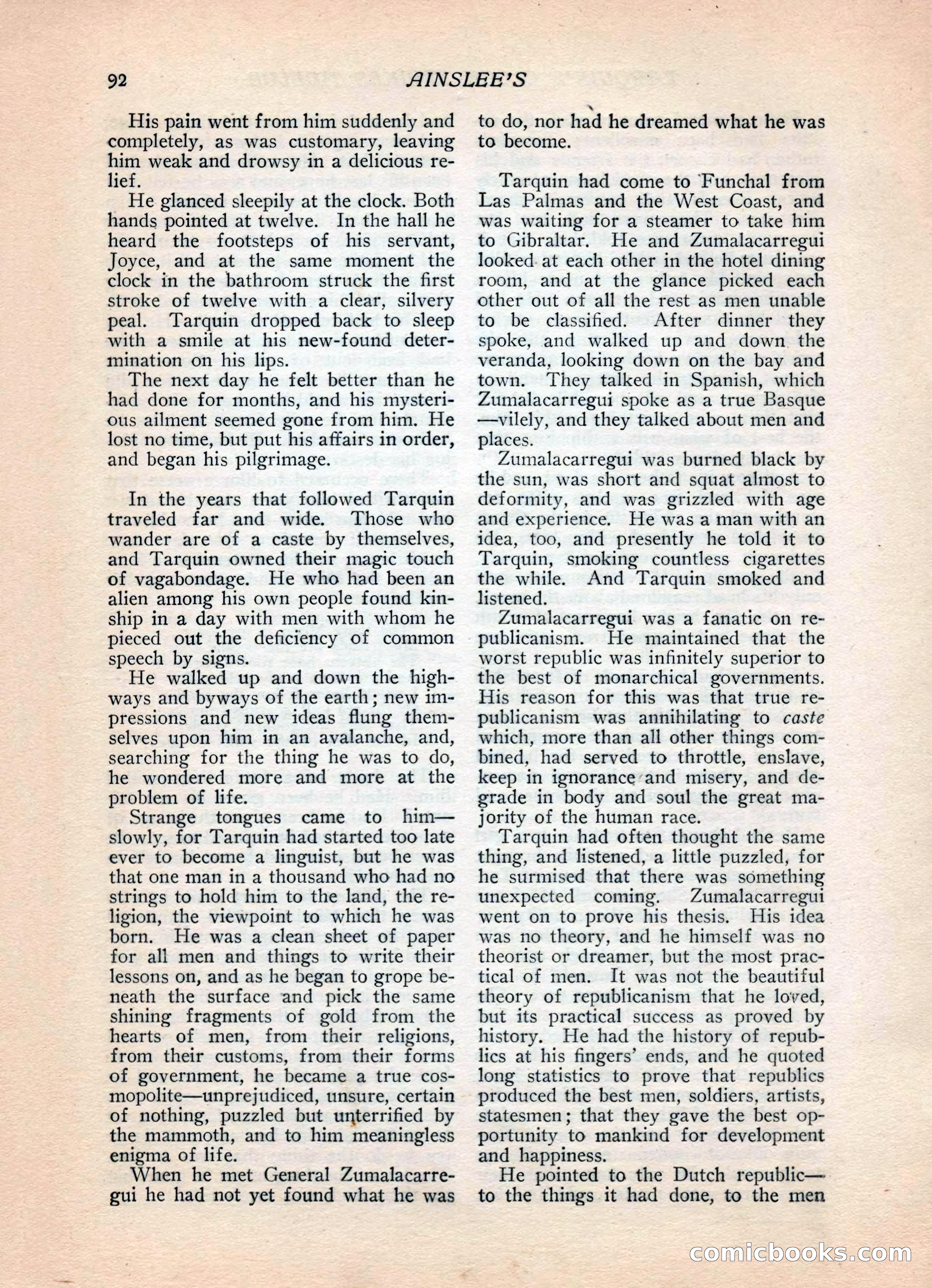
A restored page from Pulp Fiction, 1913. Page through the whole issue in the reader above.
📄 Transcribed text from this page (OCR, searchable)
Machine-transcribed from the original scan — historical spelling and the odd misread are preserved.
92 His pain went from him suddenly and completely, as was customary, leaving 04 weak and drowsy in a delicious re- ief, He glanced sleepily at the clock. Both hands pointed at twelve. In the hall he heard the footsteps of his servant, Joyce, and at the same moment the clock in the bathroom struck the first stroke of twelve with a clear, silvery peal. Tarquin dropped back to sleep with a smile at his new-found deter- mination on his lips. The next day he felt better than he had done for months, and his mysteri- ous ailment seemed gone from him. He lost no time, but put his affairs in order, and began his pilgrimage. In the years that followed Tarquin traveled far and wide. Those who wander are of a caste by themselves, and Tarquin owned their magic touch of vagabondage. He who had been an alien among his own people found kin- ship in a day with men with whom he pieced out the deficiency of common speech by signs. He walked up and down the high- ways and byways of the earth; new im- pressions and new ideas flung them- selves upon him in an avalanche, and, searching for the thing he was to do, he wondered more and more at the problem of life. Strange tongues came to him— slowly, for Tarquin had started too late ever to become a linguist, but he was that one man in a thousand who had no strings to hold him to the land, the re- ligion, the viewpoint to which he was born. He was a clean sheet of paper for all men and things to write their lessons on, and as he began to grope be- neath the surface and pick the same shining fragments of gold from the hearts of men, from their religions, from their customs, from their forms of government, he became a true cos- mopolite—unprejudiced, unsure, certain of nothing, puzzled but unterrified by the mammoth, and to him meaningless enigma of life. When he met General Zumalacarre- gui he had not yet found what he was AINSLEE’S to do, nor had he dreamed what he was to become. Tarquin had come to Funchal from Las Palmas and the West Coast, and was waiting for a steamer to take him to Gibraltar. He and Zumalacarregui looked. at each other in the hotel dining room, and at the glance picked each other out of all the rest as men unable to be classified. After dinner they spoke, and walked up and down the veranda, looking down on the bay and town. They talked in Spanish, which Zumalacarregui spoke as a true Basque —vilely, and they talked about men and places. Zumalacarregui was burned black by the sun, was short and squat almost to deformity, and was grizzled with age and experience. He was a man with an idea, too, and presently he told it to Tarquin, smoking countless cigarettes the while. And Tarquin smoked and listened. Zumalacarregui was a fanatic on re- publicanism. He maintained that the worst republic was infinitely superior to the best of monarchical governments. His reason for this was that true re- publicanism was annihilating to caste which, more than all other things com- bined, had served to throttle, enslave, keep in ignorance’and misery, and de- grade in body and soul the great ma- jority of the human race. Tarquin had often thought the same thing, and listened, a little puzzled, for he surmised that there was something unexpected coming. Zumalacarregut went on to prove his thesis. His idea was no theory, and he himself was no theorist or dreamer, but the most prac- tical of men. It was not the beautiful theory of republicanism that he loved, but its practical success as proved by history. He had the history of repub- lics at his fingers’ ends, and he quoted long statistics to prove that republics produced the best men, soldiers, artists, statesmen; that they gave the best op- portunity to mankind for development and happiness. He pointed to the Dutch republic— to the things it had done, to the men (C@) AMUC vOOK (E@)