
Pulp Fiction, 1913 · page 103 of 192
Ainslee's Magazine, February 1913 — page 103: what you’re looking at
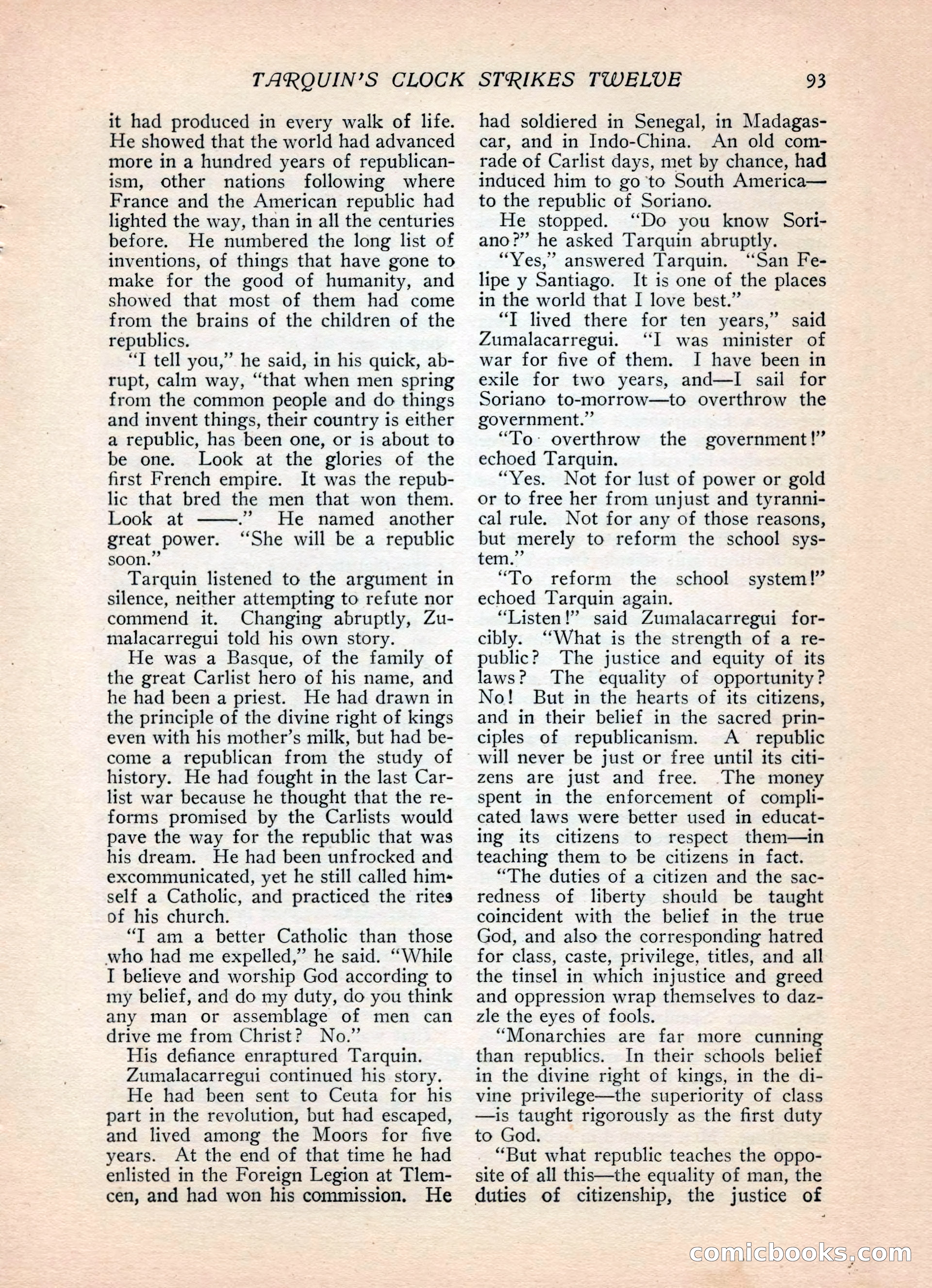
A restored page from Pulp Fiction, 1913. Page through the whole issue in the reader above.
📄 Transcribed text from this page (OCR, searchable)
Machine-transcribed from the original scan — historical spelling and the odd misread are preserved.
TARQUIN’S CLOCK it had produced in every walk of life. He showed that the world had advanced more in a hundred years of republican- ism, Other nations following where France and the American republic had lighted the way, than in all the centuries before. He numbered the long list of inventions, of things that have gone to make for the good of humanity, and showed that most of them had come from the brains of the children of the republics. “T tell you,” he said, in his quick, ab- rupt, calm way, “that when men spring from the common people and do things and invent things, their country is either a republic, has been one, or is about to be one. Look at the glories of the first French empire. It was the repub- lic that bred the men that won them. Look at .’ He named another great power. “She will be a republic soon.” Tarquin listened to the argument in silence, neither attempting to refute nor commend it. Changing abruptly, Zu- malacarregui told his own story. He was a Basque, of the family of the great Carlist hero of his name, and he had been a priest. He had drawn in the principle of the divine right of kings even with his mother’s milk, but had be- come a republican from the study of history. He had fought in the last Car- list war because he thought that the re- forms promised by the Carlists would pave the way for the republic that was his dream. He had been unfrocked and excommunicated, yet he still called him- self a Catholic, and practiced the rites of his church. “T am a better Catholic than those who had me expelled,” he said. “While I believe and worship God according to my belief, and do my duty, do you think any man or assemblage of men can drive me from Christ? No.” His defiance enraptured Tarquin. Zumalacarregui continued his story. He had been sent to Ceuta for his part in the revolution, but had escaped, and lived among the Moors for five years. At the end of that time he had enlisted in the Foreign Legion at Tlem- cen, and had won his commission. He STRIKES TWELVE 93 had soldiered in Senegal, in Madagas- car, and in Indo-China. An old com- rade of Carlist days, met by chance, had induced him to go ‘to South America— to the republic of Soriano. He stopped. “Do you know Sori- ano?” he asked Tarquin abruptly. “Yes,” answered Tarquin. ‘San Fe- lipe y Santiago. It is one of the places in the world that I love best.” “TI lived there for ten years,” said Zumalacarregui. “I was minister of war for five of them. I have been in exile for two years, and—lI sail for Soriano to-morrow—to overthrow the government.” “To: overthrow echoed Tarquin. “Yes. Not for lust of power or gold or to free her from unjust and tyranni- cal rule. Not for any of those reasons, but merely to reform the school sys- tem.” “To reform the echoed Tarquin again. “Listen!” said Zumalacarregui for- cibly. ‘What is the strength of a re- public? The justice and equity of its laws? The equality of opportunity? No! But in the hearts of its citizens, and in their belief in the sacred prin- ciples of republicanism. A republic will never be just or free until its citi- zens are just and free. ‘The money spent in the enforcement of compli- cated laws were better used in educat- ing its citizens to respect them—in teaching them to be citizens in fact. “The duties of a citizen and the sac- redness of liberty should be taught coincident with the belief in the true God, and also the corresponding hatred for class, caste, privilege, titles, and all the tinsel in which injustice and greed and oppression wrap themselves to daz- zle the eyes of fools. “Monarchies are far more cunning than republics. In their schools belief in the divine right of kings, in the di- vine privilege—the superiority of class —is taught rigorously as the first duty to God. “But what republic teaches the oppo- site of all this—the equality of man, the duties of citizenship, the justice of the government!” school system!” EORNICLOO© (@