
Pulp Fiction, 1913 · page 168 of 192
Ainslee's Magazine, February 1913 — page 168: what you’re looking at
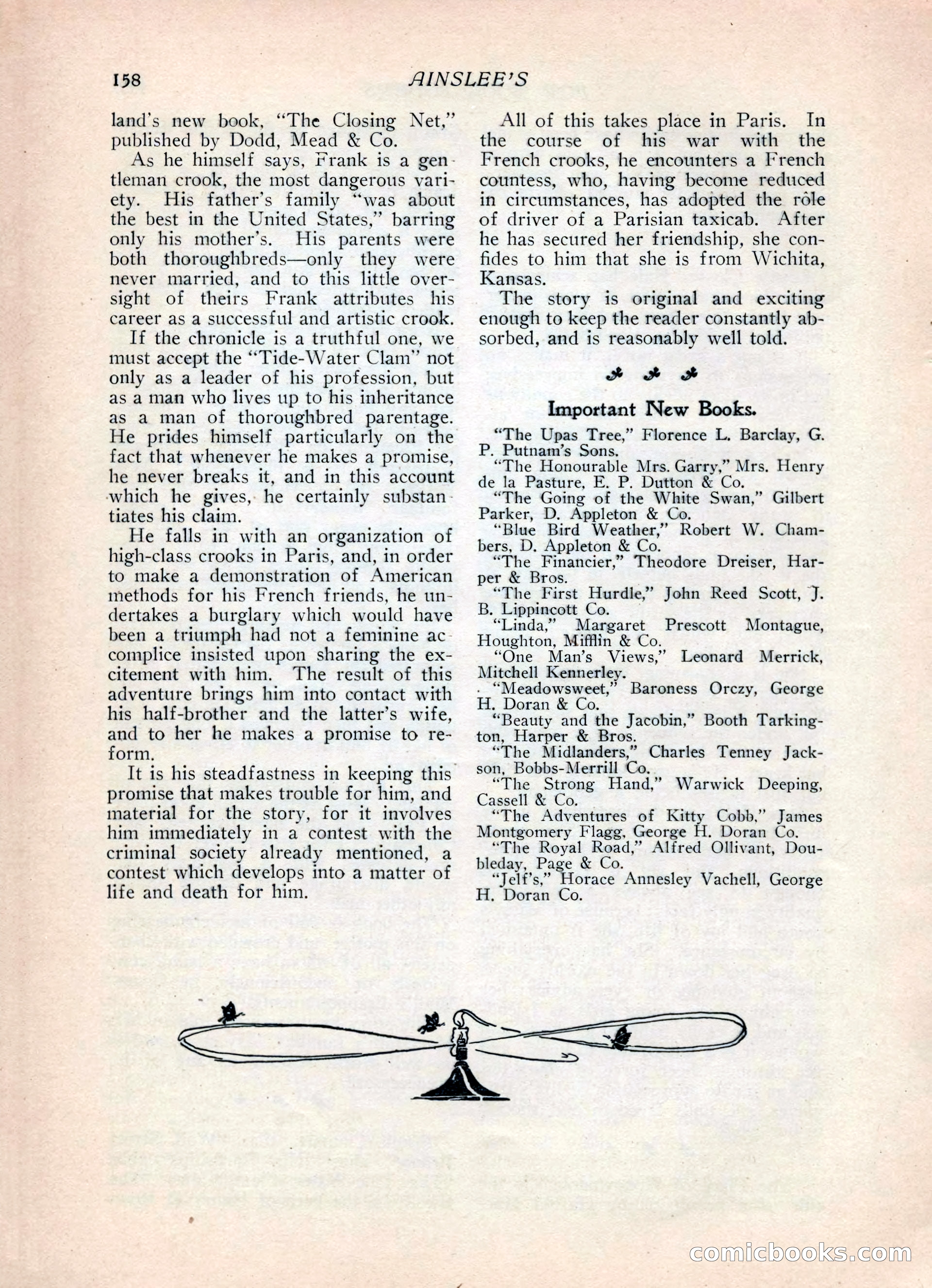
A restored page from Pulp Fiction, 1913. Page through the whole issue in the reader above.
📄 Transcribed text from this page (OCR, searchable)
Machine-transcribed from the original scan — historical spelling and the odd misread are preserved.
158 land’s new book, “The Closing Net,” published by Dodd, Mead & Co. As he himself says, frank is a gen- tleman crook, the most dangerous vari- ety. His father’s family “was about the best in the United States,” barring only his mother’s. His parents were both thoroughbreds—only they were never married, and to this little over- sight of theirs Frank attributes his career as a successful and artistic crook. If the chronicle is a truthful one, we must accept the “Tide-Water Clam” not only as a leader of his profession, but as a man who lives up to his inheritance as a man of thoroughbred parentage. He prides himself particularly on the fact that whenever he makes a promise, he never breaks it, and in this account which he gives, he certainly substan: tiates his claim. He falls in with an organization of high-class crooks in Paris, and, in order to make a demonstration of American methods for his French friends, he un- dertakes a burglary which would have been a triumph had not a feminine ac- complice insisted upon sharing the ex- citement with him. The result of this adventure brings him into contact with his half-brother and the latter’s wife, and to her he makes a promise to re- form, It is his steadfastness in keeping this promise that makes trouble for him, and material for the story, for it involves him immediately in a contest with the criminal society already mentioned, a contest which develops into a matter of life and death for him. AINSLEE’S All of this takes place in Paris. In the course of his war with the French crooks, he encounters a French countess, who, having become reduced in circumstances, has adopted the role of driver of a Parisian taxicab. After he has secured her friendship, she con- fides to him that she is from Wichita, Kansas. The story is original and exciting enough to keep the reader constantly ab- sorbed, and is reasonably well told. es * & Important New Books. “The Upas Tree,” Florence L. Barclay, G. P. Putnam’s Sons. “The Honourable Mrs. Garry,” Mrs. Henry de la Pasture, E. P. Dutton & Co. “The Going of the White Swan,” Gilbert Parker, D. Appleton & Co. “Blue Bird Weather,’ Robert W. Cham- bers, D. Appleton & Co. “The Financier,” Theodore Dreiser, Har- per & Bros. “The First Hurdle,’ John Reed Scott, J. B. Lippincott Co. “Linda,” Margaret Prescott Montague, Houghton, Mifflin & Co. “One Man’s Views,” Leonard Merrick, Mitchell Kennerley. . “Meadowsweet,” Baroness Orczy, George H. Doran & Co. “Beauty and the Jacobin,” Booth Tarking- ton, Harper & Bros. “The Midlanders,” Charles Tenney Jack- son, Bobbs-Merrill Co. “The Strong Hand,’ Warwick Deeping, Cassell & Co. “The Adventures of Kitty Cobb,” James Montgomery Flagg, George H. Doran Co. “The Royal Road,’ Alfred Ollivant, Dou- bleday, Page & Co. “Jelf’s,’” Horace Annesley Vachell, George H, Doran Co. NOOK