
Pulp Fiction, 1913 · page 169 of 192
Ainslee's Magazine, February 1913 — page 169: what you’re looking at
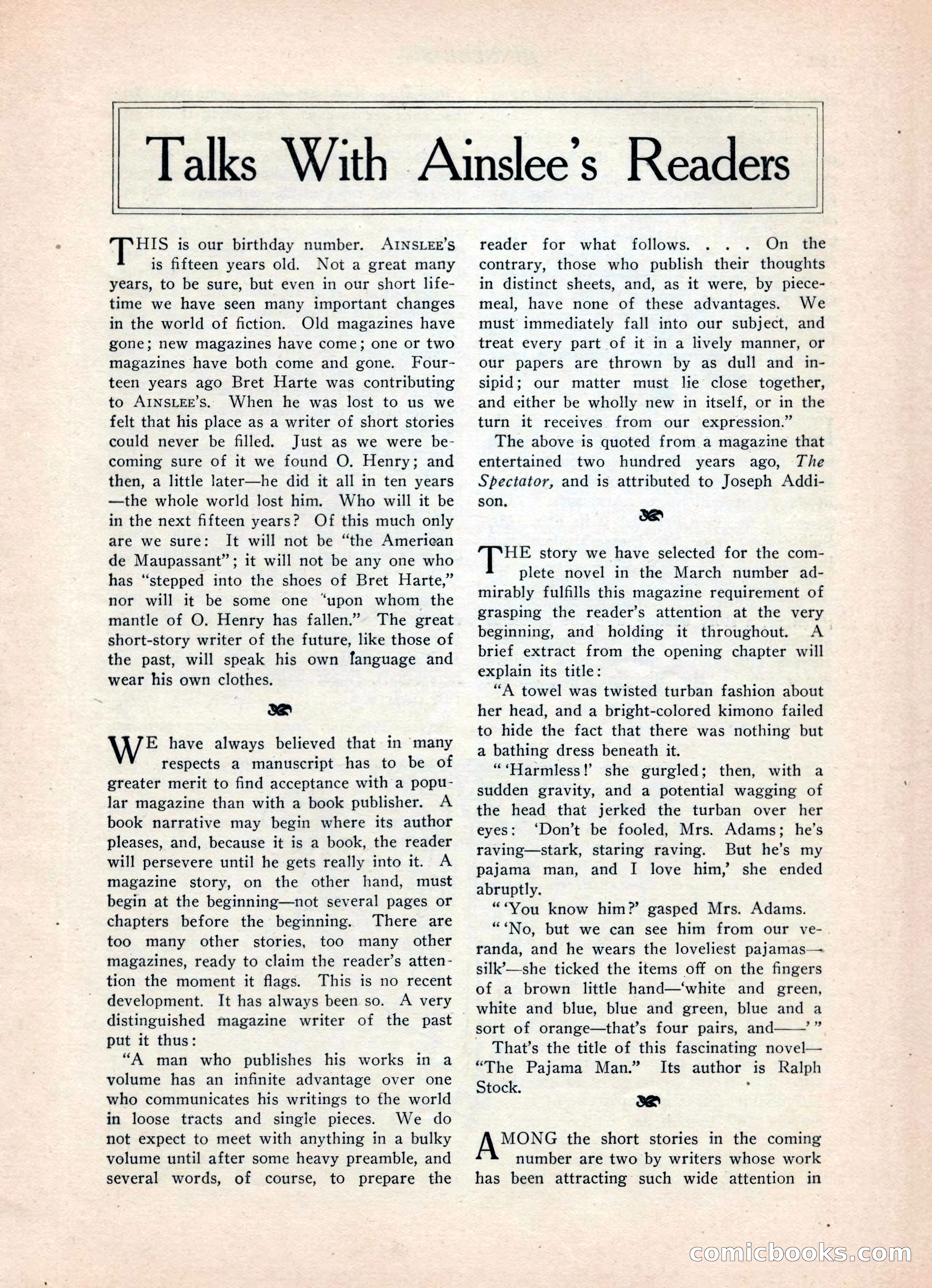
A restored page from Pulp Fiction, 1913. Page through the whole issue in the reader above.
📄 Transcribed text from this page (OCR, searchable)
Machine-transcribed from the original scan — historical spelling and the odd misread are preserved.
Talks With Ainslee’s Readers HIS is our birthday number. AINSLEE’S is fifteen years old. Not a great many years, to be sure, but even in our short life- time we have seen many important changes in the world of fiction. Old magazines have gone; new magazines have come; one or two magazines have both come and gone. Four- teen years ago Bret Harte was contributing to AINSLEE’s. When he was lost to us we felt that his place as a writer of short stories could never be filled. Just as we were be- coming sure of it we found O. Henry; and then, a little }ater—he did it all in ten years —the whole world lost him. Who will it be in the next fifteen years? Of this much only are we sure: It will not be “the American de Maupassant”; it will not be any one who has “stepped into the shoes of Bret Harte,” nor will it be some one “upon whom the mantle of O. Henry has fallen.” The great short-story writer of the future, like those of the past, will speak his own fanguage and wear his own clothes. Wé. have always believed that in many respects a manuscript has to be of greater merit to find acceptance with a popu- lar magazine than with a book publisher. A book narrative may begin where its author pleases, and, because it is a book, the reader will persevere until he gets really into it. A magazine story, on the other hand, must begin at the beginning—not several pages or chapters before the beginning. There are too many other stories, too many other magazines, ready to claim the reader’s atten- tion the moment it flags. This is no recent development. It has always been so. A very distinguished magazine writer of the past put it thus: “A man who publishes his works in a volume has an infinite advantage over one who communicates his writings to the world in loose tracts and single pieces. We do not expect to meet with anything in a bulky volume until after some heavy preamble, and several words, of course, to prepare the reader for what follows. On the contrary, those who publish their thoughts in distinct sheets, and, as it were, by piece- meal, have none of these advantages. We must immediately fall into our subject, and treat every part of it in a lively manner, or our papers are thrown by as dull and in- sipid; our matter must lie close together, and either be wholly new in itself, or in the turn it receives from our expression.” The above is quoted from a magazine that entertained two hundred years ago, The Spectator, and is attributed to Joseph Addi- son, oe HE story we have selected for the com- plete novel in the March number ad- mirably fulfills this magazine requirement of grasping the reader’s attention at the very beginning, and holding it throughout. A brief extract from the opening chapter will explain its title: “A towel was twisted turban fashion about her head, and a bright-colored kimono failed to hide the fact that there was nothing but a bathing dress beneath it. ““Harmless!’ she gurgled; then, with a sudden gravity, and a potential wagging of the head that jerked the turban over her eyes: ‘Don’t be fooled, Mrs. Adams; he’s raving—stark, staring raving. But he’s my pajama man, and I love him,’ she ended abruptly. “*You know him?’ gasped Mrs. Adams. ““No, but we can see him from our ve- randa, and he wears the loveliest pajamas— silk’—she ticked the items off on the fingers of a brown little hand—‘white and green, _ white and blue, blue and green, blue and a > 9 sort of orange—that’s four pairs, and—— That’s the title of this fascinating novel— “The Pajama Man.” Its author is Ralph Stock. ; om MONG the short stories in the coming number are two by writers whose work has been attracting such wide attention in (C@ NOOLK (C@