
Pulp Fiction, 1913 · page 84 of 192
Ainslee's Magazine, February 1913 — page 84: what you’re looking at
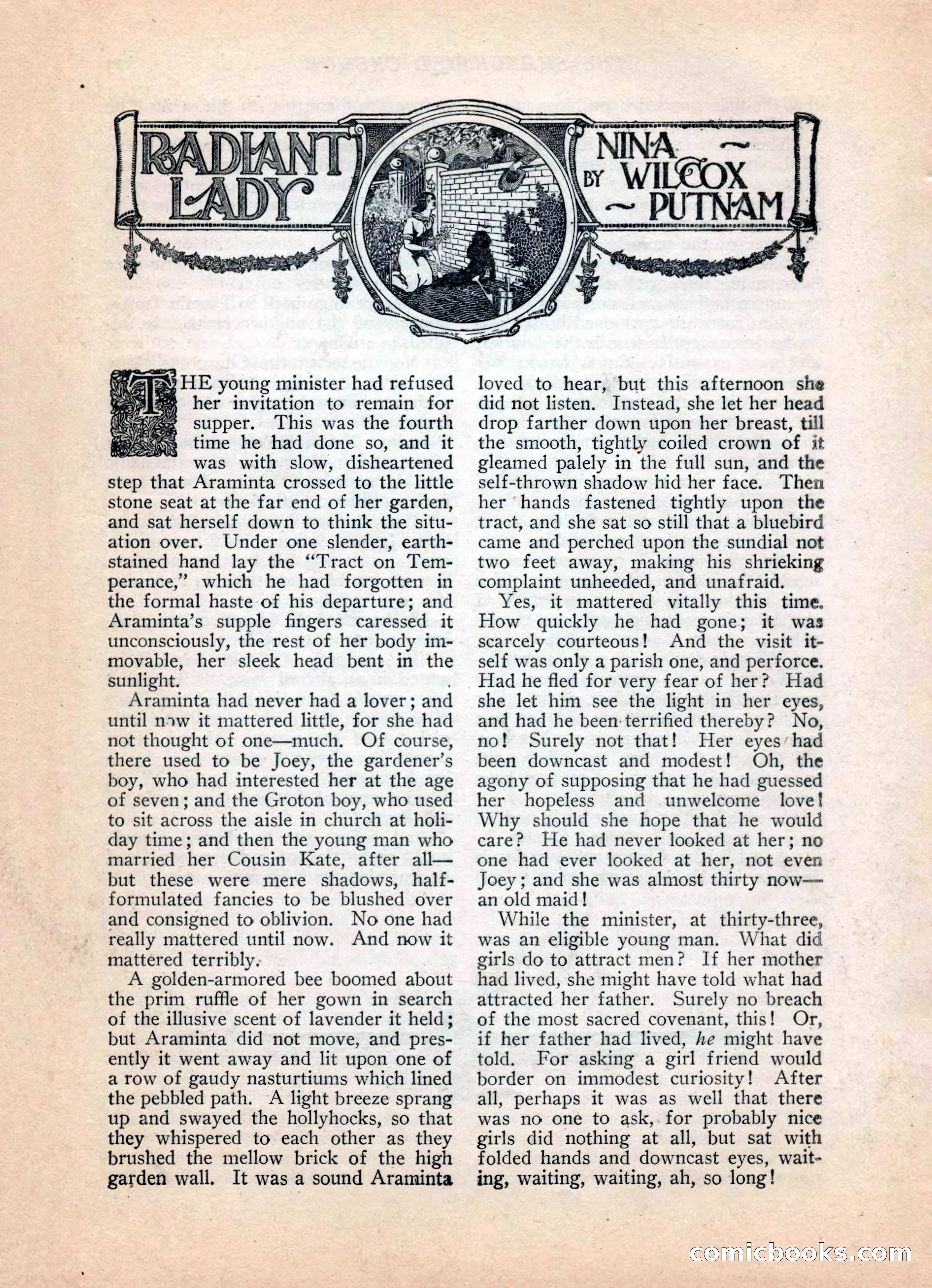
A restored page from Pulp Fiction, 1913. Page through the whole issue in the reader above.
📄 Transcribed text from this page (OCR, searchable)
Machine-transcribed from the original scan — historical spelling and the odd misread are preserved.
(Ztay HE young minister had refused aia her invitation to remain for supper. This was the fourth time he had done so, and it was with slow, disheartened step that Araminta crossed to the little stone seat at the far end of her garden, and sat herself down to think the situ- ation over. Under one slender, earth- stained hand lay the “Tract on Tem- perance,’ which he had forgotten in the formal haste of his departure; and Araminta’s supple fingers caressed it unconsciously, the rest of her body im- movable, her sleek head bent in the sunlight. Araminta had never had a lover; and until now it mattered little, for she had not thought of one—much. Of course, there used to be Joey, the gardener’s boy, who had interested her at the age of seven; and the Groton boy, who used to sit across the aisle in church at holi- day time; and then the young man who married her Cousin Kate, after all— but these were mere shadows, half- formulated fancies to be blushed over and consigned to oblivion. No one had really mattered until now. And now it mattered terribly. A golden-armored bee boomed about the prim ruffle of her gown in search of the illusive scent of lavender it held; but Araminta did not move, and pres- ently it went away and lit upon one of a row of gaudy nasturtiums which lined the pebbled path. A light breeze sprang up and swayed the hollyhocks, so that they whispered to each other as they brushed the mellow brick of the high garden wall. It was a sound Araminta loved to hear, but this afternoon she did not listen. Instead, she let her head drop farther down upon her breast, till the smooth, tightly coiled crown of it gleamed palely in the full sun, and the self-thrown shadow hid her face. Then her hands fastened tightly upon the tract, and she sat so still that a bluebird came and perched upon the sundial not two feet away, making his shrieking complaint unheeded, and unafraid. Yes, it mattered vitally this time. How quickly he had gone; it was scarcely courteous! And the visit it- self was only a parish one, and perforce. Had he fled for very fear of her? Had she let him see the light in her eyes, and had he been-terrified thereby? No, no! Surely not that! Her eyes’had been downcast and modest! Oh, the agony of supposing that he had guessed her hopeless and unwelcome love! Why should she hope that he would care? He had never looked at her; no one had ever looked at her, not even Joey ; and she was almost thirty now— an old maid! While the minister, at thirty-three, was an eligible young man. What did girls do to attract men? If her mother had lived, she might have told what had attracted her father. Surely no breach of the most sacred covenant, this! Or, if her father had lived, he might have told. For asking a girl friend would border on immodest curiosity! After all, perhaps it was as well that there was no one to ask,. for probably nice girls did nothing at all, but sat with folded hands and downcast eyes, wait- ing, waiting, waiting, ah, so long! EOPNICLOOOL< (E@)