
Pulp Fiction, 1913 · page 85 of 192
Ainslee's Magazine, February 1913 — page 85: what you’re looking at
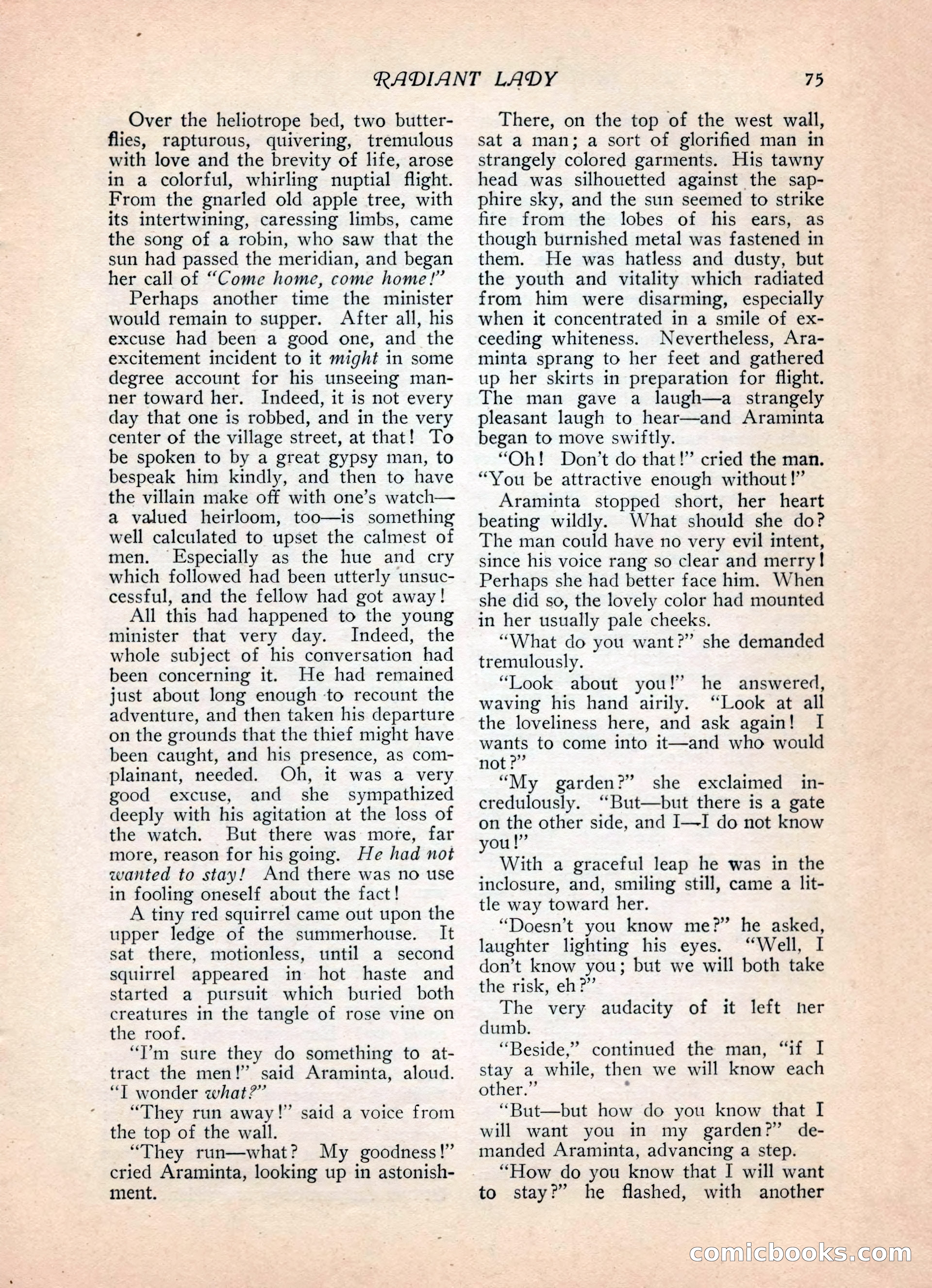
A restored page from Pulp Fiction, 1913. Page through the whole issue in the reader above.
📄 Transcribed text from this page (OCR, searchable)
Machine-transcribed from the original scan — historical spelling and the odd misread are preserved.
RADIANT LADY Over the heliotrope bed, two butter- flies, rapturous, quivering, tremulous with love and the brevity of life, arose in a colorful, whirling nuptial flight. From the gnarled old apple tree, with its intertwining, caressing limbs, came the song of a robin, who saw that the sun had passed the meridian, and began her call of “Come home, come home!” Perhaps another time the minister would remain to supper. After all, his excuse had been a good one, and the excitement incident to it might in some degree account for his unseeing man- ner toward her. Indeed, it is not every day that one is robbed, and in the very center of the village street, at that! To be spoken to by a great gypsy man, to bespeak him kindly, and then to have the villain make off with one’s watch— a valued heirloom, too—is something well calculated to upset the calmest of men. Especially as the hue and cry which followed had been utterly unsuc- cessful, and the fellow had got away! All this had happened to the young minister that very day. Indeed, the whole subject of his conversation had been concerning it. He had remained just about long enough to recount the adventure, and then taken his departure on the grounds that the thief might have been caught, and his presence, as com- plainant, needed. Oh, it was a very good excuse, and she sympathized deeply with his agitation at the loss of the watch. But there was more, far more, reason for his going. He had not wanted to stay! And there was no use in fooling oneself about the fact! A tiny red squirrel came out upon the upper ledge of the summerhouse. It sat there, motionless, until a second squirrel appeared in hot haste and started a pursuit which buried both creatures in the tangle of rose vine on the roof. “I’m sure they do something to at- tract the men!” said Araminta, aloud. “Tl wonder what?” “They run away!” said a voice from the top of the wall. “They run—what? My goodness!’ cried Araminta, looking up in astonish- ment. 75 There, on the top of the west wall, sat a man; a sort of glorified man in strangely colored garments. His tawny head was silhouetted against the sap- phire sky, and the sun seemed to strike fire from the lobes of his ears, as though burnished metal was fastened in them. He was hatless and dusty, but the youth and vitality which radiated from him were disarming, especially when it concentrated in a smile of ex- ceeding whiteness. Nevertheless, Ara- minta sprang to her feet and gathered up her skirts in preparation for flight. The man gave a laugh—a strangely pleasant laugh to hear—and Araminta began to move swiftly. “Oh! Don’t do that!” cried the man. “You be attractive enough without!” Araminta stopped short, her heart beating wildly. What should she do? The man could have no very evil intent, since his voice rang so clear and merry! Perhaps she had better face him. When she did so, the lovely color had mounted in her usually pale cheeks. “What do you want?” she demanded tremulously. “Look about you!’ he answered, waving his hand airily. “Look at all the loveliness here, and ask again! I wants to come into it—and who would not ?” “My garden?” she exclaimed in- credulously. ‘‘But—but there is a gate on the other side, and I—I do not know you!” With a graceful leap he was in the inclosure, and, smiling still, came a lit- tle way toward her. “Doesn’t you know me?” he asked, laughter lighting his eyes. “Well, I don’t know you; but we will both take the risk, eh?” The very audacity of it left her dumb. “Beside,” continued the man, “if I stay a while, then we will know each other.” : “But—but how do you know that I will want you in my garden?” de- manded Araminta, advancing a step. “How do you know that I will want to stay?” he flashed, with another (C@) ANU IOOKk (E@)