
Pulp Fiction, 1928 · page 70 of 100
Amazing Stories, Vol. 3, No. 2 — page 70: what you’re looking at
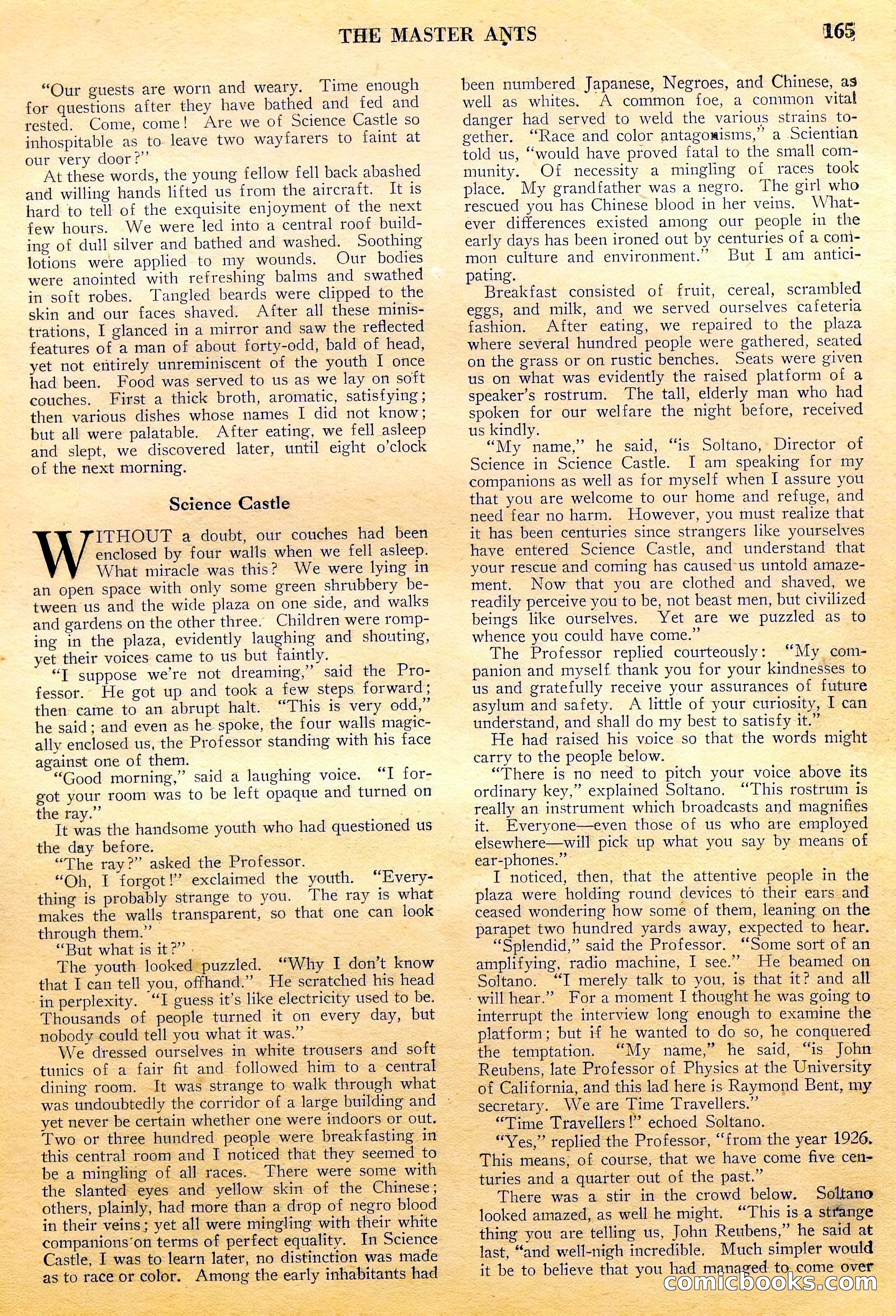
A restored page from Pulp Fiction, 1928. Page through the whole issue in the reader above.
📄 Transcribed text from this page (OCR, searchable)
Machine-transcribed from the original scan — historical spelling and the odd misread are preserved.
THE MASTER ANTS | 165 “Our guests are worn and weary. Time enough for questions after they have bathed and fed and rested, Come, come! Are we of Science Castle so inhospitable as to. leave two wayfarers to faint at our very door?” At these words, the young fellow fell back abashed and willing hands lifted us from the aircraft. It is hard to tell of the exquisite enjoyment of the next few hours. We were led into a central roof build- ing of dull silver and bathed and washed. Soothing lotions were applied to my wounds. Our bodies were anointed with refreshing balms and swathed in soft robes. Tangled beards were clipped to the skin and our faces shaved. After all these minis- trations, I glanced in a mirror and saw the reflected features of a man of about forty-odd, bald of head, yet not entirely unreminiscent of the youth I once had been. Food was served to us as we lay on soft couches. First a thick broth, aromatic, satisfying ; then various dishes whose names I did not know; but all were palatable. After eating, we fell asleep and slept, we discovered later, until eight o'clock of the next morning. Science Castle ITHOUT a doubt, our couches had been enclosed by four walls when we fell asleep. What miracle was this? We were lying in an open space with only some green shrubbery be- tween us and the wide plaza on one side, and walks and gardens on the other three. Children were romp- ing in the plaza, evidently laughing and shouting, yet their voices came to us but faintly. “IT suppose we're not dreaming,” said the Pro- fessor. He got up and took a few steps forward ; then. came to an abrupt halt. “This is very odd,” he said; and even as he spoke, the four walls magic- ally enclosed us, the Professor standing with his face against one of them. “Good morning,” said a laughing voice. “I for- got your room was to be left opaque and turned on the ray.” Se. It was the handsome youth who had questioned us the day before. : “The ray?” asked the Professor. “Oh, I forgot!” exclaimed the youth. “Every- thing is probably strange to you. The ray is what makes the walls transparent, so that one can look through them.” “But what is it?” The youth looked puzzled. “Why I don’t know that I can tell you, offhand.” He seratched his head -in perplexity. “I guess it’s like electricity used to be. Thousands of people turned it on every day, but nobody could tell you what it was.” We dressed ourselves in white trousers and soft tunics of a fair fit and followed him to a central dining room, It was strange to walk through what was undoubtedly the corridor of a large building and ~— yet never be certain whether one were indoors or out. Two or three hundred people were breakfasting in this central room and I noticed that they seemed to be a mingling of all races. There were some with the slanted eyes and yellow skin of the Chinese; others, plainly, had more than a drop of negro blood in their veins; yet all were mingling with their white companions‘on terms of perfect equality. In Science: Castle, I was to learn later, no distinction was made as to race or color. Among the early inhabitants had — been numbered Japanese, Negroes, and Chinese, as well as whites. A common foe, a common vital danger had served to weld the various strains to- gether. “Race and color antagowisms,” a Scientian told us, “would have proved fatal to the small com- munity. Of necessity a mingling of races took place. My grandfather was a negro. The girl who rescued you has Chinese blood in her veins, What- ever differences existed among our people in the early days has been ironed out by centuries of a comi- mon culture and environment.” But I am antici- pating. Breakfast consisted of fruit, cereal, scrambled eges, and milk, and we served ourselves cafeteria fashion. After eating, we repaired to the plaza where several hundred people were gathered, seated on the grass or on rustic benches. Seats were given us on what was evidently the raised platform of a speaker’s rostrum. The tall, elderly man who had spoken for our welfare the night before, received us kindly. “My name,” he said, “is Soltano, Director of Science in Science Castle. I am speaking for my companions as well as for myself when [ assure you that you are welcome to our home and refuge, and need fear no harm. However, you must realize that it has been centuries since strangers like yourselves have entered Science Castle, and understand that your rescue and coming has caused-us untold amaze- ment. Now that you are clothed and shaved, we readily perceive you to be, not beast men, but civilized beings like ourselves. Yet are we puzzled as to whence you could have come.” The Professor replied courteously: “My com- panion and myself thank you for your kindnesses to us and gratefully receive your assurances of future asylum and safety. A little of your curiosity, I can understand, and shall do my best to satisfy it.” He had raised his voice so that the words might © carry to the people below. “There is no need to pitch your voice above its ordinary key,” explained Soltano, “This rostrum is really an instrument which broadcasts and magnifies it. Everyone—even those of us who are employed elsewhere—will pick up what you say by means of eat-phones.” I noticed, then, that the attentive people in the plaza were holding round devices to their ears and ceased wondering how some of them, leaning on the parapet two hundred yards away, expected to hear. “Splendid,” said the Professor. “Some sort of an amplifying, radio machine, I see.” He beamed on Soltano. “I merely talk to you, is that it? and all -will hear.’ For a moment I thought he was going to interrupt the interview long enough to examine the platform; but if he wanted to do so, he conquered the temptation. “My name,” he said, “is John Reubens, late Professor of Physics at the University of California, and this lad here is Raymond Bent, my — secretary. Weare Time Travellers.” “Time Travellers!” echoed Soltano. “Yes,” replied the Professor, “from the year 1926, This means, of course, that we have come five cen- turies and a quarter out of the past.” There was a stir in the crowd below. Soltano — looked amazed, as well he might. “This is a stfange thing you are telling us, John Reubens,” he said at last, “and well-nigh incredible. Much simpler would it be to believe that you had mangned to. come ovet Comic HOOKS COM pene Rae,