
Pulp Fiction, 1928 · page 71 of 100
Amazing Stories, Vol. 3, No. 2 — page 71: what you’re looking at
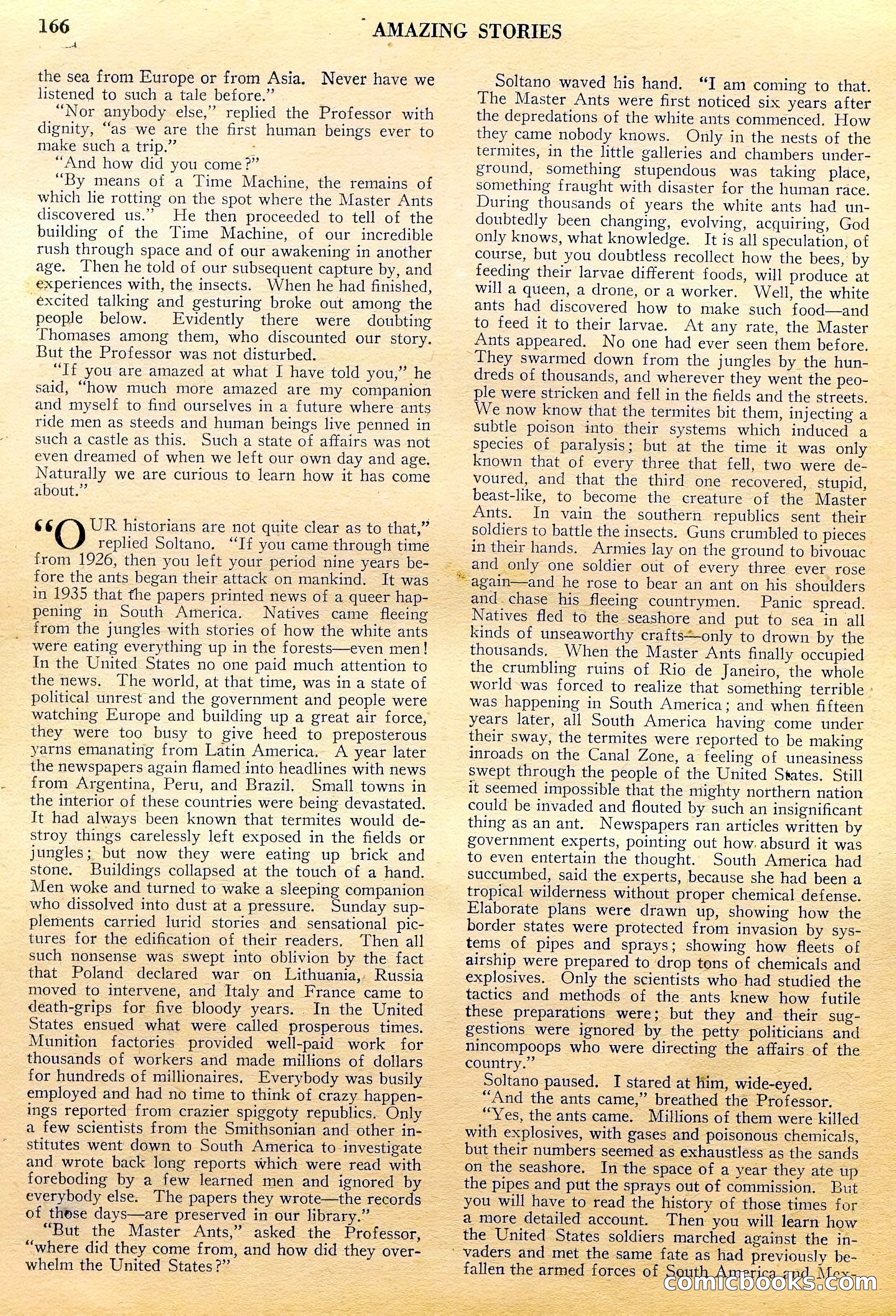
A restored page from Pulp Fiction, 1928. Page through the whole issue in the reader above.
📄 Transcribed text from this page (OCR, searchable)
Machine-transcribed from the original scan — historical spelling and the odd misread are preserved.
166 aA the sea from Europe or from Asia. Never have we listened to such a tale before.” “Nor anybody else,” replied the Professor with dignity, “as we are the first human beings ever to make such a trip.” “And how did you come? “By means of a Time Machine, the remains of which lie rotting on the spot where the Master Ants discovered us.” He then proceeded to tell of the building of the Time Machine, of our incredible tush through space and of our awakening in another age. Then he told of our subsequent capture by, and experiences with, the insects. When he had finished, excited talking and gesturing broke out among the people below. Evidently there were doubting Thomases among them, who discounted our story. But the Professor was not disturbed. “If you are amazed at what I have told you,” he said, “how much more amazed are my companion and myself to find ourselves in a future where ants ride men as steeds and human beings live penned in such a castle as this. Such a state of affairs was not even dreamed of when we left our own day and age. Naturally we are curious to learn how it has come about.” : ” 66 UR historians are not quite clear as to that,” replied Soltano. “If you came through time from 1926, then you left your period nine years be- fore the ants began their attack on mankind. It was - in 1935 that the papers printed news of a queer hap- pening in South America. Natives came fleeing from the jungles with stories of how the white ants were eating everything up in the forests—even men! In the United States no one paid much attention to the news. The world, at that time, was in a state of political unrest and the government and people were watching Europe and building up a great air force, they were too busy to give heed to preposterous yarns emanating from Latin America. A year later the newspapers again flamed into headlines with news from Argentina, Peru, and Brazil, Small towns in the interior of these countries were being devastated. It had always been known that termites would de- stroy things carelessly left exposed in the fields or jungles; but now they were eating up brick and stone. Buildings collapsed at the touch of a hand. Men woke and turned to wake a sleeping companion who dissolved into dust at a pressure. Sunday sup- plements carried lurid stories and sensational pic- tures for the edification of their readers. Then all such nonsense was swept into oblivion by the fact that Poland declared war on Lithuania, Russia moved to intervene, and Italy and France came to death-grips for five bloody years. In the United States ensued what were called prosperous times. Munition factories provided well-paid work for thousands of workers and made millions of dollars for hundreds of millionaires. Everybody was busily employed and had no time to think of crazy happen- ings reported from crazier spiggoty republics. Only a few scientists from the Smithsonian and other in- stitutes went down to South America to investigate and wrote back long reports which were read with foreboding by a few learned men and ignored by everybody else. The papers they wrote—the records — of these days—are preserved in our library.” “But the Master Ants,” asked the Professor, “where did they come from, and how did they over- whelm the United States?” : ; AMAZING STORIES Soltano waved his hand. “I am coming to that. The Master Ants were first noticed six years after the depredations of the white ants commenced, How they came nobody knows. Only in the nests of the termites, in the little galleries and chambers under- ground, something stupendous was taking place, something fraught with disaster for the human race. During thousands of years the white ants had un- doubtedly been changing, evolving, acquiring, God only knows, what knowledge. It is all speculation, of course, but you doubtless recollect how the bees, by feeding their larvae different foods, will produce at will a queen, a drone, or a worker, Well, the white ants had discovered how to make such food—and to feed it to their larvae. At any rate, the Master Ants appeared. No one had ever seen them before. They swarmed down from the jungles by the hun- dreds of thousands, and wherever they went the peo- ple were stricken and fell in the fields and the streets. We now know that the termites bit them, injecting a subtle poison into their systems which induced a species of paralysis; but at the time it was only known that of every three that fell, two were de- voured, and that the third one recovered, stupid, beast-like, to become the creature of the Master Ants. In vain the southern republics sent their soldiers to battle the insects. Guns crumbled to pieces in their hands. Armies lay on the ground to bivouac ~ and only one soldier out of every three ever rose “again—and he rose to bear an ant on his shoulders and. chase his fleeing countrymen. Panic spread. Natives fled to the seashore and put to sea in all kinds of unseaworthy crafts+only to drown by the thousands. When the Master Ants finally occupied the crumbling ruins of Rio de Janeiro, the whole world was forced to realize that something terrible » was happening in South America; and when fifteen years later, all South America having come under their sway, the termites were reported to be making inroads on the Canal Zone, a feeling of uneasiness swept through the people of the United States, Still it seemed impossible that the mighty northern nation could be invaded and flouted by such an insignificant thing as an ant. Newspapers ran articles written by government experts, pointing out how. absurd it was to even entertain the thought. South America had succumbed, said the experts, because she had been a tropical wilderness without proper chemical defense. Elaborate plans were drawn up, showing how the border states were protected from invasion by sys- tems of pipes and sprays; showing how fleets of airship were prepared to drop tons of chemicals and explosives. Only the scientists who had studied the tactics and methods of the ants knew how futile _ these preparations were; but they and their sug- gestions were ignored by the petty politicians and nincompoops who were directing the affairs of the country.” cae aS —— Soltano paused. I stared at him, wide-eyed. “And the ants came,” breathed the Professor. “Yes, the ants came. Millions of them were killed with explosives, with gases and poisonous chemicals, but their numbers seemed as exhaustless as the sands © on the seashore, In the space of a year they ate up. the pipes and put the sprays out of commission. But you will have to read the history of those times for a more detailed account. Then you will learn how — the United States soldiers marched against the in- ‘ vaders and met the same fate as had previously be- — fallen the armed forces of South America ond Mex