
Pulp Fiction, 1928 · page 73 of 100
Amazing Stories, Vol. 3, No. 2 — page 73: what you’re looking at
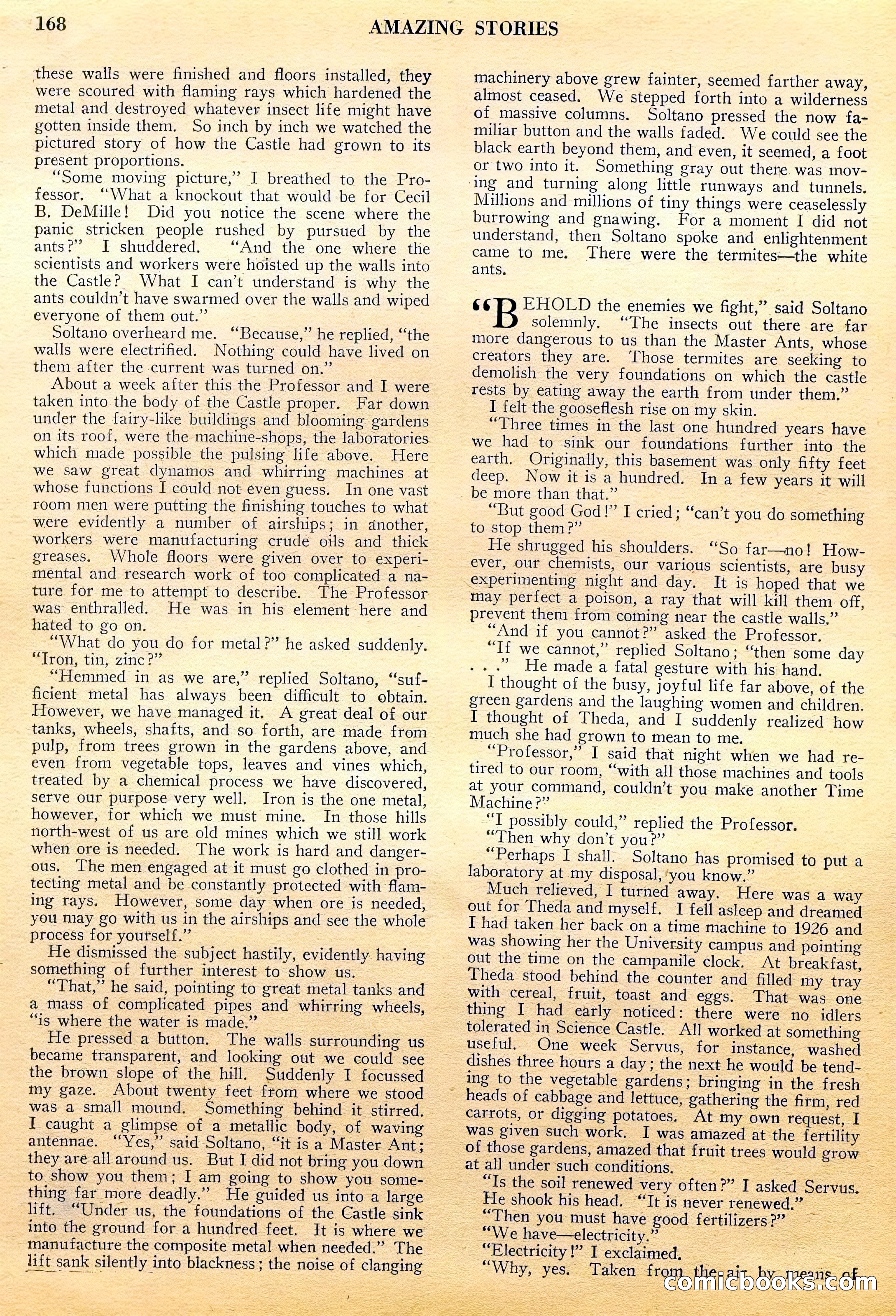
A restored page from Pulp Fiction, 1928. Page through the whole issue in the reader above.
📄 Transcribed text from this page (OCR, searchable)
Machine-transcribed from the original scan — historical spelling and the odd misread are preserved.
168 AMAZING STORIES these walls were finished and floors installed, they were scoured with flaming rays which hardened the metal and destroyed whatever insect life might have gotten inside them. So inch by inch we watched the pictured story of how the Castle had grown to its present proportions. “Some moving picture,” I breathed to the Pro- fessor. ‘What a knockout that would be for Cecil B. DeMille! Did you notice the scene where the panic stricken people rushed by pursued by the ants?’ I shuddered. ‘And the one where the scientists and workers were hoisted up the walls into the Castle? What I can’t understand is why the ants couldn’t have swarmed over the walls and wiped everyone of them out.” Soltano overheard me. “Because,” he replied, “the walls were electrified. Nothing could have lived on them after the current was turned on.” About a week after this the Professor and I were taken into the body of the Castle proper. Far down under the fairy-like buildings and blooming gardens on its roof, were the machine-shops, the laboratories which made possible the pulsing life above. Here we saw great dynamos and whirring machines at whose functions I could not even guess. In one vast room men were putting the finishing touches to what were evidently a number of airships; in dnother, workers were manufacturing crude oils and thick greases. Whole floors were given over to experi- mental and research work of too complicated a na- ture for me to attempt to describe. The Professor. was enthralled. He was in his element here and hated to go on. “What do you do for metal?” he asked suddenly. “Tron, tin, zinc 2” “Hemmed in as we are,” replied Soltano, “suf- ficient metal has always been difficult to obtain. However, we have managed it. A great deal of our tanks, wheels, shafts, and so forth, are made from pulp, from trees grown in the gardens above, and even from vegetable tops, leaves and vines which, treated by a chemical process we have discovered, serve our purpose very well. Iron is the one metal, however, for which we must mine. In those hills north-west of us are old mines which we still work when ore is needed, The work is hard and danger- ous. The men engaged at it must go clothed in pro- tecting metal and be constantly protected with flam- ing rays. However, some day when ore is needed, you may go with us in the airships and see the whole process for yourself.” He dismissed the subject hastily, evidently. having something of further interest to show us. “That,” he said, pointing to great metal tanks and a mass of complicated pipes and whirring wheels, “Gs where the water is made.” He pressed a button. The walls surrounding us became transparent, and looking out we could see the brown slope of the hill. Suddenly I focussed my gaze. About twenty feet from where we stood was a small mound. Something behind it stirred. IT caught a glimpse of a metallic body, of waving antennae. “Yes,” said Soltano, “it is a Master Ant; they are all around us. But I did not bring you down to show you them; I am going to show you some- thing far more deadly.” He guided us into a large lift. “Under us, the foundations of the Castle sink into the ground for a hundred feet. It is where we manufacture the composite metal when needed.” The lift sank silently into blackness; the noise of clanging machinery above grew fainter, seemed farther away, almost ceased. We stepped forth into a wilderness of massive columns. Soltano pressed the now fa- miliar button and the walls faded. We could see the black earth beyond them, and even, it seemed, a foot or two into it. Something gray out there was mov- ing and turning along little runways and tunnels. Millions and millions of tiny things were ceaselessly burrowing and gnawing, For a moment I did not understand, then Soltano spoke and enlightenment came to me. ‘There were the termites—the white ants. 66 JQ EHOLD the enemies we fight,” said Soltano solemnly. ‘The insects out there are far more dangerous to us than the Master Ants, whose creators they are. Those termites are seeking to demolish the very foundations on which the castle rests by eating away the earth from under them.” I felt the gooseflesh rise on my skin. “Three times in the last one hundred years have we had to sink our foundations further into the earth. Originally, this basement was only fifty feet deep. Now it is a hundred. In a few years it will be more than that.” “But good God!” I cried; “can’t you do something to stop them?” He shrugged his shoulders. “So far—no! How- ever, our chemists, our various scientists, are busy experimenting night and day, It is hoped that we may perfect a poison, a ray that will kill them off, prevent them from coming near the castle walls.” “And if you cannot?” asked the Professor. “If we cannot,” replied Soltano; “then some day ...” He made a fatal gesture with his hand. I thought of the busy, joyful life far above, of the green gardens and the laughing women and children. I thought of Theda, and I suddenly realized how much she had grown to mean to me. “Professor,” I said that night when we had re- tired to our room, “with all those machines and tools at your command, couldn’t you make another Time Machine?” “I possibly could,” replied the Professor. “Then why don’t you?” “Perhaps I shall. Soltano has promised to put a laboratory at my disposal, ‘you know.” Much relieved, I turned away. Here was a way out for Theda and myself. I fell asleep and dreamed T had taken her back on a time machine to 1926 and was showing her the University campus and pointing out the time on the campanile clock. At breakfast, Theda stood behind the counter and filled my tray with cereal, fruit, toast and eggs. That was one thing I had early noticed: there were no idlers tolerated in Science Castle. All worked at something — useful. One week Servus, for instance, washed dishes three hours a day; the next he would be tend- ing to the vegetable gardens; bringing in the fresh heads of cabbage and lettuce, gathering the firm, red carrots, or digging potatoes. At my own request, I was given such work. I was amazed at the fertility of those gardens, amazed that fruit trees would grow at all under such conditions. = “Is the soil renewed very often?” I asked Servus. He shook his head. “It is never renewed.” : “Then you must have good fertilizers?” “We have—electricity.” : “Electricity!” I exclaimed. = scomicbocks:com™