
Pulp Fiction, 1928 · page 72 of 100
Amazing Stories, Vol. 3, No. 2 — page 72: what you’re looking at
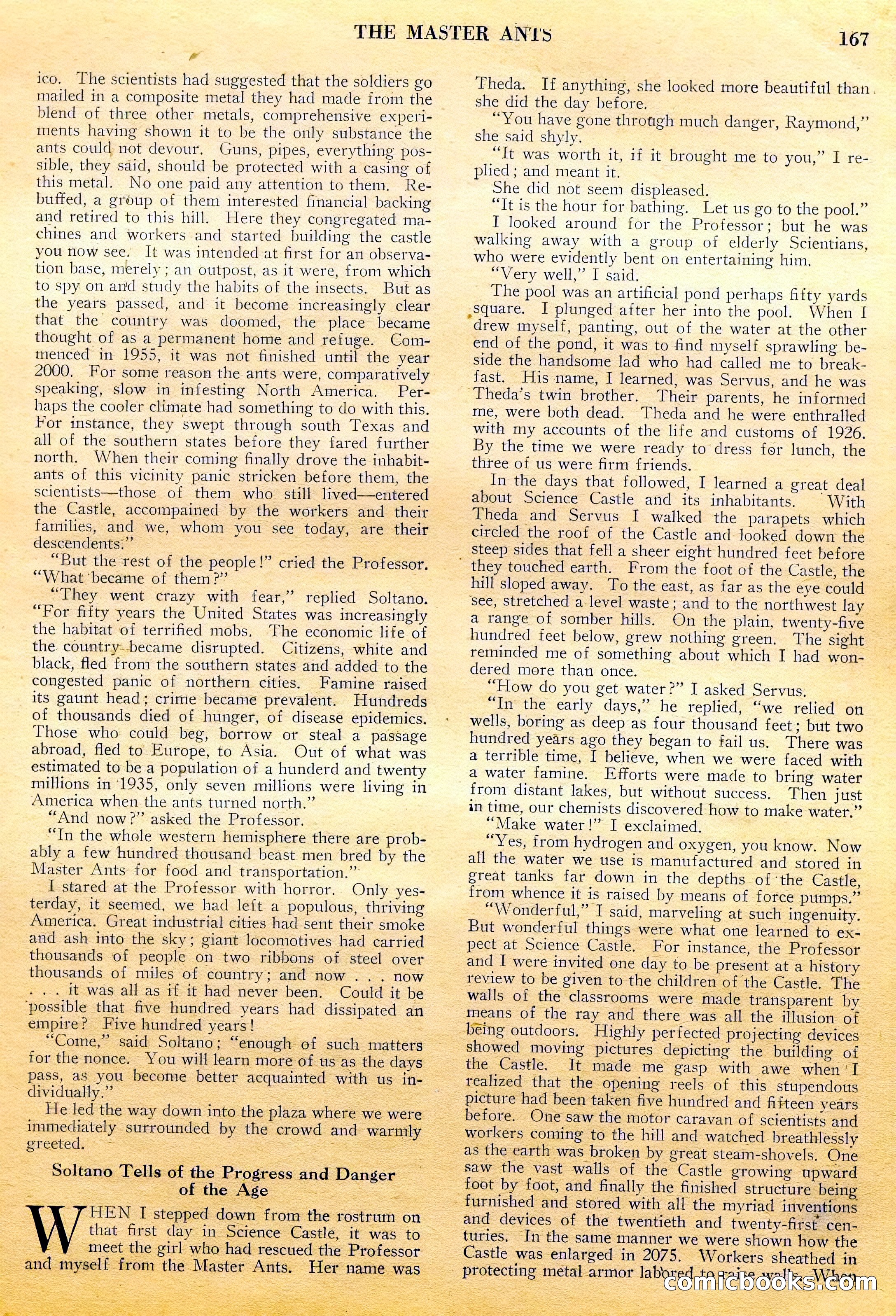
A restored page from Pulp Fiction, 1928. Page through the whole issue in the reader above.
📄 Transcribed text from this page (OCR, searchable)
Machine-transcribed from the original scan — historical spelling and the odd misread are preserved.
THE MASTER ANI 167 ¥ ico, The scientists had suggested that the soldiers go mailed in a composite metal they had made from the blend of three other metals, comprehensive experi- ments having shown it to be the only substance the ants could not devour, Gums, pipes, everything pos- sible, they said, should be protected with a casing of this metal. No one paid any attention to them. Re- buffed, a group of them interested financial backing and retired to this hill. Here they congregated ma- chines and workers and started building the castle you now see. It was intended at first for an observa- tion base, merely ; an outpost, as it were, from which to spy on and study the habits of the insects. But as the years passed, and it become increasingly clear that the country was doomed, the place became thought of as a permanent home and refuge. Com- menced in 1955, it was not finished until the year 2000. For some reason the ants were, comparatively speaking, slow in infesting North America. Per- haps the cooler climate had something to do with this. For instance, they swept through south Texas and all of the southern states before they fared further north. When their coming finally drove the inhabit- ants of this vicinity panic stricken before them, the scientists—those of them who still lived—entered the Castle, accompained by the workers and their families, and we, whom you see today, are their descendents.” “But the rest of the people!” cried the Professor. “What becarne of them?” “They went crazy with fear,” replied Soltano. “For fifty years the United States was increasingly the habitat of terrified mobs. The economic life of the country-became disrupted. Citizens, white and black, fled from the southern states and added to the congested panic of northern cities. Famine raised its gaunt head; crime became prevalent. Hundreds of thousands died of hunger, of disease epidemics. Those who could beg, borrow or steal a passage abroad, fled to Europe, to Asia. Out of what was estimated to be a population of a hunderd and twenty millions in ‘1935, only seven millions were living in America when the ants turned north.” “And now?” asked the Professor. “In the whole western hemisphere there are prob- ably a few hundred thousand beast men bred by the Master Ants for food and transportation.’” I stared at the Professor with horror. Only yes- terday, it seemed, we had left a populous, thriving America. Great industrial cities had sent their smoke and ash into the sky; giant locomotives had carried thousands of people on two ribbons of steel over thousands of miles of country; and now ... now . it was all as if it had never been. Could it be ‘possible that five hundred years had dissipated an empire? Five hundred years! “Come,” said Soltano; “enough of such matters for the nonce. You will learn more of us as the days pass, as you become better acquainted with us in- ~ dividually.” 3 He led the way down into the plaza where we were immediately surrounded by the crowd and warmly - grectedy =. Se Soltano. Tells of the Progress and Danger : that first day in Science Castle, it was to meet the girl elf from the HEN I stepped own from the rostrum on who had rescued the Professor Theda. If anything, she looked more beautiful than. she did the day before. “You have gone through much danger, Raymond,” she said shyly. “ft was worth it, if it brought me to you,” I re- plied; and meant it. She did not seem displeased. “It is the hour for bathing. Let us go to the pool.” T looked around for the Professor; but he was walling away with a group of elderly Scientians, who were evidently bent on entertaining him. “Very well,” I said. The pool was an artificial pond perhaps fifty yards Square. I plunged after her into the pool. When I drew myself, panting, out of the water at the other end of the pond, it was to find myself sprawling be- side the handsome lad who had called me to break- fast. His name, I learned, was Servus, and he was Theda’s twin brother. Their parents, he informed me, were both dead. Theda and he were enthralled with my accounts of the life and customs of 1926. By the time we were ready to dress for lunch, the three of us were firm friends. In the days that followed, I learned a great deal about Science Castle and its inhabitants. | With Theda and Servus I walked the parapets which circled the roof of the Castle and looked down the _ Steep sides that fell a sheer eight hundred feet before they touched earth. From the foot of the Castle, the hill sloped away. To the east, as far as the eye could See, stretched a level waste; and to the northwest lay a range of somber hills. On the plain, twenty-five | hundred feet below, grew nothing green. The sight reminded me of something about which I had won- dered more than once. “Flow do you get water?” I asked Servus, “In the early days,” he replied, “we relied on wells, boring as deep as four thousand feet ; but two hundred years ago they began to fail us. There was a terrible time, I believe, when we were faced with a water famine. Efforts were made to bring water from distant lakes, but without success. Then just in time, our chemists discovered how to make water.” “Make water!” I exclaimed. “Yes, from hydrogen and oxygen, you know. Now all the water we use is manufactured and stored in great tanks far down in the depths of ‘the Castle, from whence it is raised by means of force pumps.” “Wonderful,” I said, marveling at such ingenuity. But wonderful things were what one learned to ex- pect at Science Castle. For instance, the Professor and I were invited one day to be present at a history teview to be given to the children of the Castle. The walls of the classrooms were made transparent by. means of the ray and there was all the illusion of being outdoors. Highly perfected projecting devices — showed moving pictures depicting the building of - the Castle. It made me gasp with awe when ‘T_ realized that the opening reels of this stupendous picture had been taken five hundred and fifteen years —— before. One saw the motor caravan of scientists and workers coming to the hill and watched breathlessly _as the-earth was broken by great steam-shovels, One | - saw the vast walls of the Castle growing upward _ foot by foot, and finally the finished structure being furnished and stored with all the myriad inventions and devices of the twentieth and twenty-first cen- turies. In the same manner we were shown how the ~ Castle was enlarged in 2075. Workers sheathed in Master Ants. Her name \ _ protecting metal armor labored te aie avalty Wey )