
Pulp Fiction, 1927 · page 25 of 107
Amazing Stories, August 1927 — page 25: what you’re looking at
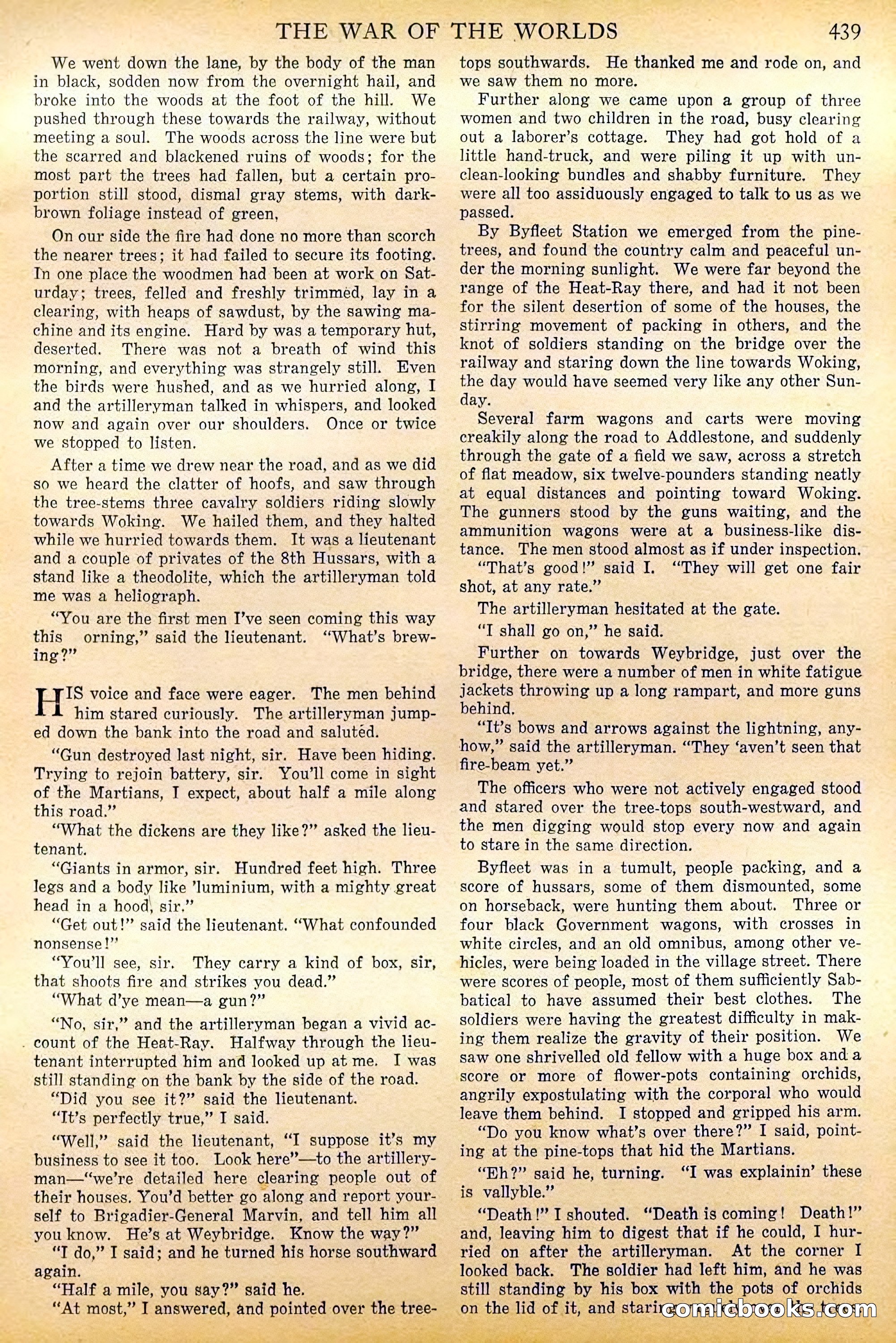
A restored page from Pulp Fiction, 1927. Page through the whole issue in the reader above.
📄 Transcribed text from this page (OCR, searchable)
Machine-transcribed from the original scan — historical spelling and the odd misread are preserved.
THE WAR OF THE WORLDS We went down the lane, by the body of the man in black, sodden now from the overnight hail, and broke into the woods at the foot of the hill. We pushed through these towards the railway, without meeting a soul. The woods across the line were but the scarred and blackened ruins of woods; for the most part the trees had fallen, but a certain pro- portion still stood, dismal gray stems, with dark- brown foliage instead of green, On our side the fire had done no more than scorch the nearer trees; it had failed to secure its footing. Tn one place the woodmen had been at work on Sat- urday; trees, felled and freshly trimmed, lay in a clearing, with heaps of sawdust, by the sawing ma- chine and its engine. Hard by was a temporary hut, deserted. There was not a breath of wind this morning, and everything was strangely still. Even the birds were hushed, and as we hurried along, I and the artilleryman talked in whispers, and looked now and again over our shoulders. Once or twice we stopped to listen. After a time we drew near the road, and as we did so we heard the clatter of hoofs, and saw through the tree-stems three cavalry soldiers riding slowly towards Woking. We hailed them, and they halted while we hurried towards them. It was a lieutenant and a couple of privates of the 8th Hussars, with a stand like a theodolite, which the artilleryman told me was a heliograph. “You are the first men I’ve seen coming this way this orning,” said the lieutenant. ‘“What’s brew- ing?” IS voice and face were eager. The men behind him stared curiously. The artilleryman jump- ed down the bank into the road and saluted. “Gun destroyed last night, sir. Have been hiding. Trying to rejoin battery, sir. You'll come in sight of the Martians, I expect, about half a mile along this road.” “What the dickens are they like?” asked the lieu- tenant. “Giants in armor, sir. Hundred feet high. Three legs and a body like luminium, with a mighty great head in a hood) sir,” “Get out!” said the lieutenant. “What confounded nonsense!” “You'll see, sir. They carry a kind of box, sir, that shoots fire and strikes you dead.” “What d’ye mean—a gun?” “No, sir,” and the artilleryman began a vivid ac- . count of the Heat-Ray. Halfway through the lieu- tenant interrupted him and looked up at me. I was still standing on the bank by the side of the road. “Did you see it?” said the lieutenant. “Tt’s perfectly true,” I said. “Well,” said the lieutenant, “I suppose it’s my business to see it too. Look here”’—to the artillery- man—“we’re detailed here clearing people out of their houses. You'd better go along and report your- self to Brigadier-General Marvin, and tell him all you know. He’s at Weybridge. Know the way?” “T do,” I said; and he turned his horse southward again. “Half a mile, you say?” said he. “At most,” I answered, and pointed over the tree- on the lid pints cand starireroyaalKa +39. tops southwards. He thanked me and rode on, and we saw them no more. Further along we came upon a group of three women and two children in the road, busy clearing out a laborer’s cottage. They had got hold of a little hand-truck, and were piling it up with un- clean-looking bundles and shabby furniture. They were all too assiduously engaged to talk to us as we passed. By Byfleet Station we emerged from the pine- trees, and found the country calm and peaceful un- der the morning sunlight. We were far beyond the range of the Heat-Ray there, and had it not been for the silent desertion of some of the houses, the stirring movement of packing in others, and the knot of soldiers standing on the bridge over the railway and staring down the line towards Woking, the day would have seemed very like any other Sun- day. Several farm wagons and carts were moving creakily along the road to Addlestone, and suddenly through the gate of a field we saw, across a stretch of flat meadow, six twelve-pounders standing neatly at equal distances and pointing toward Woking. The gunners stood by the guns waiting, and the ammunition wagons were at a business-like dis- tance. The men stood almost as if under inspection. “That’s good!” said I. “They will get one fair shot, at any rate.” The artilleryman hesitated at the gate. “T shall go on,” he said. Further on towards Weybridge, just over the bridge, there were a number of men in white fatigue jackets throwing up a long rampart, and more guns behind, “It?s bows and arrows against the lightning, any- how,” said the artilleryman. “They ‘aven’t seen that fire-beam yet.” The officers who were not actively engaged stood and stared over the tree-tops south-westward, and the men digging would stop every now and again to stare in the same direction. Byfleet was in a tumult, people packing, and a score of hussars, some of them dismounted, some on horseback, were hunting them about. Three or four black Government wagons, with crosses in white circles, and an old omnibus, among other ve- hicles, were being loaded in the village street. There were scores of people, most of them sufficiently Sab- batical to have assumed their best clothes. The soldiers were having the greatest difficulty in mak- ing them realize the gravity of their position. We saw one shrivelled old fellow with a huge box and a score or more of flower-pots containing orchids, angrily expostulating with the corporal who would leave them behind. I stopped and gripped his arm. “Do you know what’s over there?” I said, point- ing at the pine-tops that hid the Martians. “Hh?” said he, turning. “I was explainin’ these is vallyble.” “Death!” I shouted. “Death is coming! Death!” and, leaving him to digest that if he could, I hur- ried on after the artilleryman. At the corner I looked back. The soldier had left him, 4nd he was still standing by his box with the pots of orchids