
Pulp Fiction, 1927 · page 40 of 107
Amazing Stories, August 1927 — page 40: what you’re looking at
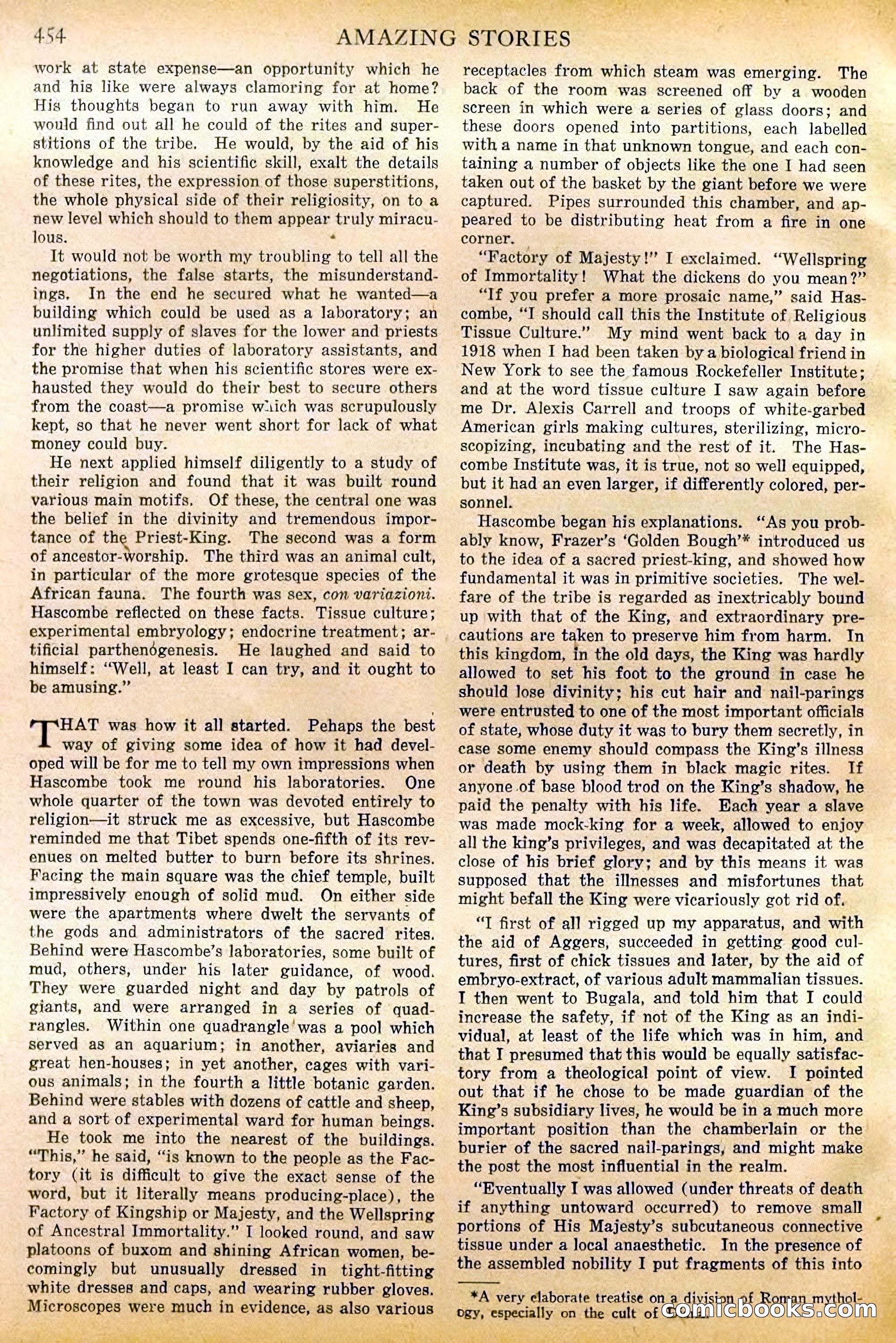
A restored page from Pulp Fiction, 1927. Page through the whole issue in the reader above.
📄 Transcribed text from this page (OCR, searchable)
Machine-transcribed from the original scan — historical spelling and the odd misread are preserved.
454 work at state expense—an opportunity which he and his like were always clamoring for at home? His thoughts began to run away with him. He would find out all he could of the rites and super- stitions of the tribe. He would, by the aid of his knowledge and his scientific skill, exalt the details of these rites, the expression of those superstitions, the whole physical side of their religiosity, on to a new level which should to them appear truly miracu- lous. “ It would not be worth my troubling to tell all the negotiations, the false starts, the misunderstand- ings, In the end he secured what he wanted—a building which could be used as a laboratory; an unlimited supply of slaves for the lower and priests for the higher duties of laboratory assistants, and the promise that when his scientific stores were ex- hausted they would do their best to secure others from the coast—a promise wiich was scrupulously kept, so that he never went short for lack of what money could buy. He next applied himself diligently to a study of their religion and found that it was built round various main motifs, Of these, the central one was the belief in the divinity and tremendous impor- tance of the Priest-King. The second was a form of ancestor-worship. The third was an animal cult, in particular of the more grotesque species of the African fauna. The fourth was sex, con variazioni. Hascombe reflected on these facts. Tissue culture; experimental embryology; endocrine treatment; ar- | tificial parthendgenesis. He laughed and said to himself: ‘Well, at least I can try, and it ought to be amusing.” nf Shee was how it all started. Pehaps the best way of giving some idea of how it had devel- oped will be for me to tell my own impressions when Hascombe took me round his laboratories. One whole quarter of the town was devoted entirely to religion—it struck me as excessive, but Hascombe reminded me that Tibet spends one-fifth of its rev- enues on melted butter to burn before its shrines. Facing the main square was the chief temple, built impressively enough of solid mud. On either side were the apartments where dwelt the servants of the gods and administrators of the sacred rites. Behind were Hascombe’s laboratories, some built of mud, others, under his later guidance, of wood. They were guarded night and day by patrols of giants, and were arranged in a series of quad- rangles. Within one quadrangle'was a pool which served a8 an aquarium; in another, aviaries and great hen-houses; in yet another, cages with vari- ous animals; in the fourth a little botanic garden. Behind were stables with dozens of cattle and sheep, and a sort of experimental ward for human beings. He took me into the nearest of the buildings. “This,” he said, “is known to the people as the Fac- tory (it is difficult to give the exact sense of the word, but it literally means producing-place), the Factory of Kingship or Majesty, and the Wellspring of Ancestral Immortality.” I looked round, and saw platoons of buxom and shining African women, be- comingly but unusually dressed in tight-fitting white dresses and caps, and wearing rubber gloves. Microscopes were much in evidence, as also various eye OS Pa ee ee Bee Bree eS ae AMAZING STORIES Sree eee on: VR Sey receptacles from which steam was emerging. The back of the room was screened off by a wooden screen in which were a series of glass doors; and these doors opened into partitions, each labelled with a name in that unknown tongue, and each con- taining a number of objects like the one I had seen taken out of the basket by the giant before we were captured. Pipes surrounded this chamber, and ap- peared to be distributing heat from a fire in one corner. — “Factory of Majesty!” I exclaimed. “Wellspring of Immortality! What the dickens do you mean?” “Tf you prefer a more prosaic name,” said Has- combe, “I should call this the Institute of Religious Tissue Culture.” My mind went back to a day in 1918 when I had been taken by a biological friend in New York to see the famous Rockefeller Institute; and at the word tissue culture I saw again before me Dr, Alexis Carrell and troops of white-garbed American girls making cultures, sterilizing, micio- scopizing, incubating and the rest of it. The Has- combe Institute was, it is true, not so well equipped, but it had an even larger, if differently colored, per- sonnel. Hascombe began his explanations. “As you prob- ably know, Frazer’s ‘Golden Bough’* introduced us to the idea of a sacred priest-king, and showed how fundamental it was in primitive societies. The wel- fare of the tribe is regarded as inextricably bound up with that of the King, and extraordinary pre- cautions are taken to preserve him from harm. In this kingdom, in the old days, the King was hardly allowed to set his foot to the ground in case he should lose divinity; his cut hair and nail-parings were entrusted to one of the most important officials of state, whose duty it was to bury them secretly, in case some enemy should compass the King’s illness or death by using them in black magic rites. If anyone of base blood trod on the King’s shadow, he paid the penalty with his life. Each year a slave was made mock-king for a week, allowed to enjoy all the king’s privileges, and was decapitated at the close of his brief glory; and by this means it was supposed that the illnesses and misfortunes that might befall the King were vicariously got rid of. “T first of all rigged up my apparatus, and with the aid of Aggers, succeeded in getting good cul- tures, first of chick tissues and later, by the aid of embryo-extract, of various adult mammalian tissues. I then went to Bugala, and told him that I could increase the safety, if not of the King as an indi- vidual, at least of the life which was in him, and that I presumed that this would be equally satisfac- tory from a theological point of view. I pointed out that if he chose to be made guardian of the King’s subsidiary lives, he would be in a much more important position than the chamberlain or the burier of the sacred nail-parings, and might make the post the most influential in the realm. “Eventually I was allowed (under threats of death if anything untoward occurred) to remove small portions of His Majesty’s subcutaneous connective tissue under a Jocal anaesthetic. In the presence of the assembled nobility I put fragments of this into — ¥A { i a ivist ona a me pe ES Comic bOOkKSseOM. BR pe Pe ee SNE,