
Pulp Fiction, 1927 · page 43 of 107
Amazing Stories, August 1927 — page 43: what you’re looking at
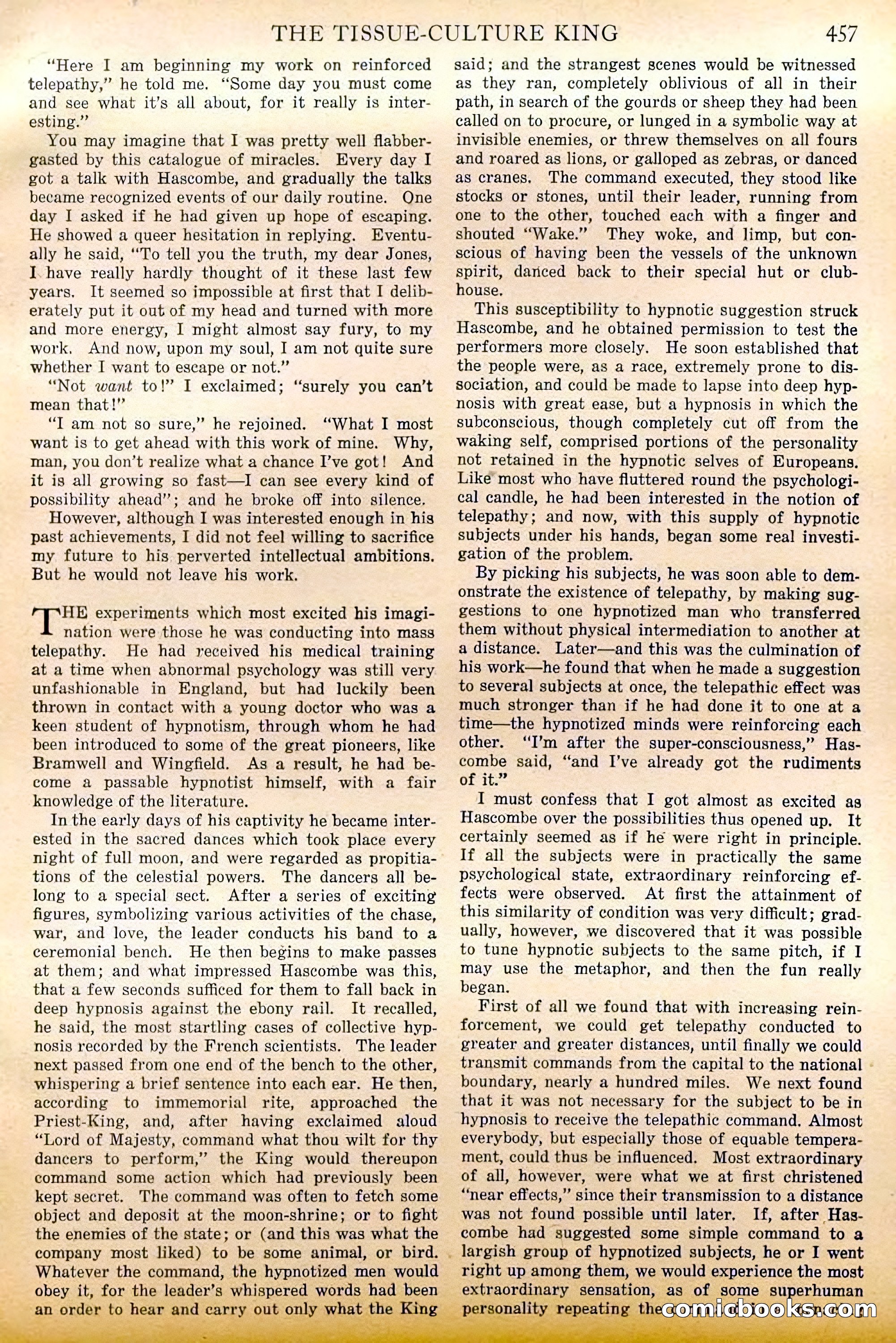
A restored page from Pulp Fiction, 1927. Page through the whole issue in the reader above.
📄 Transcribed text from this page (OCR, searchable)
Machine-transcribed from the original scan — historical spelling and the odd misread are preserved.
THE TISSUE-CULTURE KING “Here I am beginning my work on reinforced telepathy,” he told me. “Some day you must come and see what it’s all about, for it really is inter- esting.” You may imagine that I was pretty well flabber- gasted by this catalogue of miracles. Every day I got a talk with Hascombe, and gradually the talks became recognized events of our daily routine. One day I asked if he had given up hope of escaping. He showed a queer hesitation in replying. Eventu- ally he said, ‘‘To tell you the truth, my dear Jones, I. have really hardly thought of it these last few years, It seemed so impossible at first that I delib- erately put it out of my head and turned with more and more energy, I might almost say fury, to my work, And now, upon my soul, I am not quite sure whether I want to eseape or not.” “Not want to!” I exclaimed; mean that!” “T am not so sure,” he rejoined. “What I most want is to get ahead with this work of mine. Why, Ian, you don’t realize what a chance I’ve got! And it is all growing so fast—I can see every kind of possibility ahead”; and he broke off into silence. However, although I was interested enough in his past achievements, I did not feel willing to sacrifice my future to his, perverted intellectual ambitions. But he would not leave his work. “surely you can’t ew experiments which most excited his imagi- nation were those he was conducting into mass telepathy. He had yeceived his medical training at a time when abnormal psychology was still very unfashionable in England, but had luckily been thrown in contact with a young doctor who was a keen student of hypnotism, through whom he had been introduced to some of the great pioneers, like Bramwell and Wingfield. As a result, he had be- come a passable hypnotist himself, with a fair knowledge of the literature. In the early days of his captivity he became inter- ested in the sacred dances which took place every night of full moon, and were regarded as propitia- tions of the celestial powers. The dancers all be- long to a special sect. After a series of exciting figures, symbolizing various activities of the chase, war, and love, the leader conducts his band to a ceremonial bench. He then begins to make passes at them; and what impressed Hascombe was this, that a few seconds sufficed for them to fall back in deep hypnosis against the ebony rail. It recalled, he said, the most startling cases of collective hyp- nosis recorded by the French scientists. The leader next passed from one end of the bench to the other, whispering a brief sentence into each ear. He then, according to immemorial rite, approached the Priest-King, and, after having exclaimed aloud “Lord of Majesty, command what thou wilt for thy dancers to perform,” the King would thereupon command some action which had previously been kept secret. The command was often to fetch some object and deposit at the moon-shrine; or to fight the enemies of the state; or (and this was what the company most liked) to be some animal, or bird. . Whatever the command, the hypnotized men would ghey, it, for the aden ‘8 gs walsered wol 457 said; and the strangest scenes would be witnessed as they ran, completely oblivious of all in their path, in search of the gourds or sheep they had been called on to procure, or lunged in a symbolic way at invisible enemies, or threw themselves on all fours and roared as lions, or galloped as zebras, or danced as cranes. The command executed, they stood like stocks or stones, until their leader, running from one to the other, touched each with a finger and shouted “Wake.” They woke, and limp, but con- scious of having been the vessels of the unknown spirit, dariced back to their special hut or club- house, This susceptibility to hypnotic suggestion struck Hascombe, and he obtained permission to test the performers more closely. He soon established that the people were, as a race, extremely prone to dis- sociation, and could be made to lapse into deep hyp- nosis with great ease, but a hypnosis in which the subconscious, though completely cut off from the waking self, comprised portions of the personality not retained in the hypnotic selves of Europeans. Like’ most who have fluttered round the psychologi- cal candle, he had been interested in the notion of telepathy; and now, with this supply of hypnotic subjects under his hands, began some real investi- gation of the problem. By picking his subjects, he was soon able to dem- onstrate the existence of telepathy, by making sug- gestions to one hypnotized man who transferred them without physical intermediation to another at a distance. Later—and this was the culmination of his work—he found that when he made a suggestion to several subjects at once, the telepathic effect was much stronger than if he had done it to one at a time—the hypnotized minds were reinforcing each other. “I’m after the super-consciousness,” Has- combe said, “and I’ve already got the rudiments of it.” I must confess that I got almost as excited as Hascombe over the possibilities thus opened up, It certainly seemed as if he were right in principle. If all the subjects were in practically the same psychological state, extraordinary reinforcing ef- fects were observed. At first the attainment of this similarity of condition was very difficult; grad- ually, however, we discovered that it was possible to tune hypnotic subjects to the same pitch, if I may use the metaphor, and then the fun really began. First of all we found that with increasing rein- forcement, we could get telepathy conducted to greater and greater distances, until finally we could transmit commands from the capital to the national - boundary, nearly a hundred miles. We next found that it was not necessary for the subject to be in hypnosis to receive the telepathic command. Almost everybody, but especially those of equable tempera- ment, could thus be influenced. Most extraordinary of all, however, were what we at first christened “near effects,” since their transmission to a distance was not found possible until later, If, after Has- combe had suggested some simple command to a largish group of hypnotized subjects, he or I went right up among them, we would experience the most extraordinary on, as of Rome. supe SaniaD .