
Pulp Fiction, 1927 · page 56 of 107
Amazing Stories, August 1927 — page 56: what you’re looking at
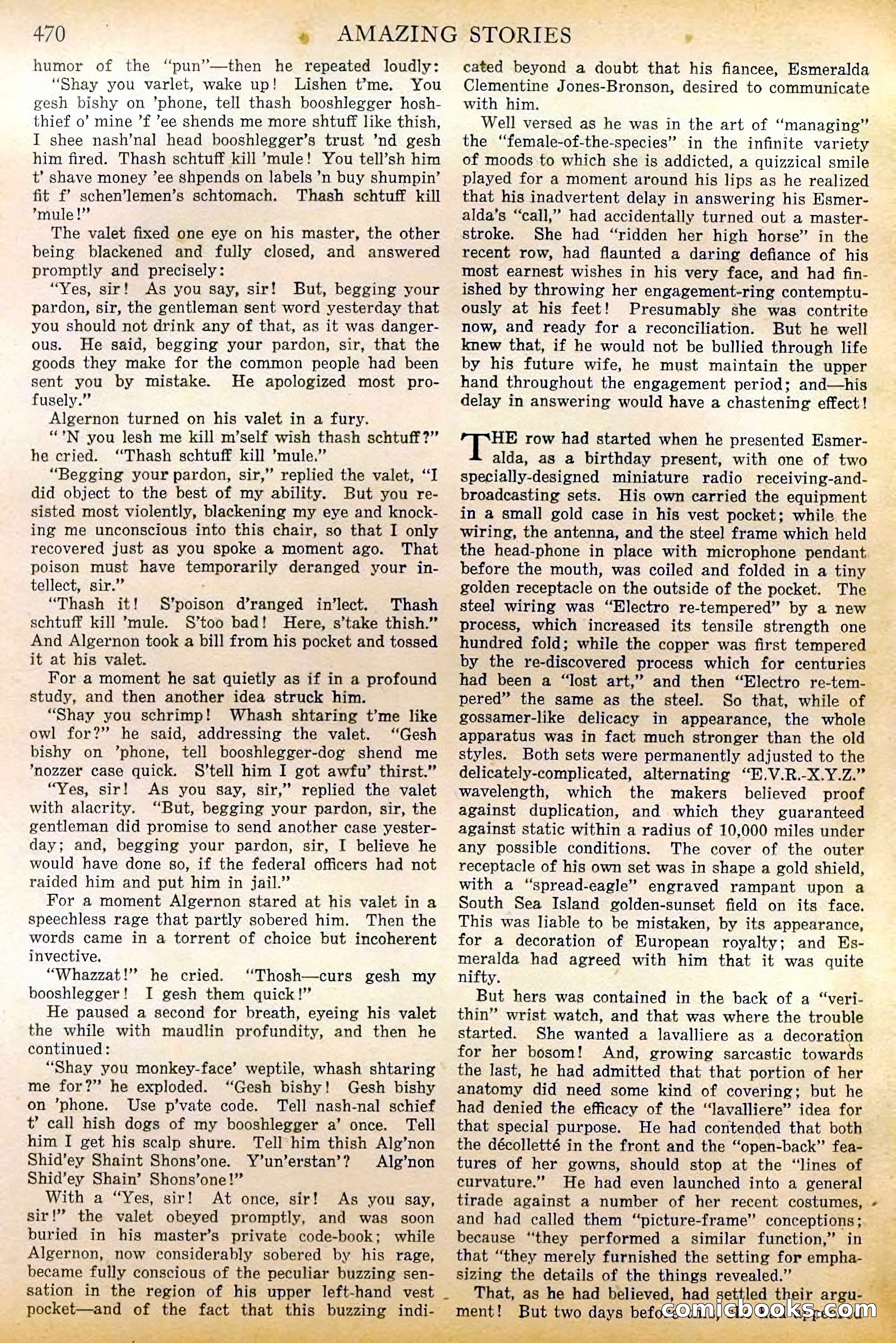
A restored page from Pulp Fiction, 1927. Page through the whole issue in the reader above.
📄 Transcribed text from this page (OCR, searchable)
Machine-transcribed from the original scan — historical spelling and the odd misread are preserved.
470 humor of the ‘“pun’—then he repeated loudly: “Shay you varlet, wake up! Lishen t?me. You gesh bishy on ’phone, tell thash booshlegger hosh- thief o’ mine ’f ’ee shends me more shtuff like thish, I shee nash’nal head booshlegger’s trust ’nd gesh him fired. Thash schtuff kill ’mule! You tell’sh him t? shave money ’ee shpends on labels ’n buy shumpin’ fit £’ schen’lemen’s schtomach. Thash schtuff kill ’mule!” The valet fixed one eye on his master, the other being blackened and fully closed, and answered promptly and precisely: “Yes, sir! As you say, sir! But, begging your pardon, sir, the gentleman sent word yesterday that you should not drink any of that, as it was danger- ous. He said, begging your pardon, sir, that the goods they make for the common people had been sent you by mistake. He apologized most pro- fusely.” Algernon turned on his valet in a fury. “*N you lesh me kill m’self wish thash schtuff?” he cried. “Thash schtuff kill ’mule.’’ “Begging your pardon, sir,” replied the valet, “I did object to the best of my ability. But you re- sisted most violently, blackening my eye and knock- ing me unconscious into this chair, so that I only recovered just as you spoke a moment ago. That poison must have temporarily deranged your in- tellect, sir.” “Thash it! S’poison d’ranged in’lect. Thash schtuff kill "mule. S’foo bad! Here, s’take thish.” And Algernon took a bill from his pocket and tossed it at his valet. For a moment he sat quietly as if in a profound study, and then another idea struck him. “Shay you schrimp! Whash shtaring t’me like owl for?” he said, addressing the valet. ‘Gesh bishy on ’phone, tell booshlegger-dog shend me *nozzer case quick. S’tell him I got awfu’ thirst.” “Yes, sir! As you say, sir,” replied the valet with alacrity. “But, begging your pardon, sir, the gentleman did promise to send another case yester- day; and, begging your pardon, sir, I believe he would have done so, if the federal officers had not raided him and put him in jail.” For a moment Algernon stared at his valet in a speechless rage that partly sobered him. Then the words came in a torrent of choice but incoherent invective. “Whazzat!” he cried. ‘“Thosh—curs gesh my booshlegger! I gesh them quick!” He paused a second for breath, eyeing his valet the while with maudlin profundity, and then he continued: “Shay you monkey-face’ weptile, whash shtaring me for?” he exploded. “Gesh bishy! Gesh bishy on ’phone. Use p’vate code. Tell nash-nal schief t? call hish dogs of my booshlegger a’ once. Tell him I get his scalp shure. Tell him thish Alg’non Shid’ey Shaint Shons’one. Y’un’erstan’? Alg’non Shid’ey Shain’ Shons’one!” With a “Yes, sir! At once, sir! As you say, sir!” the valet obeyed promptly, and was soon buried in his master’s private code-book; while Algernon, now considerably sobered by his rage, became fully conscious of the peculiar buzzing sen- sation in the region of his upper left-hand vest ment! But t Bis as eae pocket—and of the fact that this buzzing indi- Be aC es Ree Snes ss, » AMAZING STORIES , cated beyond a doubt that his fiancee, Esmeralda Clementine Jones-Bronson, desired to communicate with him. Well versed as he was in the art of “managing” the ‘“female-of-the-species” in the infinite variety of moods to which she is addicted, a quizzical smile played for a moment around his lips as he realized that his inadvertent delay in answering his Esmer- alda’s “call,” had accidentally turned out a master- stroke. She had “ridden her high horse” in the recent row, had flaunted a daring defiance of his most earnest wishes in his very face, and had fin- ished by throwing her engagement-ring contemptu- ously at his feet! Presumably she was contrite now, and ready for a reconciliation. But he well knew that, if he would not be bullied through life by his future wife, he must maintain the upper hand throughout the engagement period; and—his delay in answering would have a chastening effect! 6 Nee row had started when he presented Esmer- alda, as a birthday present, with one of two specially-designed miniature radio receiving-and- broadcasting sets. His own carried the equipment in a small gold case in his vest pocket; while the wiring, the antenna, and the steel] frame which held the head-phone in place with microphone pendant before the mouth, was coiled and folded in a tiny golden receptacle on the outside of the pocket. The steel wiring was “Electro re-tempered” by a new process, which increased its tensile strength one hundred fold; while the copper was first tempered by the re-discovered process which for centuries had been a “lost art,” and then “Electro re-tem- pered” the same as the steel. So that, while of gossamer-like delicacy in appearance, the whole apparatus was in fact much stronger than the old styles. Both sets were permanently adjusted to the delicately-complicated, alternating “TIE.V.R.-X.Y.Z.” wavelength, which the makers believed proof against duplication, and which they guaranteed against static within a radius of 10,000 miles under any possible conditions. The cover of the outer receptacle of his own set was in shape a gold shield, with a “spread-eagle” engraved rampant upon a South Sea Island golden-sunset field on its face. This was liable to be mistaken, by its appearance, for a decoration of European royalty; and Es- meralda had agreed with him that it was quite nifty. But hers was contained in the hack of a “veri- thin” wrist watch, and that was where the trouble started. She wanted a lavalliere as a decoration for her bosom! And, growing sarcastic towards the last, he had admitted that that portion of her anatomy did need some kind of covering: but he had denied the efficacy of the “lavalliere” idea for that special purpose. He had contended that both the décolletté in the front and the “open-back”’ fea- tures of her gowns, should stop at the “lines of curvature.” He had even launched into a general tirade against a number of her recent costumes, and had called them “picture-frame” conceptions; because “they performed a similar function,” in that “they merely furnished the setting for empha- a sizing the details of the things revealed.” That, as he had believed, had settled thei FA COMMCIOOKS.G