
Pulp Fiction, 1927 · page 73 of 107
Amazing Stories, August 1927 — page 73: what you’re looking at
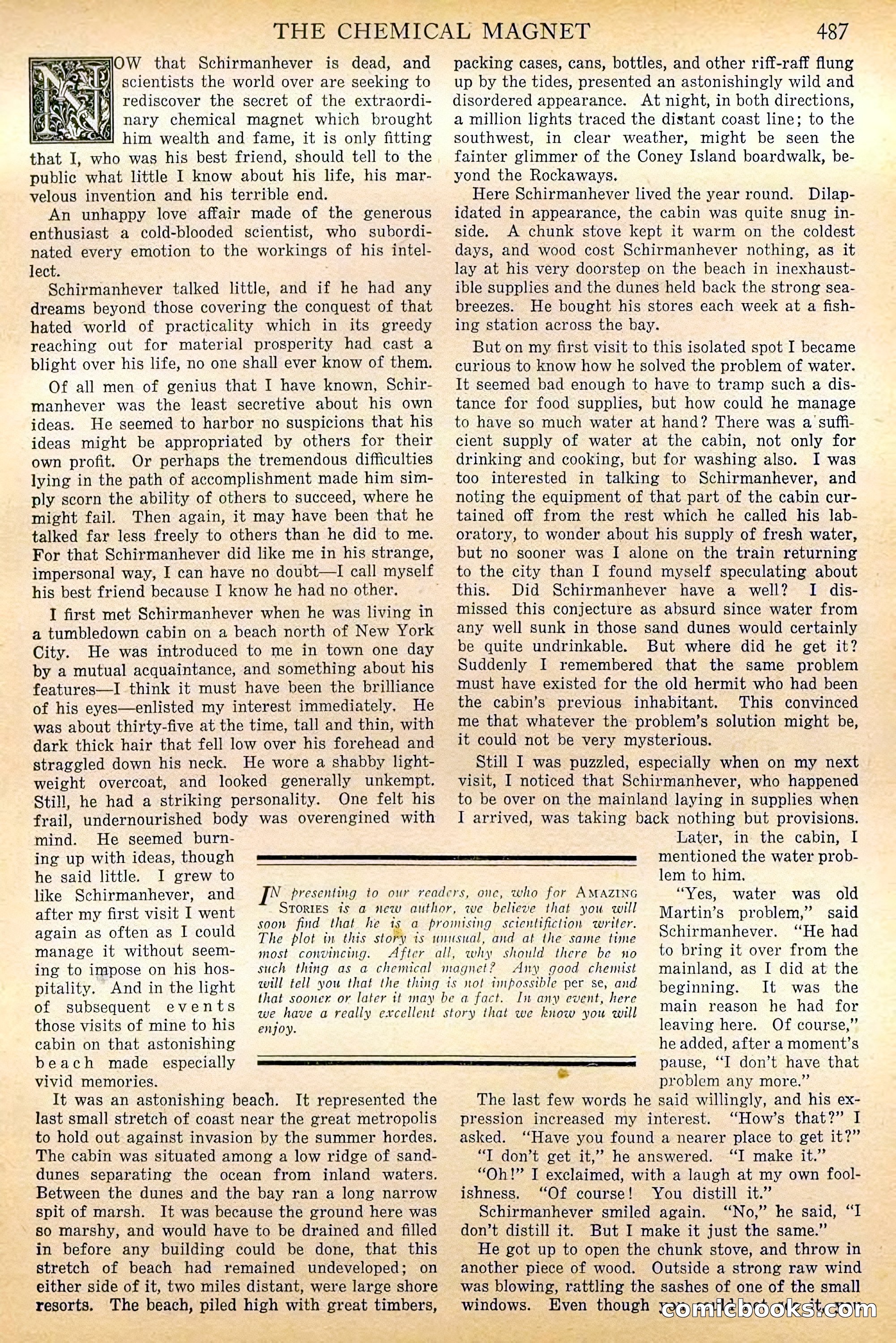
A restored page from Pulp Fiction, 1927. Page through the whole issue in the reader above.
📄 Transcribed text from this page (OCR, searchable)
Machine-transcribed from the original scan — historical spelling and the odd misread are preserved.
THE CHEMICAL MAGNET SNe that Schirmanhever is dead, and 4| scientists the world over are seeking to a rediscover the secret of the extraordi- aD nary chemical magnet which brought etl him wealth and fame, it is only fitting shat J, who was his best friend, should tell to the public what little I know about his life, his mar- velous invention and his terrible end. An unhappy love affair made of the generous enthusiast a cold-blooded scientist, who subordi- nated every emotion to the workings of his intel- lect. Schirmanhever talked little, and if he had any dreams beyond those covering the conquest of that hated world of practicality which in its greedy reaching out for material prosperity had cast a blight over his life, no one shall ever know of them. Of all men of genius that I have known, Schir- manhever was the least secretive about his own ideas. He seemed to harbor no suspicions that his ideas might be appropriated by others for their own profit. Or perhaps the tremendous difficulties lying in the path of accomplishment made him sim- ply scorn the ability of others to succeed, where he might fail. Then again, it may have been that he talked far less freely to others than he did to me. For that Schirmanhever did like me in his strange, impersonal way, I can have no doubt—I call myself his best friend because I know he had no other. I first met Schirmanhever when he was living in a tumbledown cabin on a beach north of New York City. He was introduced to me in town one day by a mutual acquaintance, and something about his features—I think it must have been the brilliance of his eyes—enlisted my interest immediately, He was about thirty-five at the time, tall and thin, with dark thick hair that fell low over his forehead and straggled down his neck. He wore a shabby light- weight overcoat, and looked generally unkempt. Still, he had a striking personality. One felt his frail, undernourished body was overengined with mind. He seemed burn- ing up with ideas, though he said little. I grew to like Schirmanhever, and after my first visit I went again as often as I could manage it without seem- ing to impose on his hos- pitality. And in the light of subsequent events those visits of mine to his cabin on that astonishing beach made especially vivid memories. It was an astonishing beach. It represented the last small stretch of coast near the great metropolis to hold out against invasion by the summer hordes. The cabin was situated among a low ridge of sand- dunes separating the ocean from inland waters. Between the dunes and the bay ran a long narrow spit of marsh. It was because the ground here was so marshy, and would have to be drained and filled in before any building could be done, that this stretch of beach had remained undeveloped; on either side of it, two miles distant, were large shore resorts. The beach, piled high with great timbers, The plot in this sto most convineng. enjoy. N presenting to our readcrs, one, who for AMAZING Stories is a new author, we believe that you will soon find that he is a promising sctentifiction writer. aa ts usual, and at the same time After all, such thing as a chemical magnet? will tell you that the thing is not tnpossible per se, and that sooner or later tt may be a fact. we have a really excellent story that we know you will RY OT 487 packing cases, cans, bottles, and other riff-raff flung up by the tides, presented an astonishingly wild and disordered appearance. At night, in both directions, a million lights traced the distant coast line; to the southwest, in clear weather, might be seen the fainter glimmer of the Coney Island boardwalk, be- yond the Rockaways. Here Schirmanhever lived the year round. Dilap- idated in appearance, the cabin was quite snug in- side. A chunk stove kept it warm on the coldest days, and wood cost Schirmanhever nothing, as it lay at his very doorstep on the beach in inexhaust- ible supplies and the dunes held back the strong sea- breezes. He bought his stores each week at a fish- ing station across the bay. But on my first visit to this isolated spot I became curious to know how he solved the problem of water. It seemed bad enough to have to tramp such a dis- tance for food supplies, but how could he manage to have so much water at hand? There was a suffi- cient supply of water at the cabin, not only for drinking and cooking, but for washing also. I was too interested in talking to Schirmanhever, and noting the equipment of that part of the cabin cur- tained off from the rest which he called his lab- oratory, to wonder about his supply of fresh water, but no sooner was I alone on the train returning to the city than I found myself speculating about this. Did Schirmanhever have a well? I dis- missed this conjecture as absurd since water from any well sunk in those sand dunes would certainly be quite undrinkable. But where did he get it? Suddenly I remembered that the same problem must have existed for the old hermit who had been the cabin’s previous inhabitant. This convinced me that whatever the problem’s solution might be, it could not be very mysterious. Still I was puzzled, especially when on my next visit, I noticed that Schirmanhever, who happened to be over on the mainland laying in supplies when I arrived, was taking back nothing but provisions. Later, in the cabin, I mentioned the water prob- lem to him, “Yes, water was old Martin’s problem,” said Schirmanhever. ‘He had to bring it over from the mainland, as I did at the beginning. It was the main reason he had for leaving here. Of course,” he added, after a moment’s pause, “I don’t have that problem any more.” The last few words he said willingly, and his ex- pression increased my interest. “How’s that?” I asked. ‘Have you found a nearer place to get it?” “T don’t get it,” he answered. “I make it.” “Oh!” I exclaimed, with a laugh at my own fool- ishness. “Of course! You distill it.’ Schirmanhever smiled again. “No,” he said, “I don’t distill it. But I make it just the same.” He got up to open the chunk stove, and throw in another piece of wood. Outside a strong raw wind was blowing, rattling the sashes of one of the small windows. Even though ‘COMIGDOOKSconn why should there be no Any good chemist Ii any event, here