
Pulp Fiction, 1927 · page 75 of 107
Amazing Stories, August 1927 — page 75: what you’re looking at
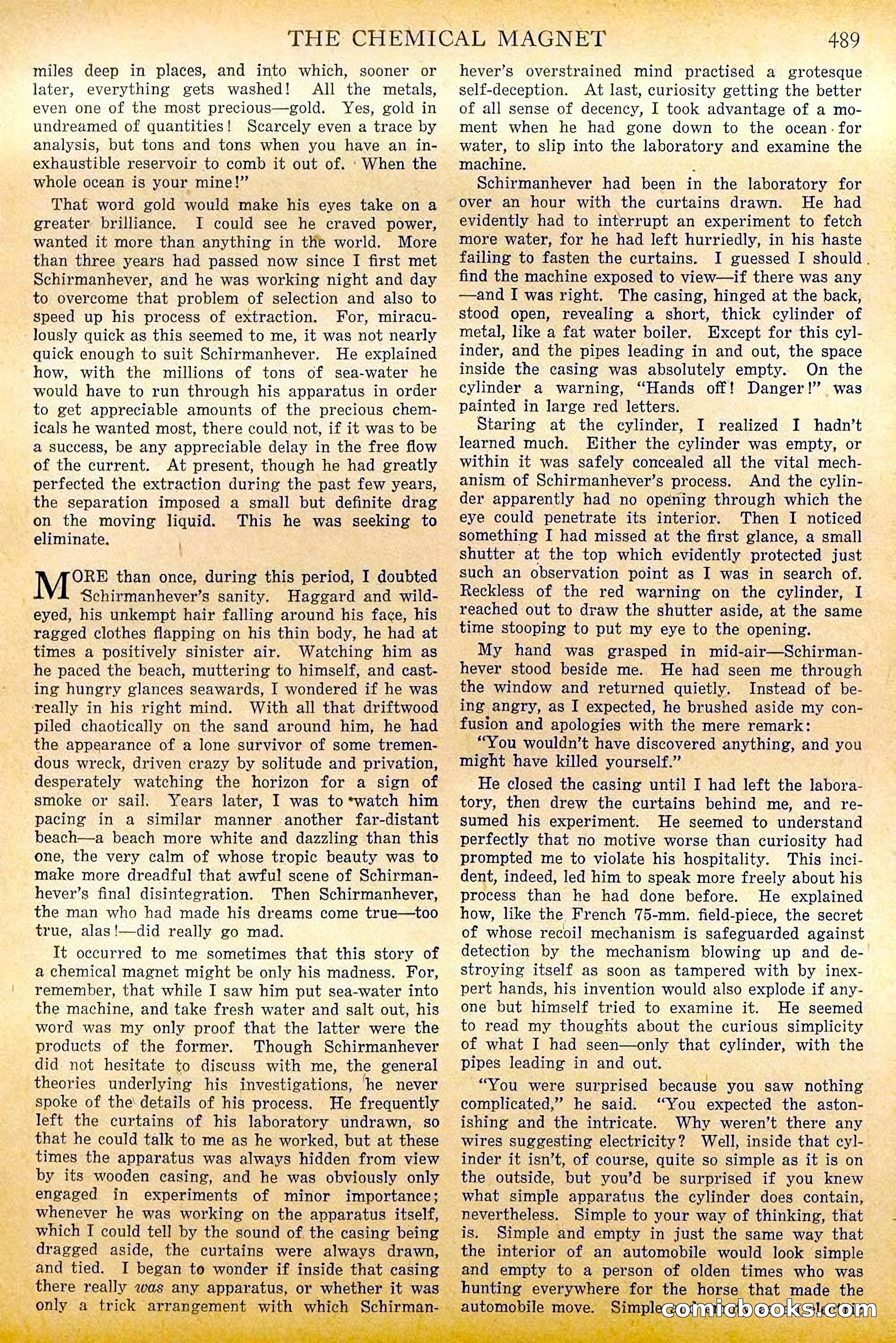
A restored page from Pulp Fiction, 1927. Page through the whole issue in the reader above.
📄 Transcribed text from this page (OCR, searchable)
Machine-transcribed from the original scan — historical spelling and the odd misread are preserved.
a THE CHEMICAL MAGNET miles deep in places, and into which, sooner or later, everything gets washed! All the metals, even one of the most precious—gold. Yes, gold in undreamed of quantities! Scarcely even a trace by analysis, but tons and tons when you have an in- exhaustible reservoir to comb it out of. ‘When the whole ocean is your mine!” That word gold would make his eyes take on a greater brilliance. I could see he craved power, wanted it more than anything in the world. More than three years had passed now since I first met Schirmanhever, and he was working night and day to overcome that problem of selection and also to speed up his process of extraction. For, miracu- lously quick as this seemed to me, it was not nearly quick enough to suit Schirmanhever. He explained how, with the millions of tons of sea-water he would have to run through his apparatus in order to get appreciable amounts of the precious chem- icals he wanted most, there could not, if it was to be a success, be any appreciable delay in the free flow of the current. At present, though he had greatly perfected the extraction during the past few years, the separation imposed a small but definite drag on the moving liquid. This he was seeking to eliminate, \ Wyk than once, during this period, I doubted Schirmanhever’s sanity. Haggard and wild- eyed, his unkempt hair falling around his face, his ragged clothes flapping on his thin body, he had at times a positively sinister air. Watching him as he paced the beach, muttering to himself, and cast- ing hungry glances seawards, I wondered if he was ‘really in his right mind. With all that driftwood piled chaotically on the sand around him, he had the appearance of a lone survivor of some tremen- dous wreck, driven crazy by solitude and privation, desperately watching the horizon for a sign of smoke or sail. Years later, I was to*watch him pacing in a similar manner another far-distant beach—a beach more white and dazzling than this one, the very calm of whose tropic beauty was to make more dreadful that awful scene of Schirman- hever’s final disintegration. Then Schirmanhever, the man who had made his dreams come true—too true, alas!—did really go mad. It occurred to me sometimes that this story of a chemical magnet might be only his madness. For, remember, that while I saw him put sea-water into the machine, and take fresh water and salt out, his word was my only proof that the latter were the products of the former. Though Schirmanhever did not hesitate to discuss with me, the general theories underlying his investigations, ‘he never spoke of the details of his process. He frequently left the curtains of his laboratory undrawn, so that he could talk to me as he worked, but at these times the apparatus was always hidden from view by its wooden casing, and he was obviously only engaged in experiments of minor importance; whenever he was working on the apparatus itself, which I could tell by the sound of the casing being dragged aside, the curtains were always drawn, and tied. I began to wonder if the interior of an automobile would look simple ie pica! ig lets 8 a Oe 489 hever’s overstrained mind practised a grotesque self-deception. At last, curiosity getting the better of all sense of decency, I took advantage of a mo- ment when he had gone down to the ocean: for water, to slip into the ae and examine the machine. Schirmanhever had been in the laboratory for over an hour with the curtains drawn. He had evidently had to interrupt an experiment to fetch more water, for he had left hurriedly, in his haste failing to fasten the curtains. I guessed I should. find the machine exposed to view—if there was any —and I was right. The casing, hinged at the back, stood open, revealing a short, thick cylinder of metal, like a fat water boiler. Except for this cyl- inder, and the pipes leading in and out, the space inside the casing was absolutely empty. On the cylinder a warning, “Hands off! Danger!’’ was painted in large red letters. Staring at the cylinder, I realized I hadn’t learned much. Hither the cylinder was empty, or within it was safely concealed all the vital mech- anism of Schirmanhever’s process. And the cylin- der apparently had no opening through which the eye could penetrate its interior. Then I noticed something I had missed at the first glance, a small shutter at the top which evidently protected just such an observation point as I was in search of. Reckless of the red warning on the cylinder, I reached out to draw the shutter aside, at the same time stooping to put my eye to the opening. My hand was grasped in mid-air—Schirman- hever stood beside me. He had seen me through the window and returned quietly. Instead of be- ing angry, as I expected, he brushed aside my con- fusion and apologies with the mere remark: “You wouldn’t have discovered anything, and you might have killed yourself.” He closed the casing until I had left the labora- tory, then drew the curtains behind me, and re- sumed his experiment. He seemed to understand perfectly that no motive worse than curiosity had prompted me to violate his hospitality. This inci- dent, indeed, led him to speak more freely about his process than he had done before. He explained how, like the French 75-mm. field-piece, the secret of whose recoil mechanism is safeguarded against detection by the mechanism blowing up and de- stroying itself as soon as tampered with by inex- pert hands, his invention would also explode if any- one but himself tried to examine it. He seemed to read my thoughts about the curious simplicity of what I had seen—only that cylinder, with the pipes leading in and out. “You were surprised because you saw nothing complicated,” he said. “You expected the aston- ishing and the intricate. Why weren’t there any wires suggesting electricity? Well, inside that cyl- inder it isn’t, of course, quite so simple as it is on the outside, but you’d be surprised if you knew what simple apparatus the cylinder does contain, nevertheless. Simple to your way of thinking, that is. Simple and empty in just the same way that