
Pulp Fiction, 1927 · page 77 of 107
Amazing Stories, August 1927 — page 77: what you’re looking at
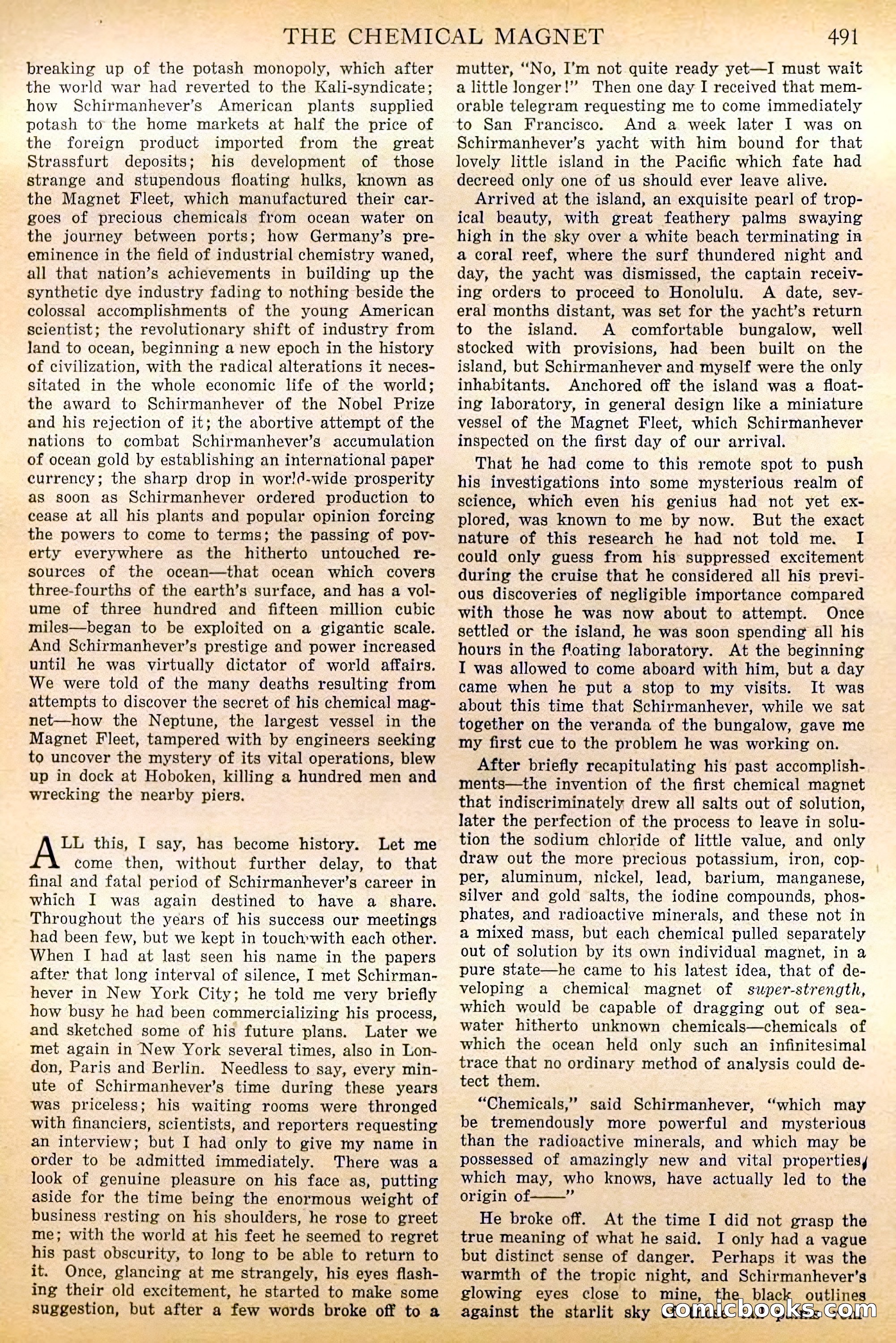
A restored page from Pulp Fiction, 1927. Page through the whole issue in the reader above.
📄 Transcribed text from this page (OCR, searchable)
Machine-transcribed from the original scan — historical spelling and the odd misread are preserved.
THE CHEMICAL MAGNET breaking up of the potash monopoly, which after the world war had reverted to the Kali-syndicate; how Schirmanhever’s American plants supplied potash to the home markets at half the price of the foreign product imported from the great Strassfurt deposits; his development of those strange and stupendous floating hulks, known as the Magnet Fleet, which manufactured their car- goes of precious chemicals from ocean water on the journey between ports; how Germany’s pre- eminence in the field of industrial chemistry waned, all that nation’s achievements in building up the synthetic dye industry fading to nothing beside the colossal accomplishments of the young American scientist; the revolutionary shift of industry from Jand to ocean, beginning a new epoch in the history of civilization, with the radical alterations it neces- sitated in the whole economic life of the world; the award to Schirmanhever of the Nobel Prize and his rejection of it; the abortive attempt of the nations to combat Schirmanhever’s accumulation of ocean gold by establishing an international paper currency; the sharp drop in world-wide prosperity as soon as Schirmanhever ordered production to cease at all his plants and popular opinion forcing the powers to come to terms; the passing of pov- erty everywhere as the hitherto untouched re- sources of the ocean—that ocean which covers three-fourths of the earth’s surface, and has a vol- ume of three hundred and fifteen million cubic miles—began to be exploited on a gigantic scale. And Schirmanhever’s prestige and power increased until he was virtually dictator of world affairs. We were told of the many deaths resulting from attempts to discover the secret of his chemical mag- net—how the Neptune, the largest vessel in the Magnet Fleet, tampered with by engineers seeking to uncover the mystery of its vital operations, blew up in dock at Hoboken, killing a hundred men and wrecking the nearby piers. LL this, I say, has become history. Let me come then, without further delay, to that final and fatal period of Schirmanhever’s career in which I was again destined to have a share. Throughout the years of his success our meetings had been few, but we kept in touchwith each other. When I had at last seen his name in the papers after that long interval of silence, I met Schirman- hever in New York City; he told me very briefly how busy he had been commercializing his process, and sketched some of his future plans. Later we Met again in New York several times, also in Lon- don, Paris and Berlin. Needless to say, every min- ute of Schirmanhever’s time during these years was priceless; his waiting rooms were thronged with financiers, scientists, and reporters requesting an interview; but I had only to give my name in order to be admitted immediately. ‘There was a look of genuine pleasure on his face as, putting aside for the time being the enormous weight of business resting on his shoulders, he rose to greet Mme; with the world at his feet he seemed to regret his past obscurity, to long to be able to return to it. Once, glancing at me strangely, his eyes flash- ing their old excitement, he started to make some Suggestion, but after a few words broke off to a he ae) a Yow eo Re 2 491 mutter, ‘‘No, I’m not quite ready yet—I must wait a little longer!” Then one day I received that mem- orable telegram requesting me to come immediately to San Francisco. And a week later I was on Schirmanhever’s yacht with him bound for that lovely little island in the Pacific which fate had decreed only one of us should ever leave alive. Arrived at the island, an exquisite pearl of trop- ical beauty, with great feathery palms swaying high in the sky over a white beach terminating in a coral reef, where the surf thundered night and day, the yacht was dismissed, the captain receiv- ing orders to proceed to Honolulu. A date, sev- eral months distant, was set for the yacht’s return to the island. A comfortable bungalow, well stocked with provisions, had been built on the island, but Schirmanhever and myself were the only inhabitants. Anchored off the island was a float- ing laboratory, in general design like a miniature vessel of the Magnet Fleet, which Schirmanhever inspected on the first day of our arrival. That he had come to this remote spot to push his investigations into some mysterious realm of science, which even his genius had not yet ex- plored, was known to me by now. But the exact nature of this research he had not told me. I could only guess from his suppressed excitement during the cruise that he considered all his previ- ous discoveries of negligible importance compared with those he was now about to attempt. Once settled or the island, he was soon spending all his hours in the floating laboratory. At the beginning I was allowed to come aboard with him, but a day came when he put a stop to my visits. It was about this time that Schirmanhever, while we sat together on the veranda of the bungalow, gave me my first cue to the problem he was working on. After briefly recapitulating his past accomplish- ments—the invention of the first chemical magnet that indiscriminately drew all salts out of solution, later the perfection of the process to leave in solu- tion the sodium chloride of little value, and only draw out the more precious potassium, iron, cop- per, aluminum, nickel, lead, barium, manganese, silver and gold salts, the iodine compounds, phos- phates, and radioactive minerals, and these not in a mixed mass, but each chemical pulled separately out of solution by its own individual magnet, in a pure state—he came to his latest idea, that of de- veloping a chemical magnet of super-strength, which would be capable of dragging out of sea- water hitherto unknown chemicals—chemicals of which the ocean held only such an infinitesimal trace that no ordinary method of analysis could de- tect them. “Chemicals,” said Schirmanhever, “which may be tremendously more powerful and mysterious than the radioactive minerals, and which may be possessed of amazingly new and vital propertiesy which may, who knows, have actually led to the origin of ——” He broke off. At the time I did not grasp the true meaning of what he said. I only had a vague but distinct sense of danger. Perhaps it was the warmth of the tropic night, and Schirmanhever’s glowing eyes close to mine, the, black outlines against the starlit sky comicboo) a a. a ey whee