
Pulp Fiction, 1927 · page 93 of 107
Amazing Stories, August 1927 — page 93: what you’re looking at
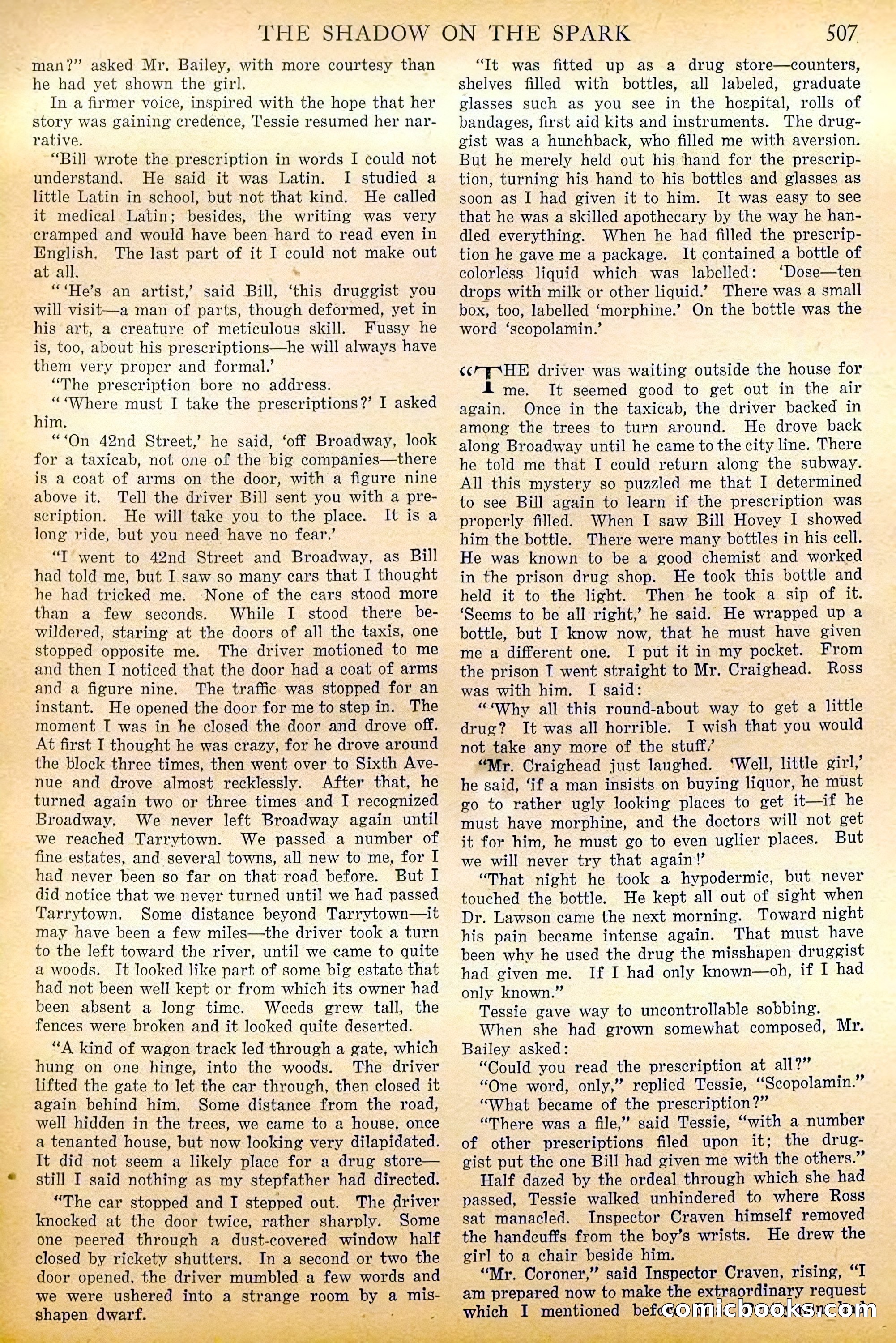
A restored page from Pulp Fiction, 1927. Page through the whole issue in the reader above.
📄 Transcribed text from this page (OCR, searchable)
Machine-transcribed from the original scan — historical spelling and the odd misread are preserved.
at @i THE SHADOW ON THE SPARK man?” asked Mr, Bailey, with more courtesy than he had yet shown the girl. In a firmer voice, inspired with the hope that her story was gaining credence, Tessie resumed her nar- rative. “Bill wrote the prescription in words I could not understand. He said it was Latin. I studied a little Latin in school, but not that kind. He called it medical Latin; besides, the writing was very eramped and would have been hard to read even in English, The last part of it I could not make out at all. % “‘We’s an artist,’ said Bill, ‘this druggist you will visit—a man of parts, though deformed, yet in his art, a creature of meticulous skill. Fussy he is, too, about his prescriptions—he will always have them very proper and formal.’ “The prescription bore no address. “‘Where must I take the prescriptions?’ I asked him. “‘On 42nd Street,’ he said, ‘off Broadway, look for a taxicab, not one of the big companies—there is a coat of arms on the door, with a figure nine above it. Tell the driver Bill sent you with a pre- scription. He will take you to the place. It is a Jong ride, but you need have no fear.’ “T went to 42nd Street and Broadway, as Bill had told me, but I saw so many cars that I thought he had tricked me. None of the cars stood more than a few seconds. While I stood there be- wildered, staring at the doors of all the taxis, one stopped opposite me. The driver motioned to me and then I noticed that the door had a coat of arms and a figure nine. The traffic was stopped for an instant. He opened the door for me to step in. The moment I was in he closed the door and drove off. At first I thought he was crazy, for he drove around the Block three times, then went over to Sixth Ave- nue and drove almost recklessly. After that, he turned again two or three times and I recognized Broadway, We never left Broadway again until we reached Tarrytown. We passed a number of fine estates, and several towns, all new to me, for I had never been so far on that road before. But I did notice that we never turned until we had passed Tarrytown. Some distance beyond Tarrytown—it may have been a few miles—the driver took a turn to the left toward the river, until we came to quite a woods. It looked like part of some big estate that had not been well kept or from which its owner had been absent a long time. Weeds grew tall, the fences were broken and it looked quite deserted. “A kind of wagon track led through a gate, which hung on one hinge, into the woods. The driver lifted the gate to let the car through, then closed it again behind him. Some distance from the road, well hidden in the trees, we came to a house, once a tenanted house, but now looking very dilapidated. It did not seem a likely place for a drug store— still I said nothing as my stepfather had directed. “The car stopped and I stepped out. The driver ~ Imocked at the door twice, rather sharply. Some one peered through a dust-covered window half closed by rickety shutters. In a second or two the door opened, the driver mumbled a few words and we were ushered into a strange room by a mis- s dwarf. aes ee 507 “Tt was fitted up as a drug store—counters, shelves filled with bottles, all labeled, graduate glasses such as you see in the hogpital, rolls of bandages, first aid kits and instruments. The drug- gist was a hunchback, who filled me with aversion. But he merely held out his hand for the prescrip- tion, turning his hand to his bottles and glasses as soon as I had given it to him. It was easy to see that he was a skilled apothecary by the way he han- dled everything. When he had filled the prescrip- tion he gave me a package. It contained a bottle of colorless liquid which was labelled: ‘Dose—ten drops with milk or other liquid” There was a small box, too, labelled ‘morphine.’ On the bottle was the word ‘scopolamin.’ (CFAPHE driver was waiting outside the house for 4 me. It seemed good to get out in the air again. Once in the taxicab, the driver backed in among the trees to turn around. He drove back along Broadway until he came to the city line. There he told me that I could return along the subway. All this mystery so puzzled me that I determined to see Bill again to learn if the prescription was properly filled. When I saw Bill Hovey I showed him the bottle. There were many bottles in his cell. He was known to be a good chemist and worked in the prison drug shop. He took this bottle and held it to the light. Then he took a sip of it. ‘Seems to be all right,’ he said. He wrapped up a bottle, but I know now, that he must have given me a different one. I put it in my pocket. From the prison I went straight to Mr. Craighead. Ross was with him. I said: “Why all this round-about way to get a little drug? It was all horrible. I wish that you would not take any more of the stuff? “Mr. Craighead just laughed. ‘Well, little girl,’ he said, ‘if a man insists on buying liquor, he must go to rather ugly looking places to get it—if he must have morphine, and the doctors will not get it for him, he must go to even uglier places. But we will never try that again!’ “That night he took a hypodermic, but never touched the bottle. He kept all out of sight when Dr. Lawson came the next morning. Toward night his pain became intense again. That must have been why he used the drug the misshapen druggist had given me. If I had only known—oh, if I had only known.” Tessie gave way to uncontrollable sobbing. When she had grown somewhat composed, Mr. Bailey asked: “Could you read the prescription at all?” “One word, only,” replied Tessie, “Scopolamin.” ‘What became of the prescription?” “There was a file,” said Tessie, “with a number of other prescriptions filed upon it; the drug- gist put the one Bill had given me with the others.” Half dazed by the ordeal through which she had passed, Tessie walked unhindered to where Ross sat manacled. Inspector Craven himself removed the handcuffs from the boy’s wrists. He drew the girl to a chair beside him. ‘Mr, Coroner,” said Inspector Craven, rising, “I m prepared now to make the extraordinary request which I mentio OMTCEDOO. is