
Pulp Fiction, 1928 · page 25 of 99
Amazing Stories — page 25: what you’re looking at
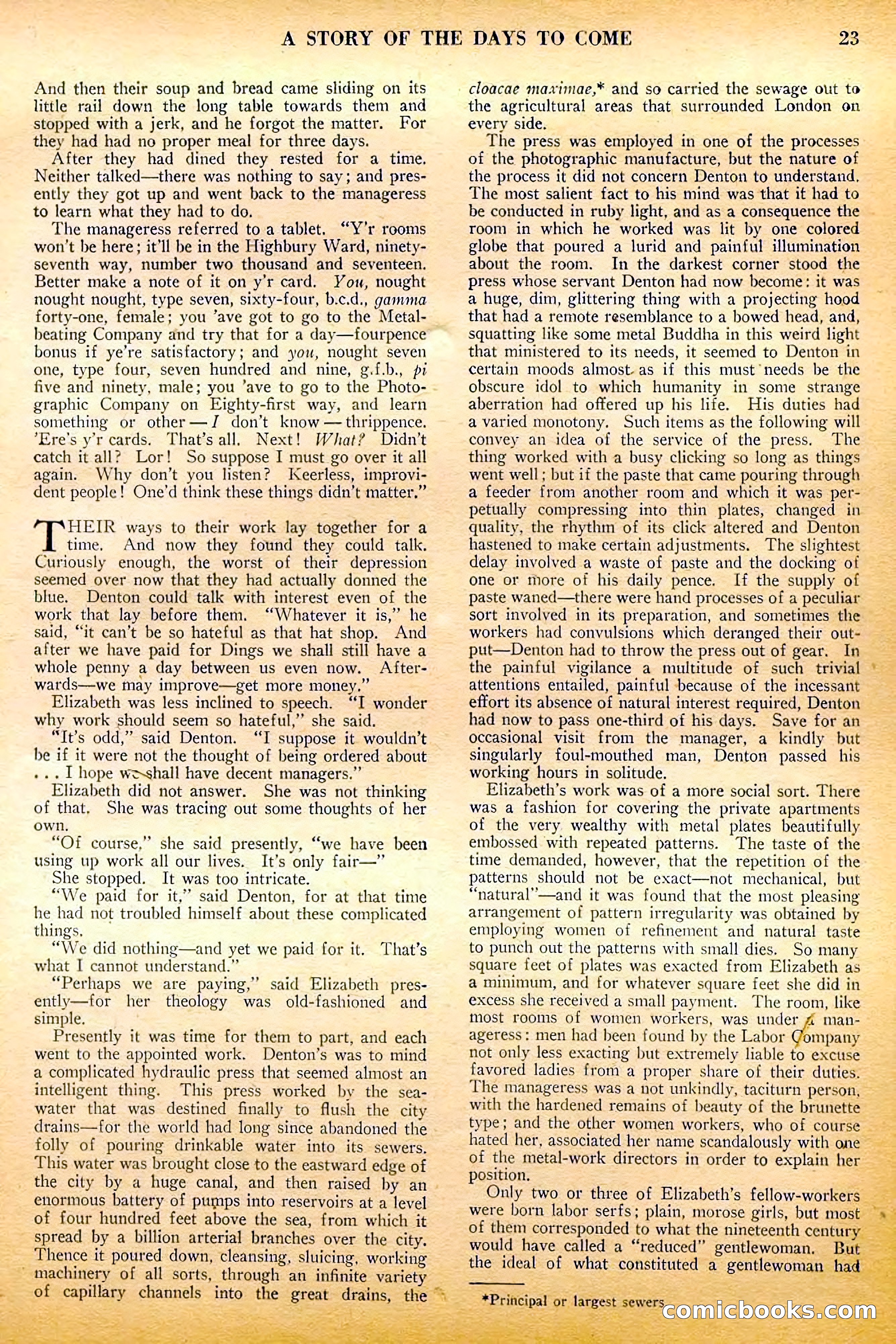
A restored page from Pulp Fiction, 1928. Page through the whole issue in the reader above.
📄 Transcribed text from this page (OCR, searchable)
Machine-transcribed from the original scan — historical spelling and the odd misread are preserved.
_— i ee ae arene om te 4 And then their soup and bread came sliding on its little rail down the long table towards them and stopped with a jerk, and he forgot the matter. For they had had no proper meal for three days. After they had dined they rested for a time. Neither talked—there was nothing to say; and pres- ently they got up and went back to the manageress to learn what they had to do, The manageress referred toa tablet. “Y’r rooms won't be here; it'll be in the Highbury Ward, ninety- seventh way, number two thousand and seventeen. Better make a note of it on y’'r card. You, nought nought nought, type seven, sixty-four, b.c.d., gamma forty-one, female; you ’ave got to go to the Metal- beating Company and try that for a day—fourpence bonus if ye’re satisfactory; and you, nought seven one, type four, seven hundred and nine, g.f.b., pi five and ninety, male; you ’ave to go to the Photo- graphic Company on Eighty-first way, and learn something or other—J don’t know —thrippence. *Ere’s y'r cards. That’s all. Next! What? Didn't catch it all? Lor! So suppose I must go over it all again. Why don’t you listen? Keerless, improvi- dent people! One’d think these things didn’t matter.” HEIR ways to their work lay together for a time. And now they found they could talk. Curiously enough, the worst of their depression seemed over now that they had actually donned the blue. Denton could talk with interest even of the work that lay before them. “Whatever it is,” he said, “it can’t be so hateful as that hat shop. And after we have paid for Dings we shall still have a whole penny a day between us even now. Ajfter- wards—we may improve—get more money,” Elizabeth was less inclined to speech. “I wonder why work should seem so hateful,’’ she said. “It’s odd,” said Denton. “I suppose it wouldn’t be if it were not the thought of being ordered about .. + T hope weshall have decent managers.” Elizabeth did not answer. She was not thinking of that, She was tracing out some thoughts of her own. “Of course,” she said presently, “we have been using up work all our lives. It’s only fair—” She stopped. It was too intricate. “We paid for it,” said Denton, for at that time he had not troubled himself about these complicated things, “We did nothing—and yet we paid for it. That’s what I cannot understand.” “Perhaps we are paying,” said Elizabeth pres- ently—for her theology was old-fashioned and simple. Presently it was time for them to part, and each went to the appointed work. Denton’s was to mind a complicated hydraulic press that seemed almost an intelligent thing. This press worked by the sea- water that was destined finally to flush the city drains—for the world had long since abandoned the folly of pouring drinkable water into its sewers. This water was brought close to the eastward edge of the city by a huge canal, and then raised by an. enormous battery of pumps into reservoirs at a level of four hundred feet above the sea, from which it - spread by a billion arterial branches over the city. Thence it poured down, cleansing, sluicing, working machinery of all sorts, through an infinite variety — nnels into the great md in — o — A STORY OF THE DAYS TO COME rains, the > - 7 se cloacae maxiniae,* and so carried the sewage out to the agricultural areas that surrounded London on every side. The press was employed in one of the processes of the photographic manufacture, but the nature of the process it did not concern Denton to understand, The most salient fact to his mind was that it had to be conducted in ruby light, and as a consequence the ~ room in which he worked was lit by one colored globe that poured a lurid and painful illumination about the room. In the darkest corner stood the press whose servant Denton had now become: it was a huge, dim, glittering thing with a projecting hood that had a remote resemblance to a bowed head, and, squatting like some metal Buddha in this weird light that ministered to its needs, it seemed to Denton in certain moods almost as if this must needs be the obscure idol to which humanity in some strange aberration had offered up his life. His duties had a varied monotony. Such items as the following will convey an idea of the service of the press. The thing worked with a busy clicking so long as things went well; but if the paste that came pouring through a feeder from another room and which it was per- petually compressing into thin plates, changed in quality, the rhythm of its click altered and Denton hastened to make certain adjustments. The slightest delay involved a waste of paste and the docking of one or more of his daily pence. If the supply of paste waned—there were hand processes of a peculiar sort involved in its preparation, and sometimes the — workers had convulsions which deranged their out- = put—Denton had to throw the press out of gear. In the painful vigilance a multitude of such trivial © ae - += a is oe attentions entailed, painful because of the incessant — effort its absence of natural interest required, Denton had now to pass one-third of his days. Save for an occasional visit from the manager, a kindly but singularly foul-mouthed man, Denton passed his working hours in solitude. : Elizabeth’s work was of a more social sort. There was a fashion for covering the private apartments of the very wealthy with metal plates beautifully embossed with repeated patterns. The taste of the time demanded, however, that the repetition of the patterns should not be exact—not mechanical, but “natural”—and it was found that the most pleasing arrangement of pattern irregularity was obtained by employing women of refinement and natural taste to punch out the patterns with small dies. So many square feet of plates was exacted from Elizabeth as a minimum, and for whatever square feet she did in excess she received a small payment. The room, like most rooms of women workers, was under A man- ageress: men had been found by the Labor pment not only less exacting but extremely liable to excuse favored ladies from a proper share of their duties. The manageress was a not unkindly, taciturn person, with the hardened remains of beauty of the brunette — type; and the other women workers, who of course — hated her, associated her name scandalously with one of the metal-work directors in order to explain her — position. : a Only two or three of Elizabeth’s fellow-workers were born labor serfs; plain, morose girls, but most of them corresponded to what the nineteenth century would have called a “reduced” gentlewoman. — the ideal of what constituted a gentlewo “ faith — a