
Pulp Fiction, 1928 · page 26 of 99
Amazing Stories — page 26: what you’re looking at
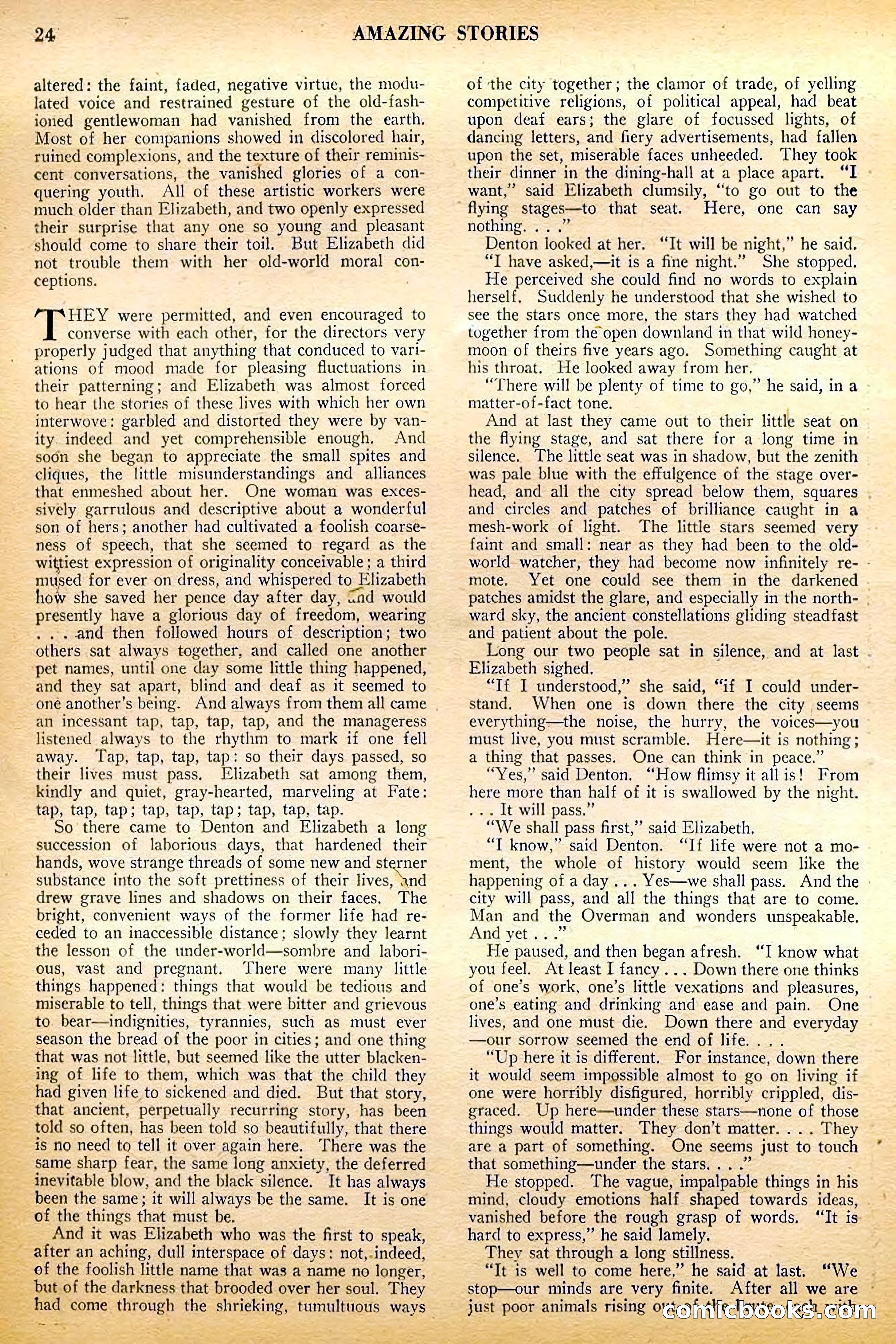
A restored page from Pulp Fiction, 1928. Page through the whole issue in the reader above.
📄 Transcribed text from this page (OCR, searchable)
Machine-transcribed from the original scan — historical spelling and the odd misread are preserved.
24 altered: the faint, faded, negative virtue, the modu- lated voice and restrained gesture of the old-fash- ioned gentlewoman had vanished from the earth. Most of her companions showed in discolored hair, ruined complexions, and the texture of their reminis- cent conversations, the vanished glories of a con- quering youth. All of these artistic workers were much older than Elizabeth, and two openly expressed their surprise that any one so young and pleasant should come to share their toil. But Elizabeth did not trouble them with her old-world moral con- ceptions. HEY were permitted, and even encouraged to converse with each other, for the directors very properly judged that anything that conduced to vari- ations of mood made for pleasing fluctuations in their patterning; and Elizabeth was almost forced to hear the stories of these lives with which her own interwove: garbled and distorted they were by van- ity. indeed and yet comprehensible enough. And soén she began to appreciate the small spites and cliques, the little misunderstandings and alliances that enmeshed about her. One woman was exces- sively garrulous and descriptive about a wonderful son of hers; another had cultivated a foolish coarse- ness of speech, that she seemed to regard as the wittiest expression of originality conceivable; a third mused for ever on dress, and whispered to Elizabeth how she saved her pence day after day, nd would presently have a glorious day of freedom, wearing ... and then followed hours of description; two others sat always together, and called one another ‘pet names, until one day some little thing happened, and they sat apart, blind and deaf as it seemed to oné another’s being. And always from them all came an incessant tap, tap, tap, tap, and the manageress listened always to the rhythm to mark if one fell away. Tap, tap, tap, tap: so their days passed, so their lives must pass. Elizabeth sat among them, kindly and quiet, gray-hearted, marveling at Fate: tap, tap, tap; tap, tap, tap; tap, tap, tap. So there came to Denton and Elizabeth a long succession of laborious days, that hardened their hands, wove strange threads of some new and sterner substance into the soft prettiness of their lives, and drew grave lines and shadows on their faces. The bright, convenient ways of the former life had re- ceded to an inaccessible distance; slowly they learnt the lesson of the under-world—sombre and labori- ous, vast and pregnant. There were many little things happened: things that would be tedious and miserable to tell, things that were bitter and grievous to bear—indignities, tyrannies, such as must ever season the bread of the poor in cities; and one thing that was not little, but seemed like the utter blacken- ing of life to them, which was that the child they had given life to sickened and died. But that story, that ancient, perpetually recurring story, has been told so often, has been told so beautifully, that there is no need to tell it over again here. There was the same sharp fear, the same long anxiety, the deferred inevitable blow, and the black silence. It has always been the same; it will always be the same. It is one ‘flying stages—to that seat. AMAZING STORIES of the city together; the clamor of trade, of yelling competitive religions, of political appeal, had beat upon deaf ears; the glare of focussed lights, of dancing letters, and fiery advertisements, had fallen upon the set, miserable faces unheeded. ‘They took their dinner in the dining-hall at a place apart. “TI - want,” said Elizabeth clumsily, “to go out to the Here, one can say nothing. .. .” Denton looked at her. “It will be night,” he said. “T have asked,—it is a fine night.” She stopped. He perceived she could find no words to explain herself, Suddenly he understood that she wished to see the stars once more, the stars they had watched together from the open downland in that wild honey- moon of theirs five years ago. Something caught at his throat. He looked away from her. “There will be plenty of time to go,” he said, ina matter-of-fact tone. And at last they came out to their little seat on the flying stage, and sat there for a long time in silence. The little seat was in shadow, but the zenith was pale blue with the effulgence of the stage over- head, and all the city spread below them, squares . and circles and patches of brilliance caught in a mesh-work of light. The little stars seemed very faint and small: near as they had been to the old- world watcher, they had become now infinitely re- - mote. Yet one could see them in the darkened patches amidst the glare, and especially in the north- . ward sky, the ancient constellations gliding steadfast and patient about the pole. Long our two people sat in silence, and at last . Elizabeth sighed. “Tf I understood,” she said, “if I could under- stand. When one is down there the city seems everything—the noise, the hurry, the voices—you must live, you must scramble. Here—it is nothing; a thing that passes. One can think in peace.” “Yes,” said Denton. “How flimsy it all is! From here more than half of it is swallowed by the night. . + It will pass.” “We shall pass first,” said Elizabeth. “T know,” said Denton. “If life were not a mo- ment, the whole of history would seem like the happening of a day .. . Yes—we shall pass. And the » city will pass, and all the things that are to come. Man and the Overman and wonders unspeakable, And yet...” : He paused, and then began afresh, “I know what you feel. Atleast I fancy ... Down there one thinks of one’s work, one’s little vexations and pleasures, one’s eating and drinking and ease and pain. One lives, and one must die. Down there and everyday —our sorrow seemed the end of life... “Up here it is different. For instance, down there it would seem impossible almost to go on living if one were horribly disfigured, horribly crippled, dis- graced. Up here—under these stars—none of those things would matter. They don’t matter... . They are a part of something. One seems just to touch that something—under the stars. . . .” He stopped. The vague, impalpable things in hi = mind, cloudy emotions half shaped towards ideas, of the things that must be. vanished before the rough grasp of words. “It is. ¥ And it was Elizabeth who was the first to speak, hard to express,” he said lamely. _ after an aching, dull interspace of days: not,-indeed, They sat through a long stillness. _ of the foolish little name that was a name no longer, “It is well to come here,” he said at last. “We but of the darkness that brooded over her soul. They stop—our minds are very finite. After all we are © _ had come through the shrieking, tumultuous ways et Hn ee just poor animals rising opznt be lastel eh ie —~ - aoe = —— . Se —" a antl ow = lh = ~ == a ae EN Pe nea si Gong Do a ae I mh ee a Pm * eames ae a ee ~ 4 w ~ a as =—y ft en Tea