
Pulp Fiction, 1928 · page 32 of 99
Amazing Stories — page 32: what you’re looking at
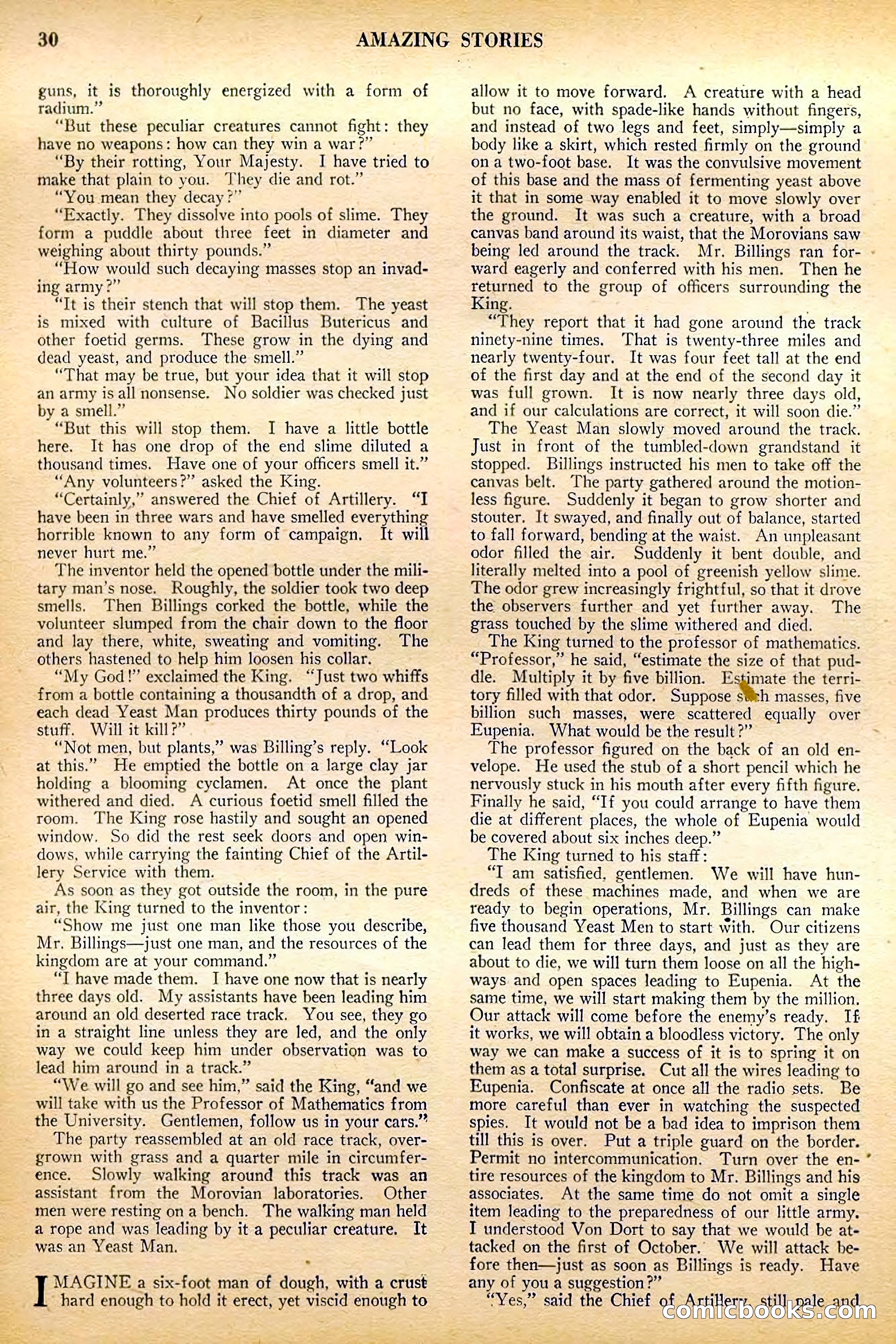
A restored page from Pulp Fiction, 1928. Page through the whole issue in the reader above.
📄 Transcribed text from this page (OCR, searchable)
Machine-transcribed from the original scan — historical spelling and the odd misread are preserved.
> —, 30 AMAZING STORIES guns, it is thoroughly energized with a form of radium.” “But these peculiar creatures cannot fight: they have no weapons: how can they win a war?” “By their rotting, Your Majesty. I have tried to make that plain to you. They die and rot.” “You mean they decay?” “Exactly. They dissolve into pools of slime. They form a puddle about three feet in diameter and weighing about thirty pounds.” “How would such decaying masses stop an invad- ing army?” “Tt is their stench that will stop them. The yeast is mixed with culture of Bacillus Butericus and other foetid germs. These grow in the dying and dead yeast, and produce the smell.” “That may be true, but your idea that it will stop an army is all nonsense. No soldier was checked just by:a smell? “But this will stop them. I have a little bottle here. It has one drop of the end slime diluted a thousand times. Have one of your officers smell it.” “Any volunteers?” asked the King. “Certainly,” answered the Chief of Artillery. “I have been in three wars and have smelled everything horrible known to any form of campaign. It will never hurt me.” The inventor held the opened bottle under the mili- tary man’s nose. Roughly, the soldier took two deep smells. Then Billings corked the bottle, while the volunteer slumped from the chair down to the floor and lay there, white, sweating and vomiting. The others hastened to help him loosen his collar. “My God!” exclaimed the King. “Just two whiffs from a bottle containing a thousandth of a drop, and each dead Yeast Man produces thirty pounds of the stuff. Will it kill?” “Not men, but plants,” was Billing’s reply. “Look at this.” He emptied the bottle on a large clay jar holding a blooming cyclamen. At once the plant withered and died. A curious foetid smell filled the room. The King rose hastily and sought an opened window. So did the rest seek doors and open win- dows, while carrying the fainting Chief of the Artil- lery Service with them. As soon as they got outside the room, in the pure air, the King turned to the inventor: “Show me just one man like those you describe, Mr. Billings—just one man, and the resources of the kingdom are at your command.” “I have made them. I have one now that is nearly three days old. My assistants have been leading him around an old deserted race track. You see, they go in a straight line unless they are led, and the only way we could keep him under observation was to lead him around in a track.” “We will go and see him,” said the King, “and we will take with us the Professor of Mathematics from the University. Gentlemen, follow us in your cars.” The party reassembled at an old race track, over- grown with grass and a quarter mile in circumfer- ence. Slowly walking around this track was an assistant from the Morovian laboratories. Other men were resting ona bench. The walking man held a rope and was leading by it a peculiar creature. It was an Yeast Man. MAGINE a six-foot man of dough, with a crust . hard enough to hold it erect, yet viscid enough to 7% a allow it to move forward. A creature with a head but no face, with spade-like hands without fingers, and instead of two legs and feet, simply—simply a body like a skirt, which rested firmly on the ground ona two-foot base. It was the convulsive movement of this base and the mass of fermenting yeast above it that in some way enabled it to move slowly over the ground. It was such a creature, with a broad canvas band around its waist, that the Morovians saw being led around the track. Mr. Billings ran for- - ward eagerly and conferred with his men. Then he penis to the group of officers surrounding the ing. : “They report that it had gone around the track ninety-nine times. That is twenty-three miles and nearly twenty-four. It was four feet tall at the end of the first day and at the end of the second day it was full grown. It is now nearly three days old, and if our calculations are correct, it will soon die.” The Yeast Man slowly moved around the track. Just in front of the tumbled-down grandstand it stopped. Billings instructed his men to take off the canvas belt. The party gathered around the motion- less figure. Suddenly it began to grow shorter and stouter. It swayed, and finally out of balance, started to fall forward, bending at the waist. An unpleasant odor filled the air. Suddenly it bent double, and literally melted into a pool of greenish yellow slime. The odor grew increasingly frightful, so that it drove the observers further and yet further away. The grass touched by the slime withered and died. The King turned to the professor of mathematics. “Professor,” he said, “estimate the size of that pud- dle. Multiply it by five billion. Estimate the terri- tory filled with that odor. Suppose s@eh masses, five billion such masses, were scattered equally over Eupenia. What would be the result ?” The professor figured on the back of an old en- velope. He used the stub of a short pencil which he nervously stuck in his mouth after every fifth figure. Finally he said, “If you could arrange to have them die at different places, the whole of Eupenia would be covered about six inches deep.” The King turned to his staff: “I am Satisfied, gentlemen. We will have hun- dreds of these machines made, and when we are ready to begin operations, Mr. Billings can make five thousand Yeast Men to start with. Our citizens can lead them for three days, and just as they are about to die, we will turn them loose on all the high- ways. and open spaces leading to Eupenia. At the same time, we will start making them by the million. Our attack will come before the enemy’s ready. If it works, we will obtain a bloodless victory. The only way we can make a success of it is to spring it on them as a total surprise. Cut all the wires leading to Eupenia. Confiscate at once all the radio sets. Be more careful than ever in watching the suspected spies. It would not be a bad idea to imprison them till this is over. Put a triple guard on the border. Permit no intercommunication. Turn over the en- tire resources of the kingdom to Mr. Billings and his associates. At the same time do not omit a single item leading to the preparedness of our little army. I understood Von Dort to say that we would be at- tacked on the first of October. We will attack be- fore then—just as soon as Billings is ready. Have any of you a suggestion?” a said the Chief of Arttert stilliaale and