
Pulp Fiction, 1928 · page 33 of 99
Amazing Stories — page 33: what you’re looking at
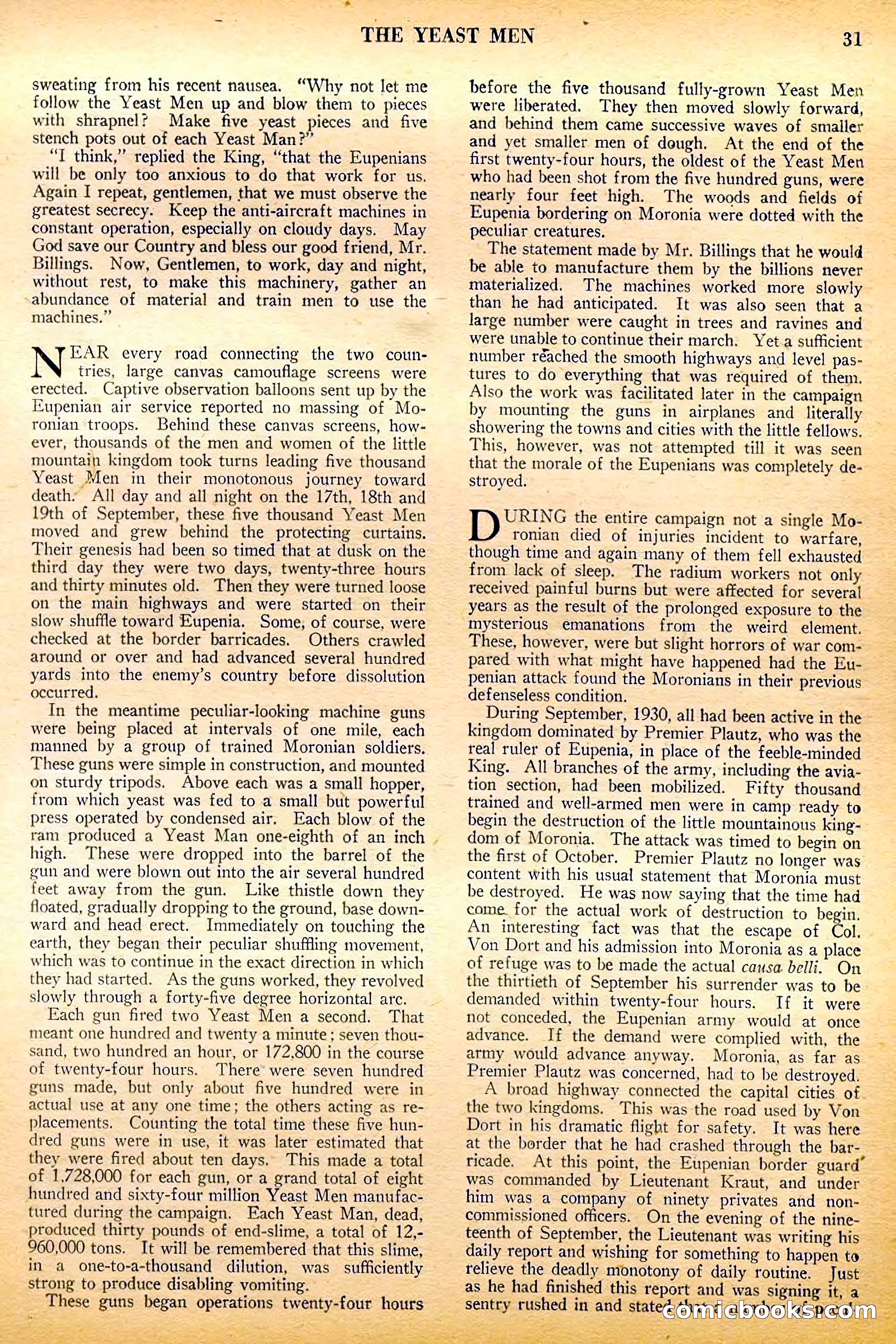
A restored page from Pulp Fiction, 1928. Page through the whole issue in the reader above.
📄 Transcribed text from this page (OCR, searchable)
Machine-transcribed from the original scan — historical spelling and the odd misread are preserved.
sweating from his recent nausea. “Why not Jet me follow the Yeast Men up and blow them to pieces with shrapnel? Make five yeast pieces and five stench pots out of each Yeast Man?” “I think,” replied the King, “that the Eupenians will be only too anxious to do that work for us. Again I repeat, gentlemen, that we must observe the greatest secrecy. Keep the anti-aircraft machines in constant operation, especially on cloudy days. May God save our Country and bless our good friend, Mr. Billings. Now, Gentlemen, to work, day and night, without rest, to make this machinery, gather an sabundance of material and train men to use the machines.” EAR every road connecting the two coun- N tries, large canvas camouflage screens were erected. Captive observation balloons sent up by the Eupenian air service reported no massing of Mo- ronian troops. Behind these canvas screens, how- ever, thousands of the men and women of the little mountain kingdom took turns leading five thousand Yeast Men in their monotonous journey toward death. All day and all night on the 17th, 18th and 19th of September, these five thousand Yeast Men moved and grew behind the protecting curtains. Their genesis had been so timed that at dusk on the third day they were two days, twenty-three hours and thirty minutes old. Then they were turned loose on the main highways and were started on their slow shuffle toward Eupenia. Some, of course, were checked at the border barricades. Others crawled around or over and had advanced several hundred yards into the enemy’s country before dissolution occurred. In the meantime peculiar-looking machine guns were being placed at intervals of one mile, each manned by a group of trained Moronian soldiers. These guns were simple in construction, and mounted on sturdy tripods. Above each was a small hopper, from which yeast was fed to a small but powerful press operated by condensed air. Each blow of the ram produced a Yeast Man one-eighth of an inch | high. These were dropped into the barrel of the gun and were blown out into the air several hundred feet away from the gun. Like thistle down they floated, gradually dropping to the ground, base down- ward and head erect. Immediately on touching the earth, they began their peculiar shuffling movement, which was to continue in the exact direction in which they had started. As the guns worked, they revolved slowly through a forty-five degree horizontal are. Each gun fired two Yeast Men a second. That meant one hundred and twenty a minute; seven thou- sand, two hundred an hour, or 172,800 in the course of twenty-four hours. There’ were seven hundred guns made, but only about five hundred were in actual use at any one time; the others acting as re- placements. Counting the total time these five hun- dred guns were in use, it was later estimated that they were fired about ten days. This made a total of 1,728,000 for each gun, or a grand total of eight hundred and sixty-four million Yeast Men manufac- tured during the campaign. Each Yeast Man, dead, produced thirty pounds of end-slime, a total of 12,- 960,000 tons. It will be remembered that this slime, in a one-to-a-thousand dilution, was sufficiently strong to produce disabling vomiting. These guns began operations twenty-four h ours es — sentry” rushed in ~ ae x nee ote THE YEAST MEN 31 before the five thousand fully-grown Yeast Men were liberated. They then moved slowly forward, and behind them came successive waves of smaller and yet smaller men of dough. At the end of the first twenty-four hours, the oldest of the Yeast Men who had been shot from the five hundred guns, were nearly four feet high. The woods and fields of Eupenia bordering on Moronia were dotted with the peculiar creatures. The statement made by Mr. Billings that he would be able to manufacture them by the billions never materialized. The machines worked more slowly than he had anticipated. It was also seen that a large number were caught in trees and ravines and were unable to continue their march. Yet.a sufficient number réached the smooth highways and level pas- tures to do everything that was required of them. Also the work was facilitated later in the campaign by mounting the guns in airplanes and literally showering the towns and cities with the little fellows. This, however, was not attempted till it was seen that the morale of the Eupenians was completely de- stroyed. De G the entire campaign not a single Mo- ronian died of injuries incident to warfare, though time and again many of them fell exhausted from lack of sleep. The radium workers not only received painful burns but were affected for several years as the result of the prolonged exposure to the mysterious emanations from the weird element. These, however, were but slight horrors of war com- pared with what might have happened had the Eu- penian attack found the Moronians in their previous defenseless condition. - During September, 1930, all had been active in the — kingdom dominated by Premier Plautz, who was the real ruler of Eupenia, in place of the feeble-minded King. All branches of the army, including the avia- tion section, had been mobilized. Fifty thousand trained and well-armed men were in camp ready to begin the destruction of the little mountainous king- dom of Moronia. The attack was timed to begin on the first of October. Premier Plautz no longer was content with his usual statement that Moronia must be destroyed. He was now saying that the time had come. for the actual work of destruction to begin. An interesting fact was that the escape of Col. Von Dort and his admission into Moronia as a place of refuge was to be made the actual causa belli. On the thirtieth of September his surrender was to be demanded within twenty-four hours. If it were not conceded, the Eupenian army would at once advance. If the demand were complied with, the army would advance anyway. Moronia, as far as Premier Plautz was concerned, had to be destroyed. A broad highway connected the capital cities of. the two kingdoms. This was the road used by Von Dort in his dramatic flight for safety. It was here at the border that he had crashed through the bar- ricade. At this point, the Eupenian border guard was commanded by Lieutenant Kraut, and under him was a company of ninety privates and non- commissioned officers. On the evening of the nine- teenth of September, the Lieutenant was writing his’ daily report and wishing for something to happen to __ relieve the deadly monotony of daily routine. Just as he had finished this report and was signing es “ Mee.