
Pulp Fiction, 1928 · page 35 of 99
Amazing Stories — page 35: what you’re looking at
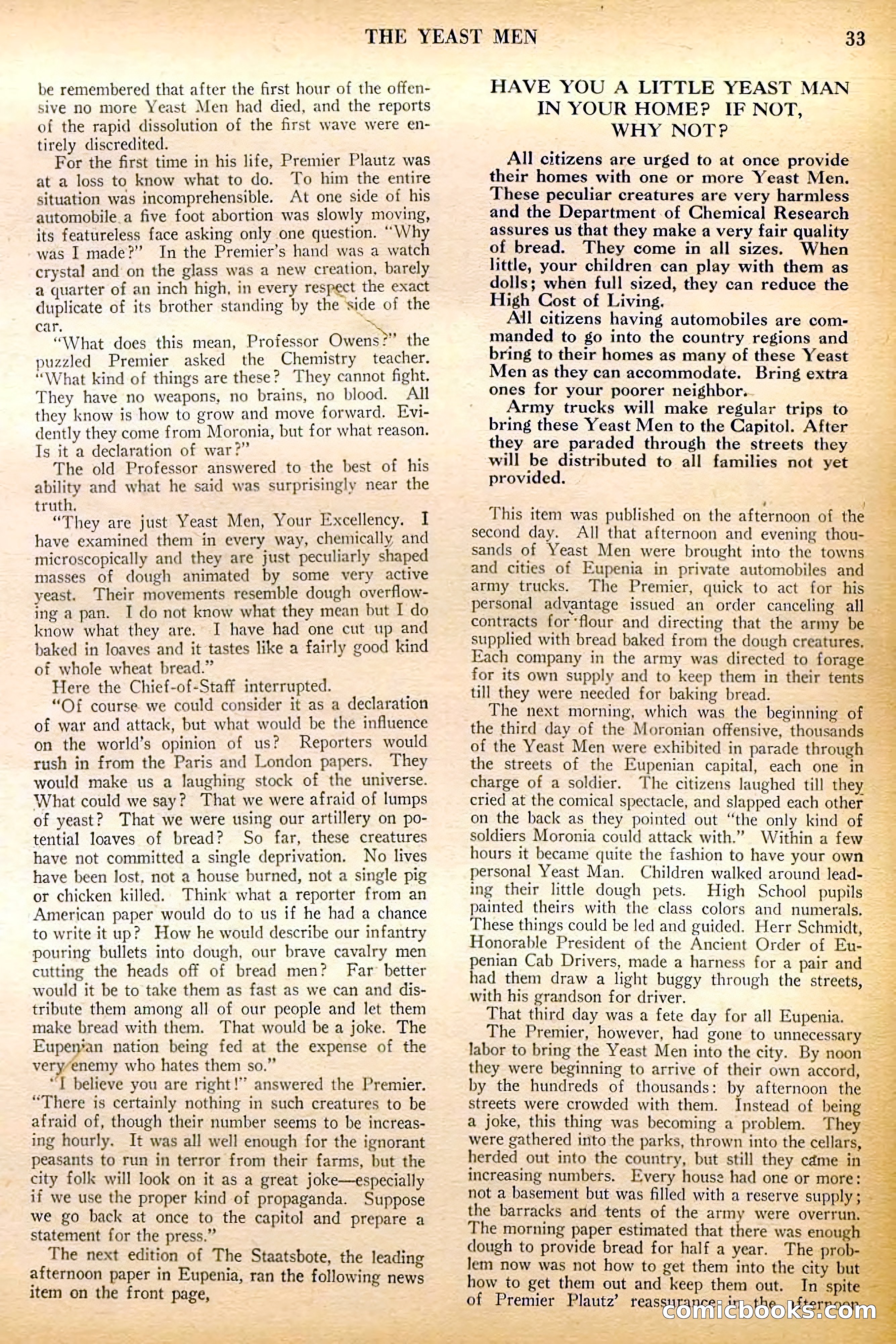
A restored page from Pulp Fiction, 1928. Page through the whole issue in the reader above.
📄 Transcribed text from this page (OCR, searchable)
Machine-transcribed from the original scan — historical spelling and the odd misread are preserved.
‘. sh ee THE YEAST MEN 33 be remembered that after the first hour of the offen- sive no more Yeast Men had died, and the reports of the rapid dissolution of the first wave were en- tirely discredited. For the first time in his life, Premier Plautz was at a loss to know what to do. To him the entire situation was incomprehensible. At one side of his automobile.a five foot abortion was slowly moving, its featureless face asking only one question. “Why was I made?” In the Premier’s hand was a watch crystal and on the glass was a new creation, barely a quarter of an inch high, in every respect the exact duplicate of its brother standing by the side of the car. “What does this mean, Professor Owens?” the puzzled Premier asked the Chemistry teacher. “What kind of things are these? They cannot fight. They have no weapons, no brains, no blood. All they know is how to grow and move forward. Evi- dently they come from Moronia, but for what reason. Is it a declaration of war?” The old Professor answered to the best of his ability and what he said was surprisingly near the truth. 2 “They are just Yeast Men, Your Excellency. I have examined them in every way, chemically and microscopically and they are just peculiarly shaped masses of dough animated by some very active yeast. Their movements resemble dough overflow- ing a pan. I do not know what they mean but I do know what they are. I have had one cut up and baked in loaves and it tastes like a fairly good kind of whole wheat bread.” Here the Chief-of-Staff interrupted. “Of course we could consider it as a declaration of war and attack, but what would be the influence on the world’s opinion of us? Reporters would rush in from the Paris and London papers. They would make us a laughing stock of the universe. What could we say? That we were afraid of lumps of yeast? That we were using our artillery on po- tential loaves of bread? So far, these creatures have not committed a single deprivation. No lives have been lost, not a house burned, not a single pig or chicken killed. Think what a reporter from an American paper would do to us if he had a chance to write it up? How he would describe our infantry pouring bullets into dough, our brave cavalry men cutting the heads off of bread men? Far better would it be to take them as fast as we can and dis- tribute them among all of our people and let them make bread with them. That would be a joke. The Eupen‘an nation being fed at the expense of the ve Wc who hates them so.” “I believe you are right!’ answered the Premier. “There is certainly nothing in such creatures to be afraid of, though their number seems to be increas- ing hourly. It was all well enough for the ignorant peasants to run in terror from their farms, but the city folk will look on it as a great joke—especially if we use the proper kind of propaganda. Suppose we go back at once to the capitol and prepare a statement for the press.” The next edition of The Staatsbote, the leading afternoon paper in Eupenia, ran the following news item on the front page, of Premier Plautz’ KS GiMIGDOoksut 2 HAVE YOU A LITTLE YEAST MAN IN YOUR HOME? IF NOT, WHY NOTP All citizens are urged to at once provide 7 their homes with one or more Yeast Men. Re. These peculiar creatures are very harmless and the Department of Chemical Research assures us that they make a very fair quality ie of bread. They come in all sizes. When = little, your children can play with them as dolls; when full sized, they can reduce the High Cost of Living. All citizens having automobiles are com- manded to go into the country regions and bring to their homes as many of these Yeast Men as they can accommodate. Bring extra ones for your poorer neighbor.. Army trucks will make regular trips to bring these Yeast Men to the Capitol. After they are paraded through the streets they will be distributed to all families not yet provided. ee fA ~ This item was published on the afternoon of the second day. All that afternoon and evening thou- sands of Yeast Men were brought into the towns and cities of Eupenia in private automobiles and army trucks. The Premier, quick to act for his personal advantage issued an order canceling all — contracts for ‘flour and directing that the army be — supplied with bread baked from the dough creatures, — Each company in the army was directed to forage | for its own supply and to keep them in their tents till they were needed for baking bread. = The next morning, which was the beginning of the third day of the Moronian offensive, thousands — of the Yeast Men were exhibited in parade through the streets of the Eupenian capital, each one in charge of a soldier. The citizens laughed till they cried at the comical spectacle, and slapped each other _ on the back as they pointed out “the only kind of soldiers Moronia could attack with.” Within a few hours it became quite the fashion to have your own personal Yeast Man. Children walked around lead- ing their little dough pets. High School pupils painted theirs with the class colors and numerals, These things could be led and guided. Herr Schmidt, Honorable President of the Ancient Order of Eu- penian Cab Drivers, made a harness for a pair and had them draw a light buggy through the streets, — with his grandson for driver. / That third day was a fete day for all Eupenia. The Premier, however, had gone to unnecessary labor to bring the Yeast Men into the city. By noon they were beginning to arrive of their own accord, by the hundreds of thousands: by afternoon the streets were crowded with them. Instead of being — a joke, this thing was becoming a problem. They — were gathered irito the parks, thrown into the cellars, herded out into the country, but still they cdme in — increasing numbers. Every house had one or more: — not a basement but was filled with a reserve supply; the barracks ard tents of the army were overrun. — The morning paper estimated that there was enough dough to provide bread for half a year. The prob- — lem now was not how to get them into the city but — how to get them out and keep them out. In spite ~ ae a ra + — is re ae ee