
Pulp Fiction, 1928 · page 36 of 99
Amazing Stories — page 36: what you’re looking at
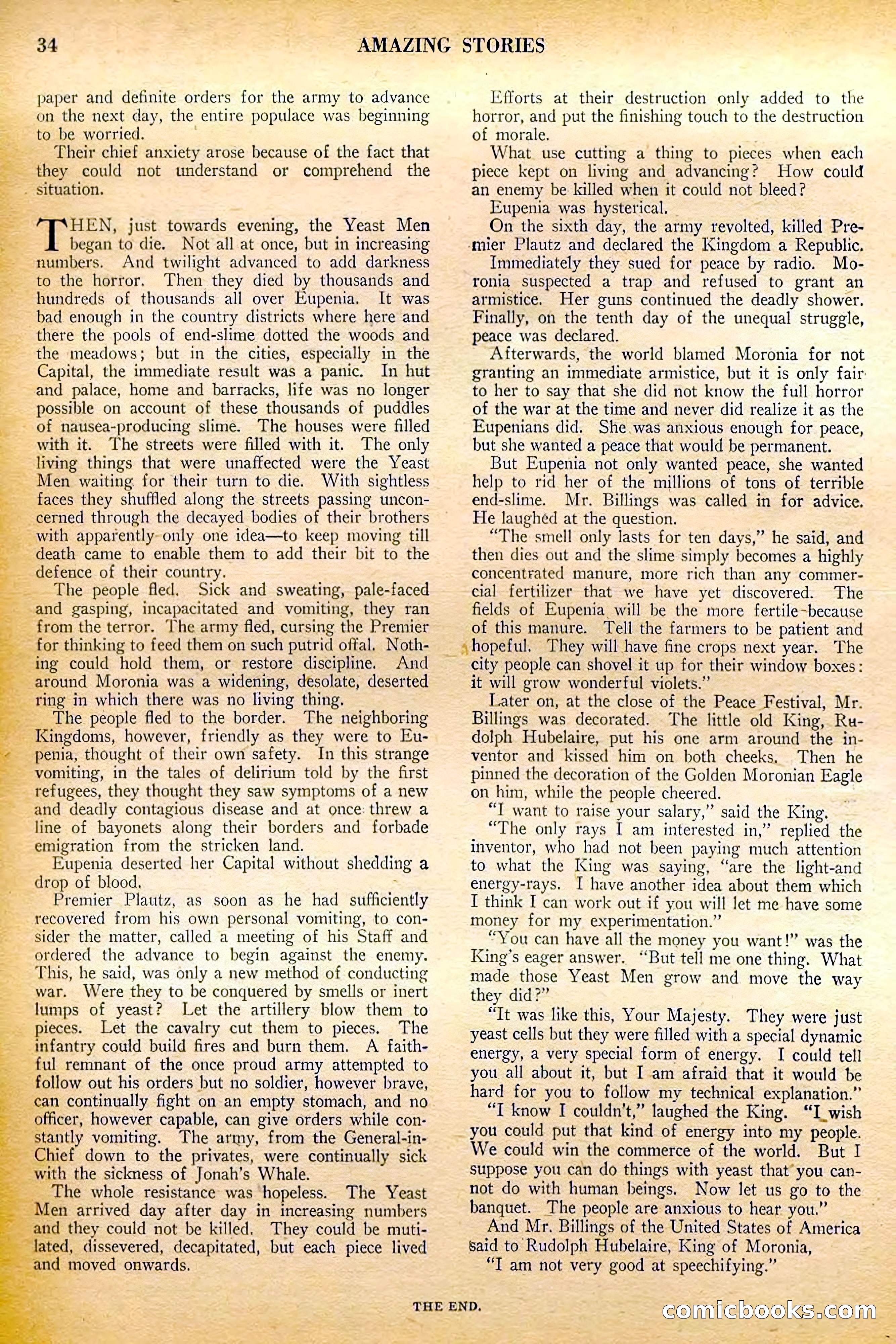
A restored page from Pulp Fiction, 1928. Page through the whole issue in the reader above.
📄 Transcribed text from this page (OCR, searchable)
Machine-transcribed from the original scan — historical spelling and the odd misread are preserved.
34 paper and definite orders for the army to advance on the next day, the entire populace was beginning to be worried. : Their chief anxiety arose because of the fact that they could not understand or comprehend the _. situation. TS HEN, just towards evening, the Yeast Men began to die. Not all at once, but in increasing numbers. And twilight advanced to add darkness to the horror. Then they died by thousands and 2 hundreds of thousands all over Eupenia. It was bad enough in the country districts where here and there the pools of end-shme dotted the woods and the meadows; but in the cities, especially in the Capital, the immediate result was a panic. In hut ; and palace, home and barracks, life was no longer __ possible on account of these thousands of puddles i: of nausea-producing slime. The houses were filled with it. The streets were filled with it. The only living things that were unaffected were the Yeast Men waiting for their turn to die. With sightless faces they shuffled along the streets passing uncon- cerned through the decayed bodies of their brothers __with apparently-only one idea—to keep moving till _ death came to enable them to add their bit to the defence of their country. The people fled, Sick and sweating, pale-faced and gasping, incapacitated and vomiting, they ran _ from the terror. The army fled, cursing the Premier for thinking to feed them on such putrid offal. Noth- - ing could hold them, or restore discipline. And around Moronia was a widening, desolate, deserted ring in which there was no living thing. The people fled to the border. The neighboring Kingdoms, however, friendly as they were to Eu- - penia, thought of their own safety. In this strange _ vomiting, in the tales of delirium told by the first _ refugees, they thought they saw symptoms of a new and deadly contagious disease and at once: threw a line of bayonets along their borders and forbade emigration from the stricken land. Eupenia deserted her Capital without shedding a drop of blood. : Premier Plautz, as soon as he had sufficiently recovered from his own personal vomiting, to con- sider the matter, called a meeting of his Staff and ordered the advance to begin against the enemy. This, he said, was only a new method of conducting war. Were they to be conquered by smells or inert lumps of yeast? Let the artillery blow them to _ pieces. Let the cavalry cut them to pieces. The _ infantry could build fires and burn them. A faith- _ ful remnant of the once proud army attempted to __ follow out his orders but no soldier, however brave, - ¢an continually fight on an empty stomach, and no fficer, however capable, can give orders while con- -stantly vomiting. The army, from the General-in- thief down to the privates, were continually sick with the sickness of Jonah’s Whale. __ The whole resistance was hopeless. The Yeast _ Men arrived day after day in increasing numbers and they could not be killed. They could be muti- lated, dissevered, decapitated, but each piece lived nd moyed onwards. Ad U2! iy ear ~~ A ae ~ ap Ae LS THE END. Re A ee A I me —. a ion AMAZING STORIES Efforts at their destruction only added to the horror, and put the finishing touch to the destruction of morale. What use cutting a thing to pieces when each piece kept on living and advancing? How could an enemy be killed when it could not bleed? Eupenia was hysterical. On the sixth day, the army revolted, killed Pre- ‘mier Plautz and declared the Kingdom a Republic. Immediately they sued for peace by radio. Mo- ronia suspected a trap and refused to grant an armistice. Her guns continued the deadly shower. Finally, on the tenth day of the unequal struggle, peace was declared. Afterwards, the world blamed Moronia for not granting an immediate armistice, but it is only fair: to her to say that she did not know the full horror of the war at the time and never did realize it as the Eupenians did. She.was anxious enough for peace, but she wanted a peace that would be permanent. But Eupenia not only wanted peace, she wanted help to rid her of the millions of tons of terrible end-slime. Mr. Billings was called in for advice. He laughed at the question. “The smell only lasts for ten days,” he said, and then dies out and the slime simply becomes a highly concentrated manure, more rich than any commer- cial fertilizer that we have yet discovered. The fields of Eupenia will be the more fertile-because of this manure. Tell the farmers to be patient and _ shopeful. They will have fine crops next year. The city people can shovel it up for their window boxes: it will grow wonderful violets.” Later on, at the close of the Peace Festival, Mr. Billings was decorated. The little old King, Ru- dolph Hubelaire, put his one arm around the in- ventor and kissed him on both cheeks. Then he pinned the decoration of the Golden Moronian Eagle on him, while the people cheered. “T want to raise your salary,” said the King. “The only rays I am interested in,” replied the Inventor, who had not been paying much attention to what the King was saying, “are the light-and energy-rays. I have another idea about them which I think I can work out if you will let me have some money for my experimentation.” “You can have all the money you want!” was the King’s eager answer. “But tell me one thing. What made those Yeast Men grow and move the way they did?” “Tt was like this, Your Majesty. They were just yeast cells but they were filled with a special dynamic energy, a very special form of energy. I could tell you all about it, but I am afraid that it would be hard for you to follow my technical explanation.” “I know I couldn't,” laughed the King. “I_wish _ you could put that kind of energy into my people. We could win the commerce of the world. But I suppose you can do things with yeast that’ you can- not do with human beings. Now let us go to the | banquet. The people are anxious to heart you.” And Mr. Billings of the United States of America said to Rudolph Hubelaire, King of Moronia, “T am not very good at speechifying.” - COMIKEOOKS.cOln