
Pulp Fiction, 1928 · page 39 of 99
Amazing Stories — page 39: what you’re looking at
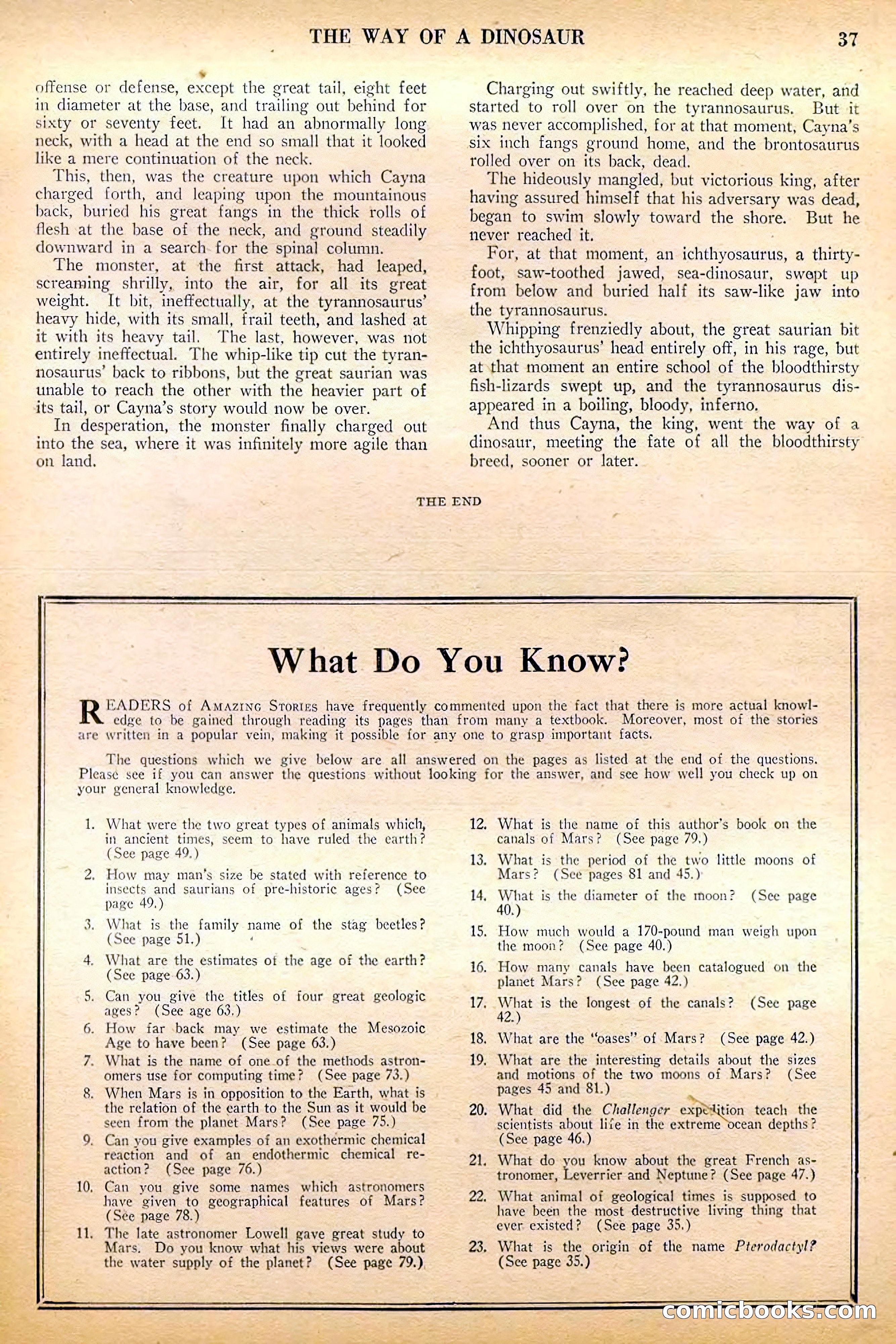
A restored page from Pulp Fiction, 1928. Page through the whole issue in the reader above.
📄 Transcribed text from this page (OCR, searchable)
Machine-transcribed from the original scan — historical spelling and the odd misread are preserved.
THE WAY OF A DINOSAUR 37 ’ offense or defense, except the great tail, eight feet in diameter at the base, and trailing out behind for sixty or seventy feet. It had an abnormally long neck, with a head at the end so small that it looked like a mere continuation of the neck. This, then, was the creature upon which Cayna charged forth, and leaping upon the mountainous back, buried his great fangs in the thick rolls of flesh at the base of the neck, and ground steadily downward in a search. for the spinal column. The monster, at the first attack, had leaped, screaming shrilly, into the air, for all its great weight. It bit, ineffectually, at the tyrannosaurus’ heavy hide, with its small, frail teeth, and lashed at it with its heavy tail. The last, however, was not entirely ineffectual. The whip-like tip cut the tyran- nosaurus’ back to ribbons, but the great saurian was unable to reach the other with the heavier part of its tail, or Cayna’s story would now be over. In desperation, the monster finally charged out into the sea, where it was infinitely more agile than on land. Charging out swiftly, he reached deep water, and started to roll over on the tyrannosaurus. But it was never accomplished, for at that moment, Cayna’s six inch fangs ground home, and the brontosaurus rolled over on its back, dead. The hideously mangled, but victorious king, after having assured himself that his adversary was dead, began to swim slowly toward the shore. But he never reached it. 7 For, at that moment, an ichthyosaurus, a thirty- foot, saw-toothed jawed, sea-dinosaur, swept up from below and buried half its saw-like jaw into the tyrannosaurus. Whipping frenziedly about, the great saurian bit the ichthyosaurus’ head entirely off, in his rage, but at that moment an entire schoo! of the bloodthirsty fish-lizards swept up, and the tyrannosaurus dis- appeared in a boiling, bloody, inferno. And thus Cayna, the king, went the way of a dinosaur, meeting the fate of all the bloodthirsty breed, sooner or later. THE END The questions which we give below are all answered on the pages as listed at the end of the questions. Please see if you can answer the questions without looking for the answer, and see how well you check up on your general knowledge. 1. What were the two great types of animals which, in ancient times, seem to have ruled the earth? (See page 49.) 2. How may man’s size be stated with reference to insects and saurians of pre-historic ages? (See page 49,) 3. What is the family name of the stag beetles? (See page 51,) ‘ 4, What are the estimates of the age of the earth? (See page 63.) 5. Can you give the titles of four great geologic awes? (See age 63,) 6. How far back may we estimate the Mesozoic Age to have been? (See page 63.) 7. What is the name of one_of the methods astron- omers use for computing time? (See page 73.) 8. When Mars is in opposition to the Earth, what is the relation of the earth to the Sun as it would be seen from the planet Mars? (See page 75.) 9. Can you give examples of an exothermic chemical reaction and of an endothermic chemical re- action? (See page 76.) 10, Can you give some names which astronomers have given to geographical features of Mars? (Sée page 78.) 11, The late astronomer Lowell gave great study to Mars. Do you know what his views were about the water supply of the planet? (See page 79.) What Do You Know? EADERS of Amazrno Stortes have frequently commented upon the fact that there is more actual knowl- edge to be gained through reading its pages than from many a textbook. Moreover, most of the stories are written in a popular vein, making it possible for any one to grasp important facts. 12. What is the name of this author’s bool on the canals of Mars? (See page 79,) 13. What is the period of the two little moons of Mars? (See pages 81 and 45.) 14, What is the diameter of the moon? (See page 40, 15. How much would a 170-pound man weigh upon the moon? (See page 40.) 16. How many canals have been catalogued on the planet Mars? (See page 42.) 17, Nel is the longest of the canals? (See page 42.) 18, What are the ‘oases’ of Mars? (See page 42.) 19, What are the interesting details about the sizes and motions of the two moons of Mars? (See pages 45 and 81.) 20. What did the Challenger expelition teach the scientists about life in the extreme ocean depths? (See page 46.) 21, What do you know about the great French as- tronomer, Leverrier and Neptune? (See page 47.) 22. What animal of geological times is supposed to have been the most destructive living thing that ever existed? (Sce page 35.) 23, What is the origin of the name Pterodactyl? (See page 35.)