
Pulp Fiction, 1928 · page 40 of 99
Amazing Stories — page 40: what you’re looking at
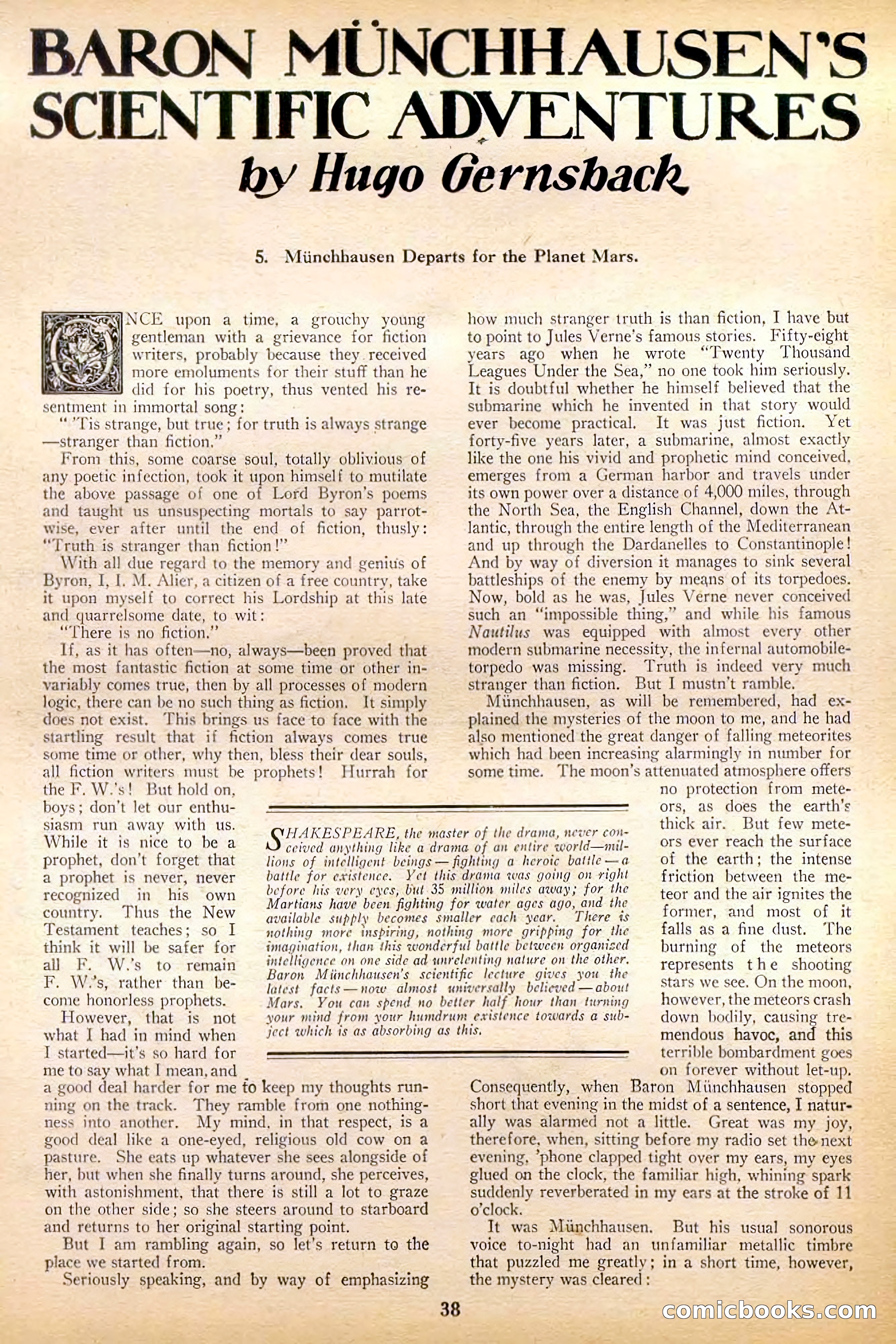
A restored page from Pulp Fiction, 1928. Page through the whole issue in the reader above.
📄 Transcribed text from this page (OCR, searchable)
Machine-transcribed from the original scan — historical spelling and the odd misread are preserved.
BARON MUNCHHAUSEN’S SCIENTIFIC ADVENTURES by Hugo Gernshack 5. Miinchhausen Departs for the Planet Mars. NCE upon a time, a grouchy young gentleman with a grievance for fiction “4 writers, probably because they. received a we) more emoluments for their stuff than he ieee) lid for his poetry, thus vented his re- sentment in immortal song: “Tis strange, but true; for truth is always strange —stranger than fiction,” From this, some coarse soul, totally oblivious of any poetic infection, took it upon himself to mutilate the above passage of one of Lord Byron’s poems and taught us unsuspecting mortals to say parrot- wise, ever after until the end of fiction, thusly: “Truth is stranger than fiction!” With all due regard to the memory and genius of Byron, I, I. M. Alier, a citizen of a free country, take it upon myself to correct his Lordship at this late and quarrelsome date, to wit: “There is no fiction.” If, as it has often—no, always—been proved that the most fantastic fiction at some time or other in- variably comes true, then by all processes of modern logic, there can be no such thing as fiction, It simply does not exist. This brings us face to face with the startling result that if fiction always comes true some time or other, why then, bless their dear souls, all fiction writers must be prophets! Murrah for the F. W.’s! But hold on, how much stranger truth is than fiction, I have but to point to Jules Verne’s famous stories. Fifty-eight years ago when he wrote “Twenty Thousand Leagues Under the Sea,” no one took him seriously. It is doubtful whether he himself believed that the submarine which he invented in that story would ever become practical. It was just fiction. Yet forty-five years later, a submarine, almost exactly like the one his vivid and prophetic mind conceived. emerges from a German harbor and travels under its own power over a distance of 4,000 miles, through the North Sea, the English Channel, down the At- lantic, through the entire length of the Mediterranean and up through the Dardanelles to Constantinople! And by way of diversion it manages to sink several battleships of the enemy by means of its torpedoes. Now, bold as he was, Jules Verne never conceived such an “impossible thing,” and while his famous Nautilus was equipped with almost every other modern submarine necessity, the infernal automobile- torpedo was missing. Truth is indeed very much stranger than fiction. But I mustn't ramble. Miunchhausen, as will be remembered, had ex- plained the mysteries of the moon to me, and he had also mentioned the great danger of falling meteorites which had been increasing alarmingly in number for some time. The moon’s attenuated atmosphere offers no protection from mete- boys; don’t let our enthu- siasm run away with us. While it is nice to be a prophet, don’t forget that a prophet is never, never recognized in his own country. Thus the New Testament teaches; so I think it will be safer for all F. W.’s to~- remain F. W's, rather than be- come honorless prophets. However, that is not what I had in mind when ee er. the master of the drama, never con- ceived anything like a drama of an entire world—mil- lions of intelligent beings — fighting a herote batile—a battle for existence. Yet this drama was going on right before his very eyes, bul 35 million miles away; for the Martians have been. fighting for water ages ago, and the available supply becomes smaller cach year. There ts nothing more inspiring, nothing more gripping for the imagination, than this wonderful battle between organised intelligence on one side ad anrelenting nature on the other. Baron Mimchhausen’s scientific lecture gives you the latest facts —now almost universally believed —about Mars. You can spend no better half hour than turning your mind from your humdrum existence towards a sub- ject which is as absorbing as this, ors, as does the earth’s thick air. But few mete- ors ever reach the surface of the earth; the intense friction between the me- teor and the air ignites the former, and most of it falls as a fine dust. “The burning of the meteors represents the shooting stars we see. On the moon, however, the meteors crash down bodily, causing tre- I started—it’s so hard for me to say what I mean,and | a good deal harder for me to keep my thoughts run- ning on the track. They ramble from one nothing- ness into another. My mind, in that respect, is a good deal like a one-eyed, religious old cow on a pasture. She eats up whatever she sees alongside of her, but when she finally turns around, she perceives, with astonishment, that there is still a lot to graze on the other side; so she steers around to starboard and returns to her original starting point. But I am rambling again, so let’s return to the place we started from. Seriously speaking, and by way of emphasizing 38 mendous havoc, and this terrible bombardment goes on forever without let-up. Consequently, when Baron Muiinchhausen stopped short that evening in the midst of a sentence, I natur- ally was alarmed not a little. Great was my joy, therefore, when, sitting before my radio set the next evening, ‘phone clapped tight over my ears, my eyes glued on the clock, the familiar high, whining spark suddenly reverberated in my ears at the stroke of 11 o'clock. Tt was Miinchhausen. But his usual sonorous voice to-night had an unfamiliar metallic timbre that puzzled me greatly; in a short time, however, the mystery was cleared: : COMMEOOo<SnCOnn = te = om =