
Pulp Fiction, 1928 · page 80 of 99
Amazing Stories — page 80: what you’re looking at
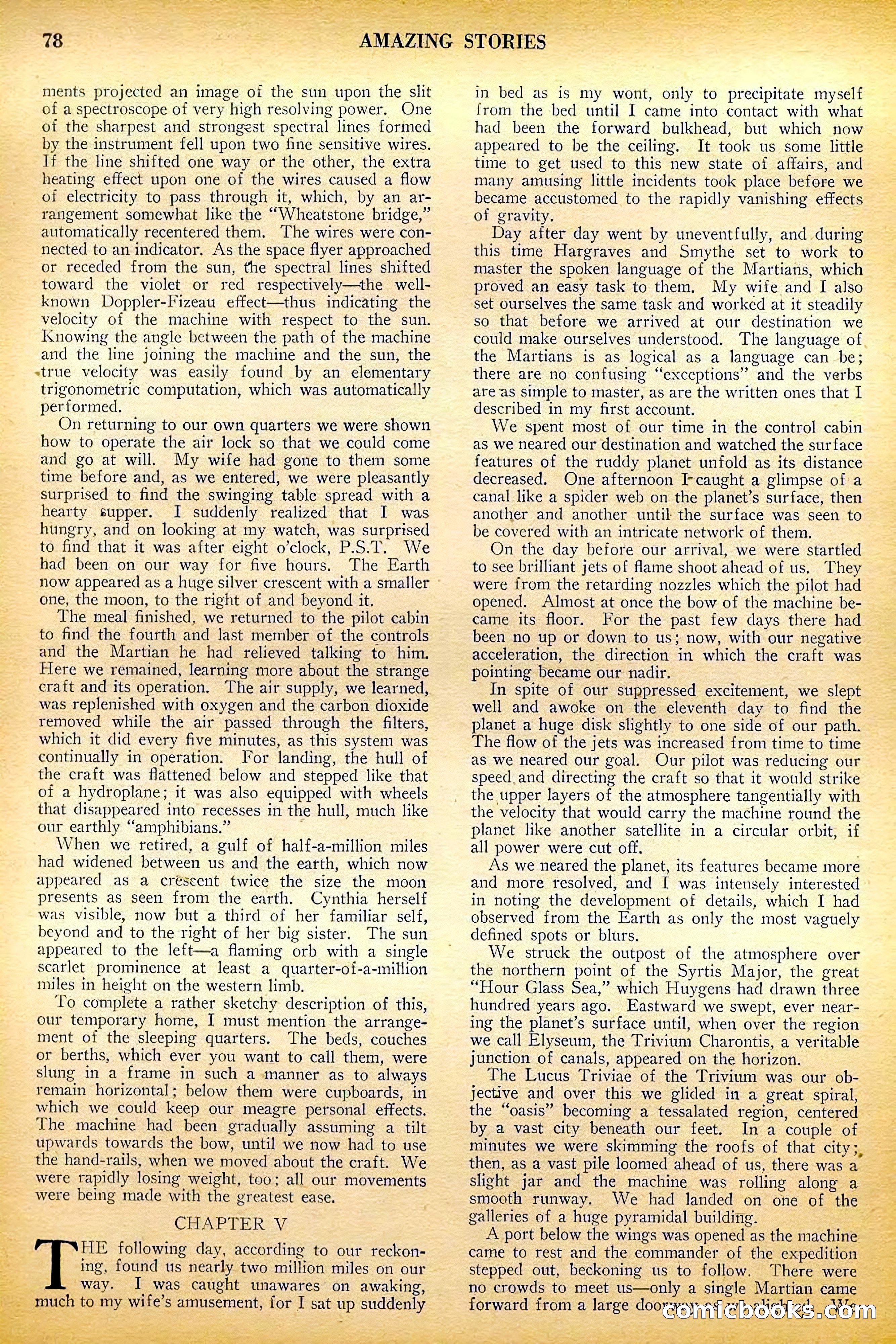
A restored page from Pulp Fiction, 1928. Page through the whole issue in the reader above.
📄 Transcribed text from this page (OCR, searchable)
Machine-transcribed from the original scan — historical spelling and the odd misread are preserved.
ments projected an image of the sun upon the slit of a spectroscope of very high resolving power, One of the sharpest and strongest spectral lines formed by the instrument fell upon two fine sensitive wires. lf the line shifted one way or the other, the extra heating effect upon one of the wires caused a flow of electricity to pass through it, which, by an ar- rangement somewhat like the “Wheatstone bridge,” automatically recentered them. The wires were con- nected to an indicator. As the space flyer approached or receded from the sun, the spectral lines shifted toward the violet or red respectively—the well- known Doppler-Fizeau effect—thus indicating the velocity of the machine with respect to the sun. Knowing the angle between the path of the machine and the line joining the machine and the sun, the strue velocity was easily found by an elementary trigonometric computation, which was automatically performed. On returning to our own quarters we were shown how to operate the air lock so that we could come and go at will. My wife had gone to them some time before and, as we entered, we were pleasantly surprised to find the swinging table spread with a hearty supper. I suddenly realized that I was hungry, and on looking at my watch, was surprised to find that it was after eight o’clock, P.S.T. We had been on our way for five hours. The Earth now appeared as a huge silver crescent with a smaller ~ one, the moon, to the right of and beyond it. The meal finished, we returned to the pilot cabin to find the fourth and last member of the controls and the Martian he had relieved talking to him. Here we remained, learning more about the strange craft and its operation. The air supply, we learned, was replenished with oxygen and the carbon dioxide removed while the air passed through the filters, which it did every five minutes, as this system was continually in operation. Tor landing, the hull of the craft was flattened below and stepped like that of a hydroplane; it was also equipped with wheels that disappeared into recesses in the hull, much like our earthly “amphibians.” When we retired, a gulf of half-a-million miles had widened between us and the earth, which now appeared as a créseent twice the size the moon presents as seen from the earth. Cynthia herself was visible, now but a third of her familiar self, beyond and to the right of her big sister. The sun appeared to the left—a flaming orb with a single scarlet prominence at least a quarter-of-a-million miles in height on the western limb. To complete a rather sketchy description of this, our temporary home, I must mention the arrange- ment of the sleeping quarters. The beds, couches or berths, which ever you want to call them, were slung in a frame in such a manner as to always remain horizontal; below them were cupboards, in which we could keep our meagre personal effects. The machine had been gradually assuming a tilt upwards towards the bow, until we now had to use the hand-rails, when we moved about the craft. We were rapidly losing weight, too; all our movements -_-were being made with the greatest ease. CHAPTER V — Tee following day, according to our reckon- wt way. I was caught unawares on awaking, much to my wife’s amusement, for I sat up suddenly - ing, found us nearly two million miles on our 78 eines _ AMAZING STORIE in bed as is my wont, only to precipitate myself from the bed until I came into contact with what had been the forward bulkhead, but which now appeared to be the ceiling. It took us some little time to get used to this new state of affairs, and many amusing little incidents took place before we became accustomed to the rapidly vanishing effects of gravity. Day after day went by uneventfully, and during this time Hargraves and Smythe set to work to master the spoken language of the Martians, which proved an easy task to them. My wife and I also set ourselves the same task and worked at it steadily so that before we arrived at our destination we could make ourselves understood. The language of. the Martians is as logical as a language can be; there are no confusing “exceptions” and the verbs are as simple to master, as are the written ones that I described in my first account. We spent most of our time in the control cabin as we neared our destination and watched the surface features of the ruddy planet unfold as its distance decreased. One afternoon I-caught a glimpse of a canal like a spider web on the planet’s surface, then another and another until the surface was seen to be covered with an intricate network of them, On the day before our arrival, we were startled to see brilliant jets of flame shoot ahead of us. They were from the retarding nozzles which the pilot had opened. Almost at once the bow of the machine be- came its floor. For the past few days there had been no up or down to us; now, with our negative acceleration, the direction in which the craft was pointing became our nadir. In spite of our suppressed excitement, we slept well and awoke on the eleventh day to find the planet a huge disk slightly to one side of our path. The flow of the jets was increased from time to time as we neared our goal. Our pilot was reducing our speed_and directing the craft so that it would strike the upper layers of the atmosphere tangentially with the velocity that would carry the machine round the planet like another satellite in a circular orbit, if all power were cut off. As we neared the planet, its features became more and more resolved, and I was intensely interested in noting the development of details, which I had observed from the Earth as only the most vaguely defined spots or blurs. We struck the outpost of the atmosphere over the northern point of the Syrtis Major, the great “Hour Glass Sea,” which Huygens had drawn three hundred years ago. Eastward we swept, ever near- ing the planet’s surface until, when over the region we call Elyseum, the Trivium Charontis, a veritable junction of canals, appeared on the horizon. The Lucus Triviae of the Trivium was our ob- jective and over this we glided in a great spiral, the “oasis” becoming a tessalated region, centered by a vast city beneath our feet. In a couple of minutes we were skimming the roofs of that city;, then, as a vast pile loomed ahead of us, there wasa sight jar and the machine was rolling along a smooth runway. We had landed on one of the galleries of a huge pyramidal building. A port below the wings was opened as the machin came to rest and the commander of the expeditio stepped out, beckoning us to follow. There wer no crowds to meet us—only a single M 1 forward from a large doorars yn aii bo!