
Pulp Fiction, 1928 · page 81 of 99
Amazing Stories — page 81: what you’re looking at
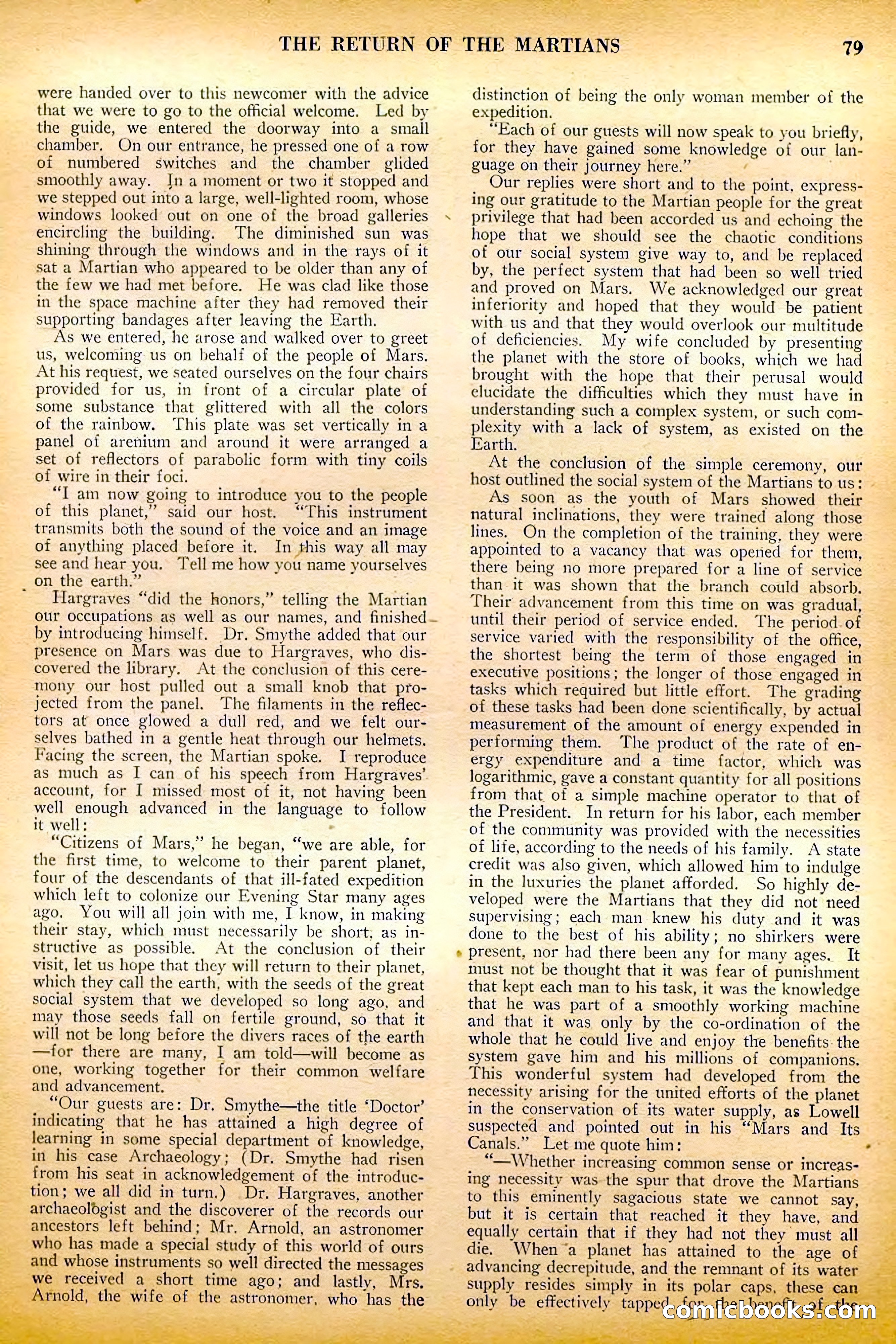
A restored page from Pulp Fiction, 1928. Page through the whole issue in the reader above.
📄 Transcribed text from this page (OCR, searchable)
Machine-transcribed from the original scan — historical spelling and the odd misread are preserved.
—— — ae cae were handed over to this newcomer with the advice that we were to go to the official welcome. Led by the guide, we entered the doorway into a small chamber. On our entrance, he pressed one of a row of numbered switches and the chamber glided smoothly away. In a moment or two it stopped and we stepped out into a large, well-lighted room, whose windows looked out on one of the broad galleries encircling the building. The diminished sun was shining through the windows and in the rays of it sat a Martian who appeared to be older than any of the few we had met before. He was clad like those in the space machine after they had removed their supporting bandages after leaving the Earth. As we entered, he arose and walked over to greet us, welcoming us on behalf of the people of Mars. At his request, we seated ourselves on the four chairs provided for us, in front of a circular plate of some substance that glittered with all the colors of the rainbow. This plate was set vertically in a panel of arenium and around it were arranged a set of reflectors of parabolic form with tiny coils of wire in their foci. “T am now going to introduce you to the people of this planet,” said our host. “This instrument transmits both the sound of the voice and an image of anything placed before it. In this way all may see and hear you. Tell me how you name yourselves on the earth.” Hargraves “did the honors,” telling the Martian our occupations as well as our names, and finished by introducing himself. Dr. Smythe added that our presence on Mars was due to Hargraves, who dis- covered the library. At the conclusion of this cere- mony our host pulled out a small knob that pro- jected from the panel. The filaments in the reflec- tors at once glowed a dull red, and we felt our- selves bathed in a gentle heat through our helmets. Facing the screen, the Martian spoke. I reproduce as much as I can of his speech from Hargraves’ account, for I missed most of it, not having been well enough advanced in the language to follow it well: . “Citizens of Mars,” he began, “we are able, for the first time, to welcome to their parent planet, four of the descendants of that ill-fated expedition which left to colonize our Evening Star many ages ago. You will all join with me, I know, in making their stay, which must necessarily be short, as in- structive as possible. At the conclusion of their visit, let us hope that they will return to their planet, which they call the earth, with the seeds of the great social system that we developed so long ago, and may those seeds fall on fertile ground, so that it will not be long before the divers races of the earth —for there are many, I am told—will become as one, working together for their common welfare and advancement. “Our guests are: Dr. Smythe—the title ‘Doctor’ indicating that he has attained a high degree of learning in some special department of knowledge, in his case Archaeology; (Dr. Smythe had risen from his seat in acknowledgement of the introduc- tion; we all did in turn.) Dr. Hargraves, another -archaeoldgist and the discoverer of the records out ancestors left behind; Mr. Arnold, an astronomer who has made a special study of this world of ours whose instruments so well directed the messages hort time ago; and lastly, Mrs. the Sr aoe =O ; THE RETURN OF THE MARTIAN ~ distinction of being the only woman member of the expedition. “Each of our guests will now speak to you briefly, for they have gained some knowledge of our lan- guage on their journey here.” f Our replies were short and to the point, express- ing our gratitude to the Martian people for the great privilege that had been accorded us and echoing the hope that we should see the chaotic conditions of our social system give way to, and be replaced by, the perfect system that had been so well tried and proved on Mars. We acknowledged our great inferiority and hoped that they would be patient with us and that they would overlook our multitude of deficiencies. My wife concluded by presenting the planet with the store of books, which we had brought with the hope that their perusal would elucidate the difficulties which they must have in understanding such a complex system, or such com- plexity with a lack of system, as existed on the Ivarth. At the conclusion of the simple ceremony, our host outlined the social system of the Martians to us: As soon as the youth of Mars showed their natural inclinations, they were trained along those lines. On the completion of the training, they were appointed to a vacancy that was opened for them, there being no more prepared for a line of service than it was shown that the branch could absorb. Their advancement from this time on was gradual, until their period of service ended. The period of service varied with the responsibility of the office, the shortest being the term of those engaged in executive positions; the longer of those engaged in tasks which required but little effort. The grading of these tasks had been done scientifically, by actual measurement of the amount of energy expended in performing them. The product of the rate of en- ergy expenditure and a time factor, which was logarithmic, gave a constant quantity for all positions from that of a simple machine operator to that of the President. In return for his labor, each member of the community was provided with the necessities of life, according to the needs of his family. A state credit was also given, which allowed him to indulge in the luxuries the planet afforded. So highly de- veloped were the Martians that they did not need supervising ; each man knew his duty and it was done to the best of his ability; no shirkers were present, nor had there been any for many ages. It must not be thought that it was fear of punishment that kept each man to his task, it was the knowledge that he was part of a smoothly working machine and that it was only by the co-ordination of the whole that he could live and enjoy the benefits. the system gave him and his millions of companions. This wonderful system had developed from the necessity arising for the united efforts of the planet in the conservation of its water supply, as Lowell suspected and pointed out in his “Mars and Its Canals.” Let me quote him: “Whether increasing common sense or increas- ing necessity was the spur that drove the Martians to this eminently sagacious state we cannot say, but it is certain that reached it they have, and equally certain that if they had not they must all — die. When “a planet has attained to the age advancing decrepitude, and the remnant of it supply resides simply in its po wate =a ouly., ber citectivelyss » w OS yy the ict = . “me - 2 “ ea