
Pulp Fiction, 1928 · page 82 of 99
Amazing Stories — page 82: what you’re looking at
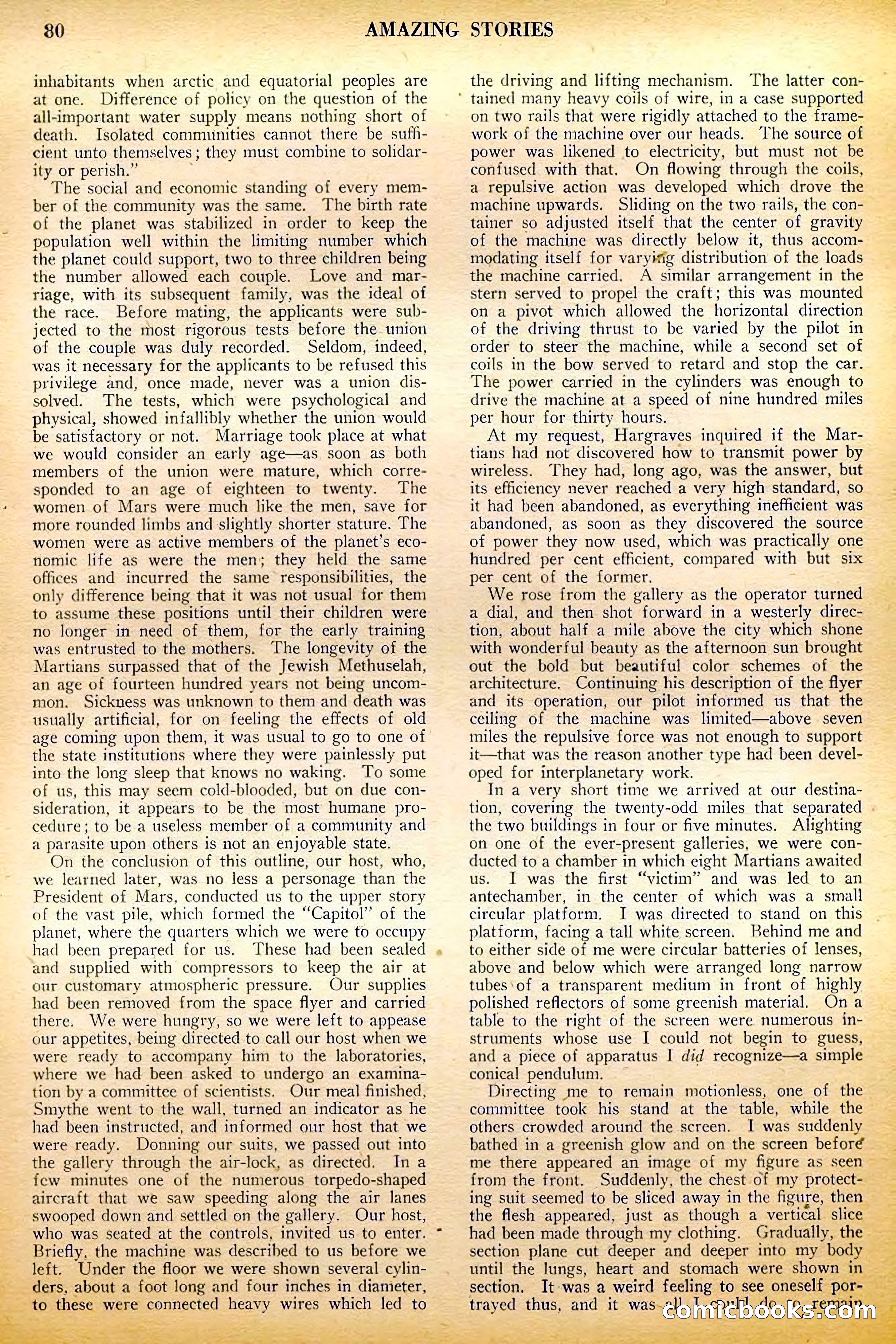
A restored page from Pulp Fiction, 1928. Page through the whole issue in the reader above.
📄 Transcribed text from this page (OCR, searchable)
Machine-transcribed from the original scan — historical spelling and the odd misread are preserved.
inhabitants when arctic and equatorial peoples are at one. Difference of policy on the question of the all-important water supply means nothing short of death. Isolated communities cannot there be suffi- cient unto themselves ; they must combine to solidar- ity or perish.” The social and economic standing of every mem- ber of the community was the same. The birth rate of the planet was stabilized in order to keep the population well within the limiting number which the planet could support, two to three children being the number allowed each couple. Love and mar- riage, with its subsequent family, was the ideal of the race. Before mating, the applicants were sub- jected to the most rigorous tests before the union of the couple was duly recorded. Seldom, indeed, was it necessary for the applicants to be refused this privilege and, once made, never was a union dis- solved. The tests, which were psychological and physical, showed infallibly whether the union would be satisfactory or not. Marriage took place at what we would consider an early age—as soon as both members of the union were mature, which corre- sponded to an age of eighteen to twenty. The women of Mars were much like the men, save for more rounded limbs and slightly shorter stature. The women were as active members of the planet’s eco- nomic life as were the men; they held the same offices and incurred the same responsibilities, the only difference being that it was not usual for them to assume these positions until their children were no longer in need of them, for the early training was entrusted to the mothers, The longevity of the Martians surpassed that of the Jewish Methuselah, an age of fourteen hundred years not being uncom- mon. Sickness was unknown to them and death was usually artificial, for on feeling the effects of old age coming upon them, it was usual to go to one of the state institutions where they were painlessly put into the long sleep that knows no waking. To some of us, this may seem cold-blooded, but on due con- sideration, it appears to be the most humane pro- cedure; to be a useless member of a community and a parasite upon others is not an enjoyable state. On the conclusion of this outline, our host, who, we learned later, was no less a personage than the President of Mars, conducted us to the upper story of the vast pile, which formed the “Capitol” of the planet, where the quarters which we were to occupy had been prepared for us. These had been sealed and supplied with compressors to keep the air at our customary atmospheric pressure. Our supplies had been removed from the space flyer and carried there. We were hungry, so we were left to appease our appetites, being directed to call our host when we were ready to accompany him to the laboratories, where we had been asked to undergo an examina- tion by a committee of scientists. Our meal finished, Smythe went to the wall, turned an indicator as he had been instructed, and informed our host that we were ready. Donning our suits, we passed out into the gallery through the air-lock, as directed. Ina few minutes one of the numerous torpedo-shaped aircraft that we saw speeding along the air lanes swooped down and settled on the gallery. Our host, who was seated at the controls, invited us to enter. Briefly, the machine was described to us before we left. Under the floor we were shown several cylin- \ _ ders, about a foot long and four inches in diameter, bese: SUGKS! connected heavy wires which KS to ee “AMAZING. STORIES” the driving and lifting mechanism. ‘The latter con- ’ tained many heavy coils of wire, in a case supported on two rails that were rigidly attached to the frame- work of the machine over our heads. The source of power was likened to electricity, but must not be confused with that, On flowing through the coils, a repulsive action was developed which drove the machine upwards. Sliding on the two rails, the con- tainer so adjusted itself that the center of gravity of the machine was directly below it, thus accom- modating itself for varyitig distribution of the loads the machine carried. A similar arrangement in the stern served to propel the craft; this was mounted on a pivot which allowed the horizontal direction of the driving thrust to be varied by the pilot in order to steer the machine, while a second set of coils in the bow served to retard and stop the car. The power carried in the cylinders was enough to drive the machine at a speed of nine hundred miles per hour for thirty hours. At my request, Hargraves inquired if the Mar- tians had not discovered how to transmit power by wireless. They had, long ago, was the answer, but its efficiency never reached a very high standard, so it had been abandoned, as everything inefficient was abandoned, as soon as they discovered the source of power they now used, which was practically one hundred per cent efficient, compared with but six per cent of the former. We rose from the gallery as the operator turned a dial, and then shot forward in a westerly direc- tion, about half a mile above the city which shone with wonderful beauty as the afternoon sun brought out the bold but beautiful color schemes of the architecture. Continuing his description of the flyer and its operation, our pilot informed us that the ceiling of the machine was limited—above seven miles the repulsive force was not enough to support it—that was the reason another type had been devel- oped for interplanetary work. In a very short time we arrived at our destina- tion, covering the twenty-odd miles that separated - the two buildings in four or five minutes. Alighting on one of the ever-present galleries, we were con- ducted to a chamber in which eight Martians awaited us. I was the first “victim” and was led to an antechamber, in the center of which was a small circular platform. I was directed to stand on this platform, facing a tall white screen. Behind me and to either side of me were circular batteries of lenses, above and below which were arranged long narrow tubes‘of a transparent medium in front of highly polished reflectors of some greenish material. Ona table to the right of the screen were numerous in- struments whose use I could not begin to guess, and a piece of apparatus I did recognize—a simple conical pendulum, Directing me to remain motionless, one of the committee took his stand at the table, while the others crowded around the screen. I was suddenly bathed in a greenish glow and on the screen beforé me there appeared an image of my figure as seen — from the front. Suddenly, the chest of my protect- ing suit seemed to be sliced away in the figure, nee the flesh appeared, just as though a vertical slice had been made through my clothing. Gradually, the section plane cut deeper and deeper into my bod: = until the Jungs, heart and stomach were shown in — section. It was a weird eae to SC onescle ( prayed os: and it com a ett