
Pulp Fiction, 1928 · page 84 of 99
Amazing Stories — page 84: what you’re looking at
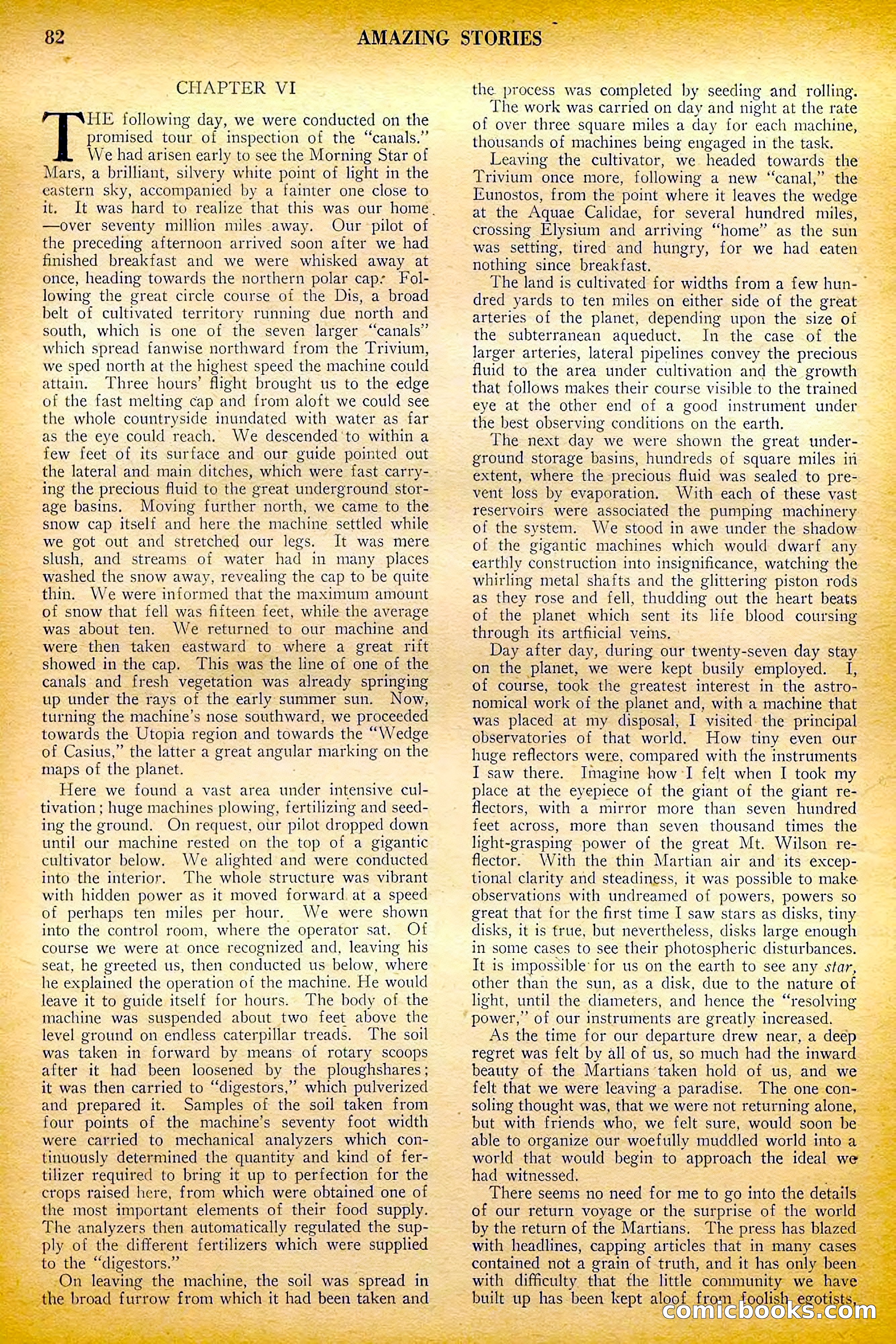
A restored page from Pulp Fiction, 1928. Page through the whole issue in the reader above.
📄 Transcribed text from this page (OCR, searchable)
Machine-transcribed from the original scan — historical spelling and the odd misread are preserved.
CHAPTER VI BONHE following day, we were conducted on the = promised tour of inspection of the “canals.” ; BM We had arisen early to see the Morning Star of - Mars, a brilliant, silvery white point of light in the eastern sky, accompanied by a fainter one close to —over seventy million miles away. Our pilot of the preceding afternoon arrived soon after we had _ finished breakfast and we were whisked away at 5 once, heading towards the northern polar cap: Fol- = lowing the great circle course of the Dis, a broad = belt of cultivated territory running due north and south, which is one of the seven larger “canals” which spread fanwise northward from the Trivium, : we sped north at the highest speed the machine could attain. Three hours’ flight brought us to the edge of the fast melting cap and from aloft we could see the whole countryside inundated with water as far . as the eye could reach. We descended ‘to within a = few feet of its surface and our guide pointed out the lateral and main ditches, which were fast carry- = ~ ing the precious fluid to the great underground stor- = _ age basins. Moving further north, we came to the snow cap itself and here the machine settled while 3 we got out and stretched our legs. It was mere = slush, and streams of water had in many places __washed the snow away, revealing the cap to be quite thin. We were informed that the maximum amount of snow that fell was fifteen feet, while the average was about ten. We returned to our machine and _ were then taken eastward to where a great rift canals and fresh vegetation was already springing up under the rays of the early summer sun. Now, turning the machine’s nose southward, we proceeded towards the Utopia region and towar ds the “W edge of Casius,” the latter a great angular marking on the a maps of the planet. ; Here we found a vast area under intensive cul- : tivation ; huge machines plowing, fertilizing and seed- ing the ground. On request, our pilot dropped down until our machine rested on the top of a gigantic cultivator below. We alighted and were conducted into the interior. The whole structure was vibrant with hidden power as it moved forward. at a speed of perhaps ten miles per hour. We were shown into the control room, where the operator sat. Of course we were at once recognized and, leaving his seat, he greeted us, then conducted us below, where he explained the operation of the machine. He would leave it to guide itself for hours. The body of the machine was suspended about two feet above the level ground on endless caterpillar treads. The soil was taken in forward by means of rotary scoops after it had been loosened by the ploughshares ; it was then carried to “digestors,” which pulverized and prepared it. Samples of the soil taken from four points of the machine’s seventy foot width were carried to mechanical analyzers which con- tinuously determined the quantity and kind of fer- tilizer required to bring it up to perfection for the + crops raised here, from which were obtained one of he most important elements of their food supply. “he analyzers then automatically regulated the sup- of the different gocuiligers which were supplied th@_ it. It was hard to realize that this was our home. _ showed in the cap. This was the line of one of the power,” of our instruments are greatly increased. _ soling thought was, that we were not returning alo the process was completed by seeding and rolling. — The work was carried on day and night at the rate of over three square miles a day for each machine, thousands of machines being engaged i in the task. Leaving the cultivator, we headed towards the — Trivium once more, following a new “canal,” the — Eunostos, from the point where it leaves the wedge = at the Aquae Calidae, for several hundred miles, crossing Elysium and arriving “home” as the sun — was setting, tired and hungry, for we had eaten — nothing since breakfast. The land is cultivated for widths from a few hun- dred yards to ten miles on either side of the great arteries of the planet, depending upon the size of : the subterranean aqueduct. In the case of the — larger arteries, lateral pipelines convey the precious fluid to the area under cultivation and the growth that follows makes their course visible to the trained eye at the other end of a good instrument under the best observing conditions on the earth. . The next day we were shown the great under- ground storage basins, hundreds of square miles iti extent, where the precious fluid was sealed to pre- vent loss by evaporation. With each of these vast reservoirs were associated the pumping machinery _ of the system. We stood in awe under the shadow — of the gigantic machines which would dwarf any earthly construction into insignificance, watching the whirling metal shafts and the glittering piston rods as they rose and fell, thudding out the heart beats of the planet which sent its life blood coursing — through its artfiicial vems. Day after day, during our twenty-seven day stay on the planet, we were kept busily employed. 1, of course, took the greatest interest in the astro- nomical work of the planet and, with a machine that was placed at my disposal, I visited the principal observatories of that world. How tiny even our huge reflectors were, compared with the instruments I saw there. Imagine how'I felt when I took my place at the eyepiece of the giant of the giant re- flectors, with a mirror more than seven hundred feet across, more than seven thousand times the light-grasping power of the great Mt. Wilson re- flector. With the thin Martian air and its excep- tional clarity and steadiness, it was possible to make observations with undreamed of powers, powers so great that for the first time I saw stars as disks, tiny disks, it is frue, but nevertheless, disks large enough in some cases to see their photospheric disturbances. It is impossible for us on the earth to see any star, other than the sun, as a disk, due to the nature of 3 light, until the diameters, and hence the “resolving — As the time for our departure drew near, a deep | regret was felt by all of us. so much had the inward — beauty of the Martians taken hold of us, and w we felt that we were leaving a paradise. The one cor but pith friends who, we felt sure, would soon able to pigatie our. woefully muddled world into a world that would begin to approach the ideal Ae had witnessed. : There seems no need for me to go into the d of our return voyage or the surprise of | by the return of the Martians. The press with headlines, BOpine et ar ticles that in :