
Pulp Fiction, 1928 · page 85 of 99
Amazing Stories — page 85: what you’re looking at
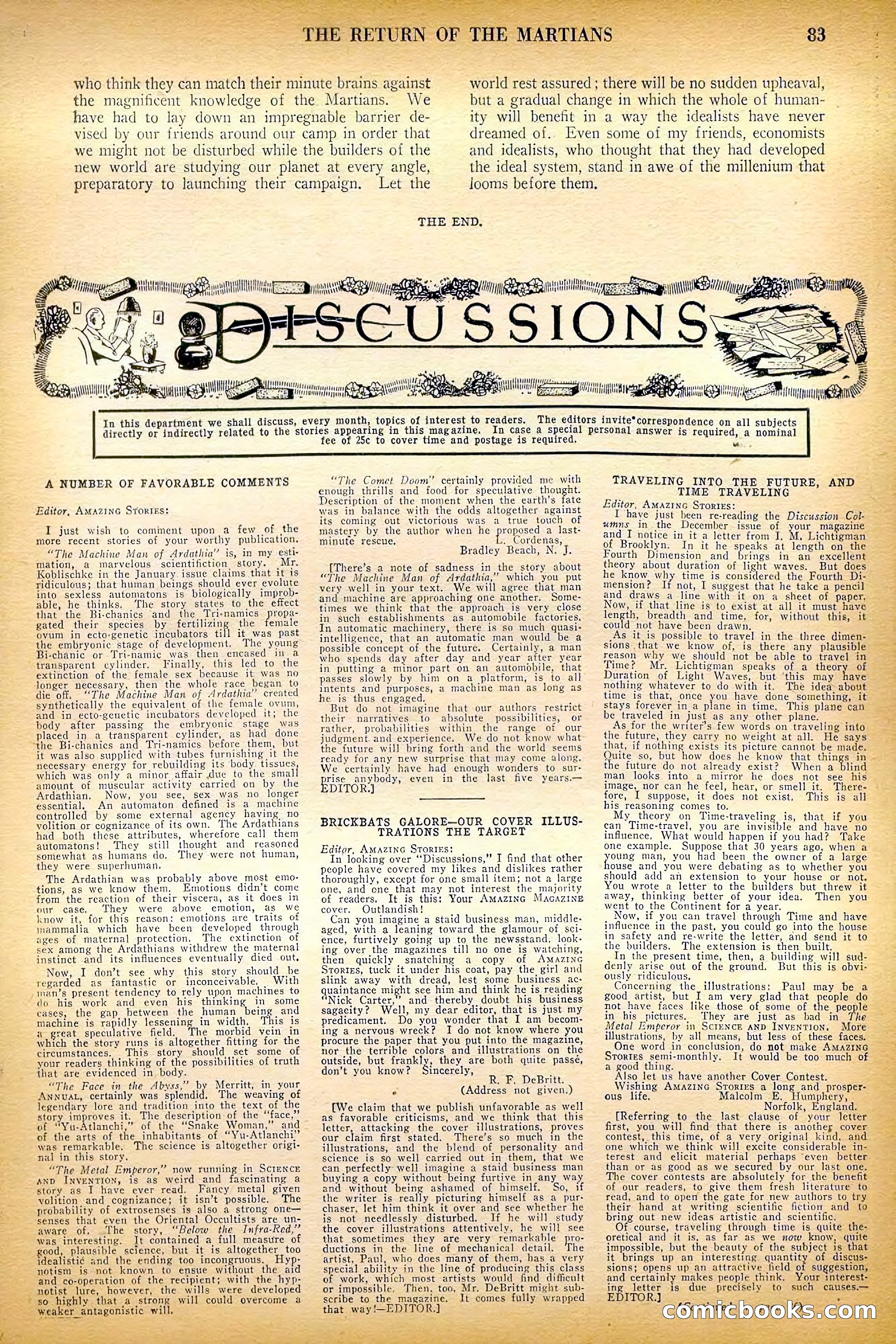
A restored page from Pulp Fiction, 1928. Page through the whole issue in the reader above.
📄 Transcribed text from this page (OCR, searchable)
Machine-transcribed from the original scan — historical spelling and the odd misread are preserved.
vised by our friends around our we might not be disturbed while Ths % é Viens oe AS aN Wisile In this department we shall discuss, AMG Va ss A NUMBER OF FAVORABLE COMMENTS = Editor, AMAZING StORTES! * I just wish to comment upon a few of the as more recent stories of your worthy publication. “The Machine Man of Ardathia’ is, in my esti- mation, & marvelous scientifiction story. Mr. Koblischke in the January. issue claims that it is ridiculous; that human beings should eyer evolute into sexless automatons is biologically improb- = able, he thinks. The story states to the effect =. that the Bi-chanics and the, Trienamics propa- = gated their species by geri leaing the female pe ovum in ecto-genetic incubators till it was past - ‘the embryonic: stage of development. The young . ‘Bi-chanic or Tri-namic was then encased in a * transparent cylinder. Finally, this led to the extinction of the female sex because it was no dJonger necessary, then the whole race bean to die off. “The Machine Man of Ardathia’ created er synthetically the equivalent of the female ovum, ; ‘and in ecto-genetic incubators developed it; the “3 body after passing the embryonic stige was placed in a transparent cylinder, as had done “the Bi-chanics and Tri-namics before them, but it was also supplicd with tubes furnishing it the necessary energy for rebuilding its body tissues which was only a minor affair due to the small ‘amount of muscular activity carried on by the Ardathian, Now, you see, sex was no longer essential, An automaton defined is a machine controlled by some external agency having no volition or cognizance of its own. The Ardathians had both these. attributes, wherefore call them automatons! They still thought and reasoned soniewhat as humans do. They -were not human, they were superhuman. The Ardathian was probably above most emo- tions, as we know them, Emotions didn’t come from the reaction of their viscera, as it does in our case, They were above emotion, as we know it, for this reason: emotions are traits of ynammalia which have been developed through ages of maternal protection, The extinction of sex among the Ardathians withdrew the maternal instinct and its influences eventually died out, Now, I don’t see why this story should be yegarded as fantastic or inconceivable, . With inan’s present tendency to rely upon machines to do his work and even his thinking in some cases, the gap between the human being and machine is eee lessening in width. This is aw great speculative field, The morbid vein in which the story runs is altogether fitting for the circumstances. This story should set some of your readers thinking of the possibilitics of truth that are evidenced in body. “The Face in the Absss,” by Merritt, in your ANNUAL, certainly was splendid. The weaving of legendary lore and tradition into the text of the pone roves it. The description of the “face,” me (oles of the arts of the inhabitants of “Yu-Atlanchi” was remarkable, The science is altogether origi- nal in this story. “The Metal Emperor,” now running in Scrence np Invention, is as weird and fascinating a ory as I have ever read. Fancy metal given volition and cognizance; it isn’t possible. The probability of extrosenses is also a strong one— senses that even the Oriental Occultists are un- aware of, The story, “Below the Infra-Red,” was interesting. It contained a full measure of good, plausible science, but it is altogether too vlistié and the ending too incongruous. Hyp- is not known to ensue without the aid a Ta of the recipient; with the hyp- lure, however, the wills were developed ily th: trong wil “overcome a who think they can match their minute brains against the magnificent knowledge of the Martians. have had to lay down an impregnable barrier de- new world are studying our planet at every angle, : preparatory to launching their campaign. re? Ses es oe = +S-CU >) aos) THU yall qin ee Wleciaagid Aes R xt 9 Kiss 38] it ER AN 0," u-Atlanchi,” of the ‘Snake Woman,” and — We camp in order that the builders of the Let the THE END, every month, topics of interest to readers. directly or indirectly related to the stories appearing in this magazine. In case a special fee of 25c to cover time and postage is required. “The Comet Doom’ certainly provided me with enough thrills and food for speculative thought. Description of the moment when the earth’s fate was in balance with the odds altogether against its coming out victorious was a true touch of mastery by the author when he propased a last: minute rescue, . Cordenas, Bradley Beach, N. J. [There’s a note of sadness in the story about “The Machine Man of Ardathia,’ which you put very well in your text. We will agree that man and machine are approaching one another. Some- times we think that the approach is very close in such establishments as automobile factories. In automatic machinery, there is so much quasi- intelligence, that an automatic man would be a possible concept of the future. Certainly, a man who spends day after day and year after year in putting a minor part on an automobile, that passes slowly by him on a platform, is to all inténts and purposes, a machine man as long as he is thus engaged. But do not imagine that our authors restrict their narratives to absolute possibilities, or rather, probabilities within. the range of our judgment and experience. We do not know what the future will bring forth and the world seems ready for any new surprise that may come along. We certainly have had enough wonders to sur- poe anybody, even in the last five years.— DITOR. GALORE—OUR COVER ILLUS- ATIONS THE TARGET Editer, AMaztnG StortKs: In looking over “Discussions,” I find that other people have covered my likes and dislikes rather thoroughly, except for one small item; not a large one, and one that may not interest the majority of readers, It is this: Your Amaztnc Macaz1ng cover. Outlandish! Can you imagine a staid business man, middle- aged, with a leaning toward the glamour of sci- ence, furtively going up to the newsstand, look- ing over the magazines till no one is watching, then quickly snatching a copy of AmAzInG Srortges, tuck it under his coat, pay the girl and slink away with dread, lest some business ac- quaintance might see him-and think he is reading “Nick Carter,” and thereby doubt his business sagacity? Well, my dear editor, that is just my - predicament. Do you wonder that I am becom- ing a nervous wreck? I do not know where you procure the paper that you put into the magazine, nor the terrible colors and illustrations on the outside, but frankly, they are both quite passé, don’t you know? Stncerely, : R, F, DeBritt. ° (Address not given.) (We claim that we publish unfavorable as well as favorable criticisms, and we think that this letter, attacking the cover illustrations, proves our claim first stated. There’s so much in the illustrations, and the blend of personality and science is so well carried out in them, that we ean perfectly well imagine a staid business man buying a copy without being furtive in any way and without being ashamed of himself. So, if the writer is cule picturing himself as a pur: chaser, let him think it over and see whether he is not needlessly disturbed. If he will study the cover illustrations attentively, he will see that sometimes they are very remarkable pro- ductions in the line of mechanical detail. The artist, Paul, who does many of them, has a very special ability in the line of producing this class oe work, which most artists would find difficult or impossible, Then. too, Mr. DeBritt might sub- scribe to the magazine. It comes full ‘capped a Ws BRICKBATS TR world rest assured ; there will be no sudden upheaval, but a gradual change in which the whole of human- ity will beneft in a way the idealists have never dreained of.. Even some of my friends, economists and idealists, who thought that they had developed the ideal system, stand in awe of the millenium that looms before them, ny EM ie RS in esa i ag Ny SIONS Pe vit ( nea yy irises vain Wer a ro - Ba NU meee” COT it ENO y eS a oes TT The editors invite*correspondence on all subjects personal answer is required, a nominal = = RS AWW we ~*~ TRAVELING INTO THE FUTURE, AND © TIME TRAVELING Editor, AMaz1NG Srortes: ae have just been re-reading the Discussion Col- wmns_in the December issue of your magazine and I notice in it a letter from J, M. Lichtigman of Brooklyn. In it he speaks at length on the Fourth Dimension and brings in an excellent — theory about duration of light waves. : he know. why time is considered the Fourth Di- mension? If not, I suggest that he take a pencil and draws a_line with it on a sheet of paper, Now, if that line is to exist at all it must have length, breadth and time, for, without this, i could not have been drawn. Soh As it is possible to travel in the three dimen- sions that we know of, is there any plausible reason why we should not be able to travel in Time? Mr. Lichtigman speaks of a theory of Duration of Light Waves, but ‘this may haves 7 nothing whatever to do with it. The idea about time is that, once you have done something, it — stays forever in.a plane in time, This plane ca be traveled in just as any other plane. = As for the writer’s few words on traveling into — the future, they carry no weight at all. He says that, if nothing exists its picture cannot be made, Quite so, but how does he know that things in- the future do not already exist? When a Pind a man looks into a mirror he does not gee his image, nor can he feel, hear, or smell it. There- | fore, I suppose, it does not exist. This is all his reasoning comes to. = My theory on Time-traveling is, that if you can Time-travel, you are invistble and have no influence, What would happen if you had? Take one example. Suppose that 30 years ago, when a peune man, you had been the owner of a large g ouse and you were debating as to whether you “6 should add an extension to your house or not. 7 You wrote a letter to the builders but threw it away, thinking better of your idea. Then you 3 went to the Continent for a year. . _ Now, if you can fravel through Time and have 3 influence in the past, you could go into the house . 2 in safety and re-write the letter, and send it to the builders. The extension is then built, =e In the present time, then, a building will sud- denly arise out of the ground. But this is obvi- ously ridiculous, : Concerning the_illustrations: Paul may be a good artist, but I'am very glad that people do not have faces like those of some of the people in his pictures. They are just as bad in The Metal Emperor in Sctenck AND InveNTION. More illustrations, by all means, but less of these faces. One word in conclusion, do not make Awaz! : Srorres semi-monthly. a good thing. Also let us have another Cover Contest. It would be too much Wishing Ansazinc Stores a long and prosper- ous life, Malcolm E, ‘umphery es Norfolk, England. [Referring to the last clause of your letter first, you will find that there is another cover | contest, this time, of a very original kind, and one which we think will excite considerable in terest and elicit material perhaps “even better than or as good as we secured by our last one, The cover contests are absolutely for the benefit — of our readers, to give them fresh literature to — read, and to open the gate for new authors to tr their hand at writing scientific fiction and bring out new ideas artistic and scientific. Of course, traveling through time is quit oretical and it is, as far as we sow know, impossible, but the beauty of the subject 18° it brings up an interesting quantit is sions; opens up an attractive field o and certainly makes people think. Yo ing letter is due cisely t ate