
Pulp Fiction, 1919 · page 111 of 196
Argosy and Railroad Man's Magazine — page 111: what you’re looking at
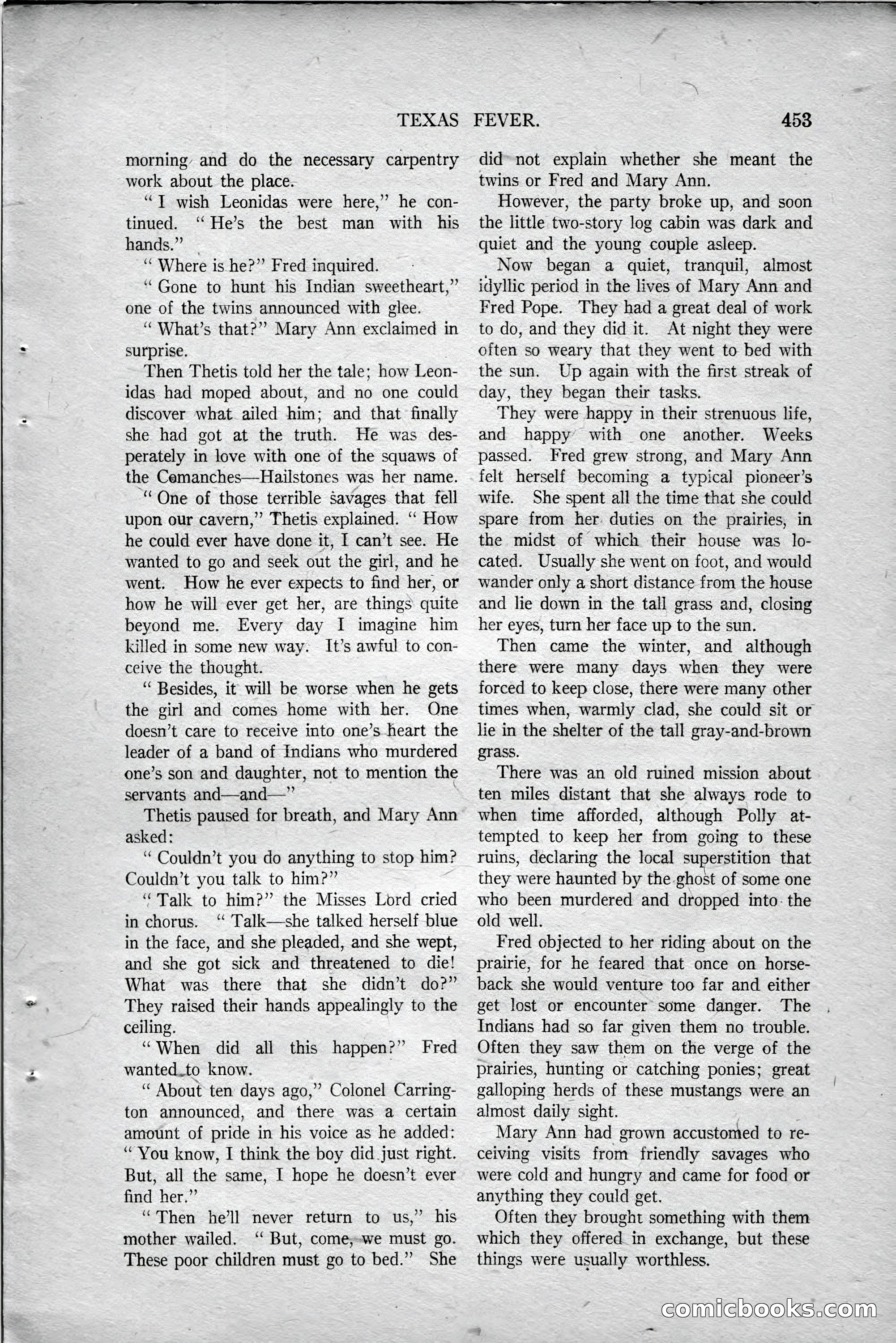
A restored page from Pulp Fiction, 1919. Page through the whole issue in the reader above.
📄 Transcribed text from this page (OCR, searchable)
Machine-transcribed from the original scan — historical spelling and the odd misread are preserved.
TEXAS morning and do the necessary carpentry work about the place. “T wish Leonidas were here,” he con- tinued. ‘“He’s the best man with his hands.” - ‘““ Where is he?” Fred inquired. “Gone to hunt his Indian sweetheart,” one of the twins announced with glee. “What’s that?” Mary Ann exclaimed in surprise. Then Thetis told her the tale; how Leon- idas had moped about, and no one could discover what ailed him; and that finally she. had got at the truth. He was des- perately in love with one of the squaws of the Cemanches—Hailstones was her name. “One of those terrible Savages that fell upon our cavern,” Thetis explained. “ How he could ever have done it, I can’t see. He wanted to go and seek out the girl, and he went. How he ever expects to find her, or how he will ever get her, are things quite beyond me. Every day I imagine him killed in some new way. It’s awful to con- ceive the thought. “ Besides, it will be worse when he gets the girl and comes home with her. One doesn’t care to receive into one’s heart the leader of a band of Indians who murdered one’s son and daughter, not to mention the servants and—and—” Thetis paused for breath, and Mary Ann asked: “Couldn’t you do anything to stop him? Couldn’t you talk to him?” “Talk to him?” the Misses Lord cried in chorus. ‘ Talk—she talked herself blue in the face, and she pleaded, and she wept, and she got sick and threatened to die! What was there that she didn’t do?” They raised their hands appealingly to the ceiling. “When did all this happen?” Fred wanted.to know. “ About ten days ago,” Colonel Carring- ton announced, and there was a certain amount of pride in his voice as he added: “You know, I think the boy did just right. But, all the same, I hope he doesn’t ever find her.” “Then he’ll never return to us,” his mother wailed. “ But, come;-we must go. These poor children must go to bed.” She 453 FEVER. did not explain whether she meant the twins or Fred and Mary Ann. However, the party broke up, and soon the little two-story log cabin was dark and quiet and the young couple asleep. Now began a quiet, tranquil, almost idyllic period in the lives of Mary Ann and Fred Pope. They had a great deal of work to do, and they did it. At night they were often so weary that they went to bed with the sun. Up again with the first streak of day, they began their tasks. They were happy in their strenuous life, and happy’ with one another. Weeks passed. Fred grew strong, and Mary Ann felt herself becoming a typical pioneer’s wife. She spent all the time that she could spare from her. duties on the prairies, in the midst of which their house was _lo- cated. Usually she went on foot, and would wander only a short distance from the house and lie down in the tall grass and, closing her eyes, turn her face up to the sun. Then came the winter, and although there were many days when they were forced to keep close, there were many other times when, warmly clad, she could sit or lie in the shelter of the tall gray-and-brown grass. There was an old ruined mission about ten miles distant that she always rode to when time afforded, although Polly at- tempted to keep her from going to these ruins, declaring the local superstition that they were haunted by the-ghost of some one who been murdered and dropped into- the old well. Fred objected to her riding about on the prairie, for he feared that once on horse- back she would venture too far and either get lost or encounter’ some danger. The Indians had so far given them no trouble. Often they saw them on the verge of the prairies, hunting or catching ponies; great galloping herds of these mustangs were an almost daily sight. Mary Ann had grown accustomed to re- ceiving visits from friendly savages who were cold and hungry and came for food or anything they could get. Often they brought something with them which they offered in exchange, but these things were usually worthless. conmiclooolks.conn