
Pulp Fiction, 1919 · page 117 of 196
Argosy and Railroad Man's Magazine — page 117: what you’re looking at
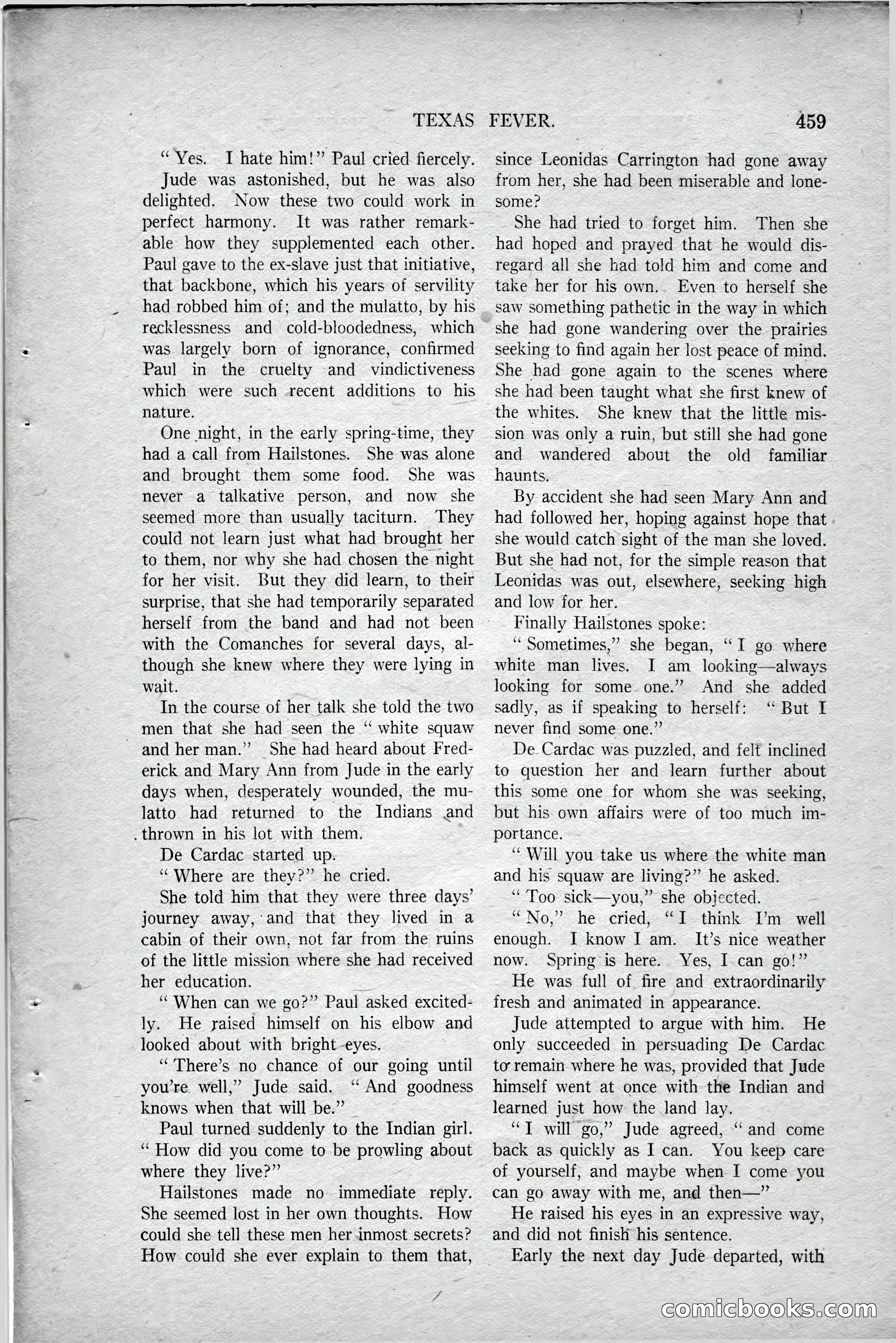
A restored page from Pulp Fiction, 1919. Page through the whole issue in the reader above.
📄 Transcribed text from this page (OCR, searchable)
Machine-transcribed from the original scan — historical spelling and the odd misread are preserved.
TEXAS “Yes. I hate him!” Paul cried fiercely. Jude was astonished, but he was also delighted. Now these two could work in perfect harmony. It was rather remark- able how they supplemented each other. Paul gave to the ex-slave just that initiative, that backbone, which his years of servility had robbed him of; and the mulatto, by his recklessness and cold-bloodedness, which was largely born of ignorance, confirmed Paul in the cruelty and vindictiveness which were such recent additions to his nature. One night, in the early spring-time, they had a call from Hailstones. She was alone and brought them some food. She was never a talkative person, and now she seemed more than usually taciturn. They could not learn just what had brought her to them, nor why she had chosen the night for her visit. But they did learn, to their surprise, that she had temporarily separated herself from the band and had not been with the Comanches for several days, al- though she knew where they were lying in wait. In the course of her talk she told the two men that she had seen the “ white squaw and her man.” She had heard about Fred- erick and Mary Ann from Jude in the early days when, desperately wounded, the mu- latto had returned to the Indians and . thrown in his lot with them. De Cardac started up. ‘“‘ Where are they?” he cried. She told him that they were three days’ journey away, and that they lived in a cabin of their own, not far from the ruins of the little mission where she had received her education. ‘When can we go?” Paul asked excited- ly. He yaised himself on his elbow and looked about with bright-eyes. “'There’s no chance of our going until you're. well,” Jude said. ‘“ And goodness knows when that will be.” Paul turned suddenly to the Indian girl. “ How did you come to be prowling about where they live?” Hailstones made no immediate reply. She seemed lost in her own thoughts. How could she tell these men her inmost secrets? How: could she ever explain to them that, J 459 FEVER. since Leonidas Carrington had gone away from her, she had been miserable and lone- some? She had tried to forget him. Then she had hoped and prayed that he would dis- regard all she had told him and come and take her for his own.. Even to herself she saw something pathetic in the way in which she had gone wandering over the prairies seeking to find again her lost peace of mind. She had gone again to the scenes where she had been taught what she first knew of the whites. She knew that the little mis- sion was only a ruin, but still she had gone and wandered about the old familiar haunts. By accident she had seen Mary Ann and had followed her, hoping against hope that she would catch sight of the man she loved. But she had not, for the simple reason that Leonidas was out, elsewhere, seeking high and low for her. Finally Hailstones spoke: “Sometimes,” she began, “I go where white man lives. I am looking—always looking for some. one.” And she added sadly, as if speaking to herself: “ But I never find some one.” De. Cardac was puzzled, and felt inclined to question her and learn further about this some one for whom she was seeking, but his own affairs were of too much im- portance. “Will you take us where the white man and his squaw are living?” he asked. “Too sick—you,” she objected. “No,” he cried, “I think I’m well enough. I know I am. It’s nice weather now. Spring is here. Yes, I can go!” He was full of fire and extraordinarily fresh and animated in appearance. Jude attempted to argue with him. He only succeeded in persuading De Cardac to remain where he was, provided that Jude himself went at once with the Indian and learned just how the land lay. “JT will go,” Jude agreed, “and come back as quickly as I can. You keep care of yourself, and maybe when I come you can go away with me, and then—” He raised his eyes in an expressive way, and did not finish his sentence. Early the next day Jude departed, with comnmiclooolks.conn