
Pulp Fiction, 1919 · page 12 of 196
Argosy and Railroad Man's Magazine — page 12: what you’re looking at
A restored page from Pulp Fiction, 1919. Page through the whole issue in the reader above.
📄 Transcribed text from this page (OCR, searchable)
Machine-transcribed from the original scan — historical spelling and the odd misread are preserved.
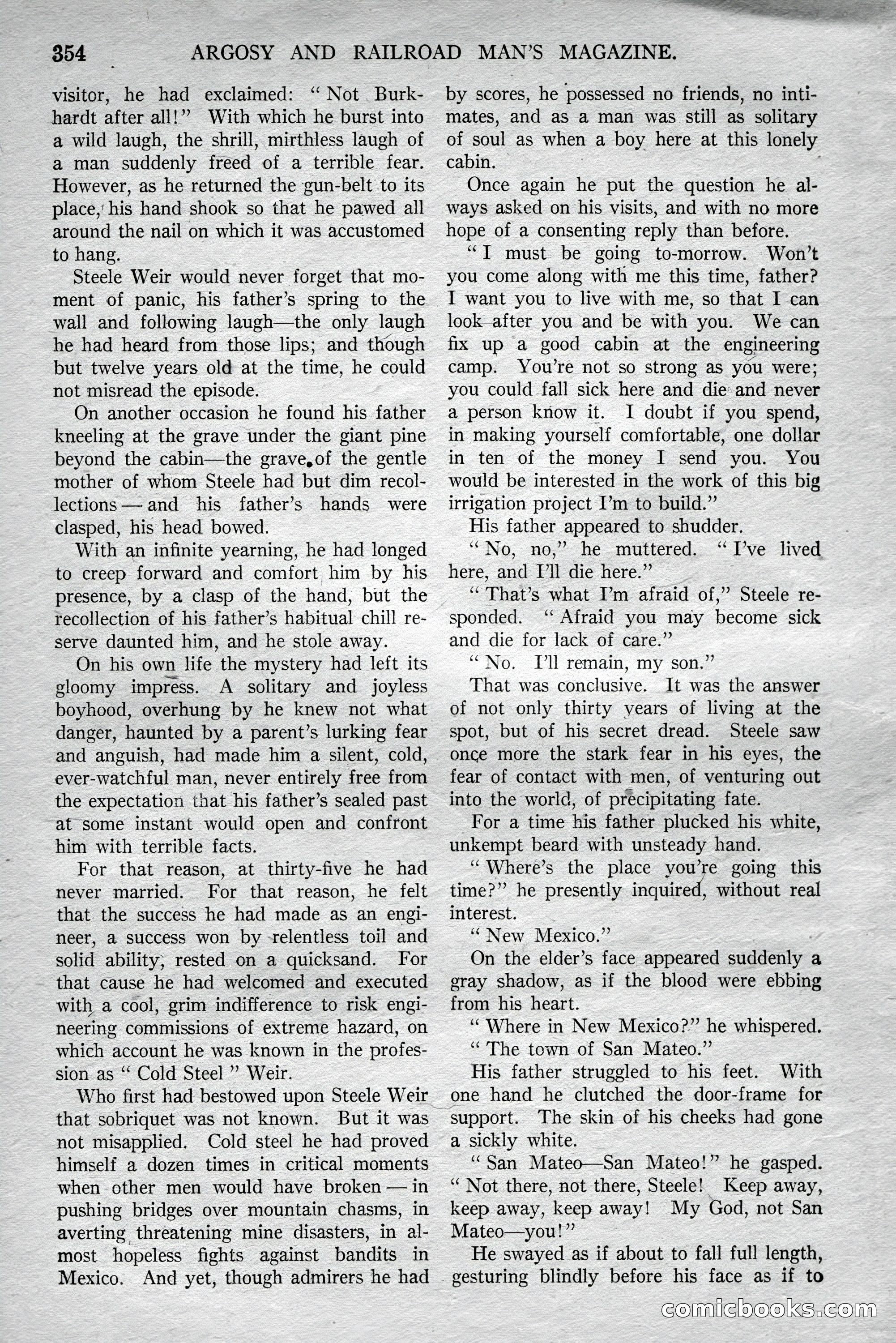
354 visitor, he had exclaimed: ‘ Not _Burk- hardt after all!” With which he burst into a wild laugh, the shrill, mirthless laugh of a man suddenly freed of a terrible fear. However, as he returned the gun-belt to its place, his hand shook so that he pawed all around the nail on which it was accustomed to hang. Steele Weir would never forget that mo- ment of panic, his father’s spring to the wall and following laugh—the only laugh he had heard from those lips; and though but twelve years old at the time, he could not misread the episode. On another occasion he found his father kneeling at the grave under the giant pine beyond the cabin—the grave,of the gentle mother of whom Steele had but dim recol- lections— and his father’s hands were clasped, his head bowed. With an infinite yearning, he had longed to creep forward and comfort him by his presence, by a clasp of the hand, but the recollection of his father’s habitual chill re- serve daunted him, and he stole away. On his own life the mystery had left its gloomy impress. A solitary and joyless boyhood, overhung by he knew not what danger, haunted by a parent’s lurking fear and anguish, had made him a silent, cold, ever-watchful man, never entirely free from the expectation that his father’s sealed past at some instant would open and confront him with terrible facts. For that reason, at thirty-five he had never married. For that reason, he felt that the success he had made as an engi- neer, a success won by -relentless toil and solid ability; rested on a quicksand. For that cause he had welcomed and executed with a cool, grim indifference to risk engi- neering commissions of extreme hazard, on which account he was known in the profes- sion as “‘ Cold Steel ” Weir. Who first had bestowed upon Steele Weir that sobriquet was not known. But it was not misapplied. Cold steel he had proved himself a dozen times in critical moments when other men would have broken — in pushing bridges over mountain chasms, in averting threatening mine disasters, in al- most hopeless fights against bandits in Mexico. And yet, though admirers he had ARGOSY AND RAILROAD MAN’S MAGAZINE. by scores, he possessed no friends, no inti- mates, and as a man was still as solitary of soul as when a boy here at this lonely cabin. : Once again he put the question he al- ways asked on his visits, and with no more hope of a consenting reply than before. “T must be going to-morrow. Won’t you come along with me this time, father? I want you to live with me, so that I can look-after you and be with you. We can fix up a good cabin at the engineering camp. Yow’re not so strong as you were; you could fall sick here and die: and never a person know it. I doubt if you spend, in making yourself comfortable, one dollar in ten of the money I send you. You would be interested in the work of this big irrigation project I’m to build.” His father appeared to shudder. “No, no,” he muttered. “I’ve lived here, and Ill die here.” “That’s what I’m afraid of,” Steele re- sponded. ‘ Afraid you may become sick and die for lack of care.” “No. Ill remain, my son.” That was conclusive. It was the answer of not only thirty years of living at the spot, but of his secret dread. Steele saw once more the stark fear in his eyes, the fear of contact with men, of venturing out into the world, of precipitating fate. For a time his father plucked his white, unkempt beard with unsteady hand. ‘““Where’s the place you’re going this time?” he presently inquired, without real interest. “ New Mexico.” On the elder’s face appeared suddenly a gray shadow, as if the blood were ebbing from his heart. “Where in New Mexico?” he whispered. “The town of San Mateo.” His father struggled to his feet. With one hand he clutched the door-frame for support. The skin of his cheeks had gone a sickly white. ‘““San Mateo—San Mateo!” he gasped. ‘““ Not there, not there, Steele! Keep away, keep away, keep away! My God, not San Mateo—you!”’ He swayed as if about to fall full length, gesturing blindly before his face as if to comniclooolks.conn