
Pulp Fiction, 1919 · page 131 of 196
Argosy and Railroad Man's Magazine — page 131: what you’re looking at
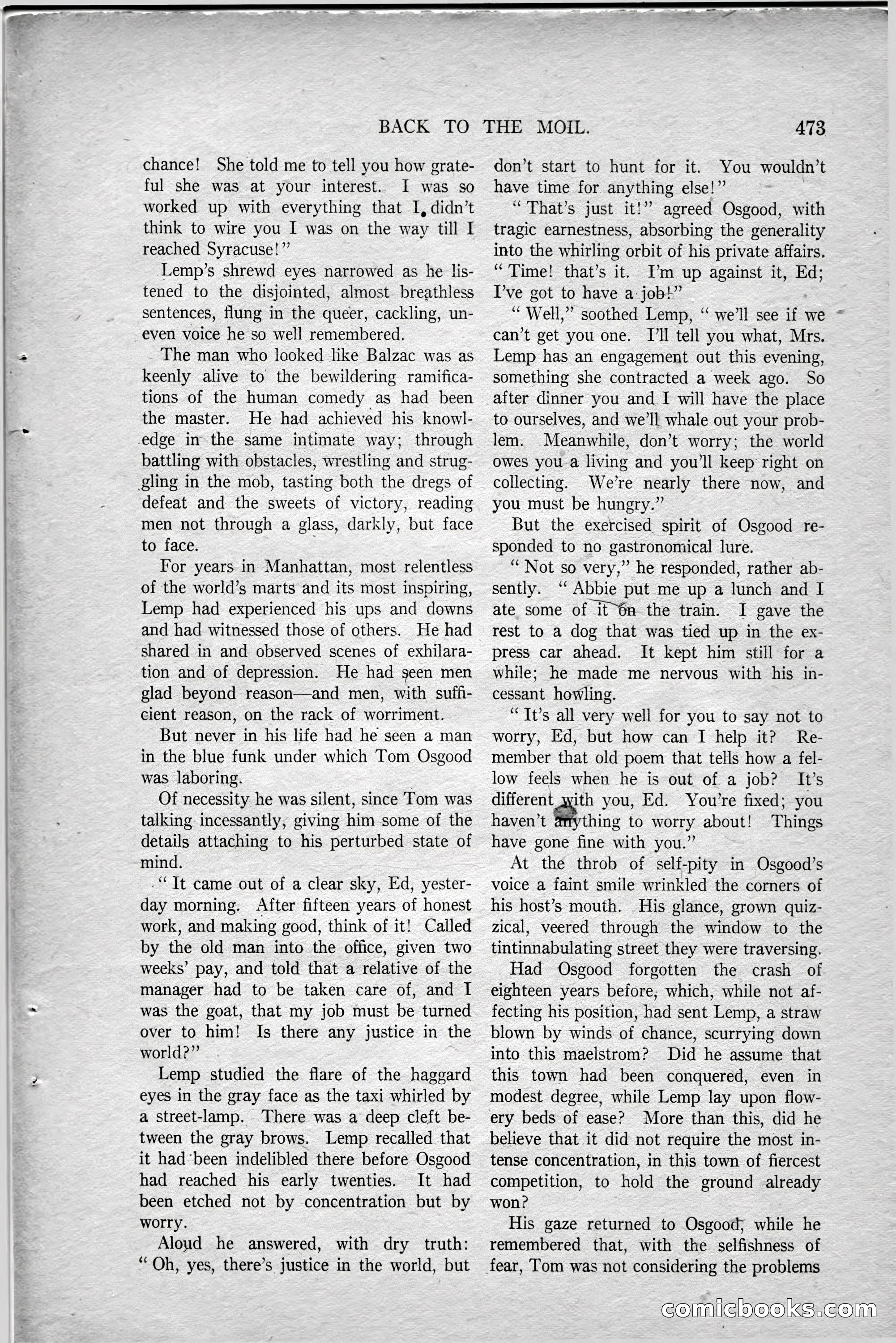
A restored page from Pulp Fiction, 1919. Page through the whole issue in the reader above.
📄 Transcribed text from this page (OCR, searchable)
Machine-transcribed from the original scan — historical spelling and the odd misread are preserved.
~ BACK TO THE MOIL. 473 chance! She told me to tell you how grate- ful she was at your interest. I was so worked up with everything that I, didn’t think to wire you I was on the way till I reached Syracuse!” Lemp’s shrewd eyes narrowed as he lis- tened to the disjointed, almost breathless sentences, flung in the queer, cackling, un- even voice he so well remembered. The man who looked like Balzac was as keenly alive to the bewildering ramifica- tions of the human comedy as had been the master. He had achieved his knowl- edge in the same intimate way; through battling with obstacles, wrestling and strug- gling in the mob, tasting both the dregs of defeat and the sweets of victory, reading men not through a glass, darkly, but face to face. For years. in Manhattan, most relentless of the world’s marts and its most inspiring, Lemp had experienced his ups and downs and had witnessed those of others. He had shared in and observed scenes of exhilara- tion and of depression. He had seen men glad beyond reason—and men, with suffi- cient reason, on the rack of worriment. But never in his life had he seen a man in the blue funk under which Tom Osgood was. laboring. Of necessity. he was silent, since Tom was talking incessantly, giving him some of the details attaching to his perturbed state of mind. “Tt came out of a clear sky, Ed, yester- day morning. After fifteen years of honest work, and making good, think of it! Called by the old man into the office, given two weeks’ pay, and told that a relative of the manager had to be taken care of, and I was the goat, that my job must be turned over to him! Is there any justice in the world?” Lemp studied the flare of the haggard eyes in the gray face as the taxi whirled by a street-lamp. There was a deep cleft be- tween the gray brows. Lemp recalled that it had been indelibled there before Osgood had reached his early twenties. It had been etched not by concentration but by worry. Aloud he answered, with dry truth: “Oh, yes, there’s justice in the world, but don’t start to hunt for it. You wouldn’t have time for anything else!” “That’s just it!” agreed Osgood, with tragic earnestness, absorbing the generality into the whirling orbit of his private affairs. “Time! that’s it. I’m up against it, Ed; I’ve got to have a:job!” “ Well,” soothed Lemp, ‘‘ we’ll see if we ~ can’t get you one. I'll tell you what, Mrs. Lemp has an engagement out this evening, something she contracted a week ago. So after dinner you and I will have the place to ourselves, and we'll whale out your prob- lem. Meanwhile, don’t worry; the world owes you-a living and you'll keep right on collecting. We’re nearly there now, and you must be hungry.” But the exercised spirit of Osgood re- sponded to no gastronomical lure. “Not so very,” he responded, rather ab- sently. ‘‘ Abbie put me up a lunch and I ate some of it 6n the train. I gave the rest to a dog that was tied up in the ex- press car ahead. It kept him still for a while; he made me nervous with his in- cessant howling. “Tt’s all very well for you to say not to worry, Ed, but how can I help it? Re- member that old poem that tells how a fel- low feels when he is out of a job? It’s different with you, Ed. You're fixed; you haven’t a@ffything to worry about! Things have gone fine with you.” At the throb of self-pity in Osgood’s voice a faint smile wrinkled the corners of his host’s mouth. His glance, grown quiz- zical, veered through the window to the tintinnabulating street they were traversing. Had Osgood forgotten the crash of eighteen years before; which, while not af- fecting his position, had sent Lemp, a straw blown by winds of chance, scurrying down into this maelstrom? Did he assume that this town had been conquered, even in modest degree, while Lemp lay upon flow- ery beds of ease? More than this, did he believe that it did not require the most in- tense concentration, in this town of fiercest competition, to hold the ground already won? His gaze returned to Osgood; while he remembered that, with the selfishness of fear, Tom was not considering the problems ConmiclooolksS.conn