
Pulp Fiction, 1919 · page 133 of 196
Argosy and Railroad Man's Magazine — page 133: what you’re looking at
A restored page from Pulp Fiction, 1919. Page through the whole issue in the reader above.
📄 Transcribed text from this page (OCR, searchable)
Machine-transcribed from the original scan — historical spelling and the odd misread are preserved.
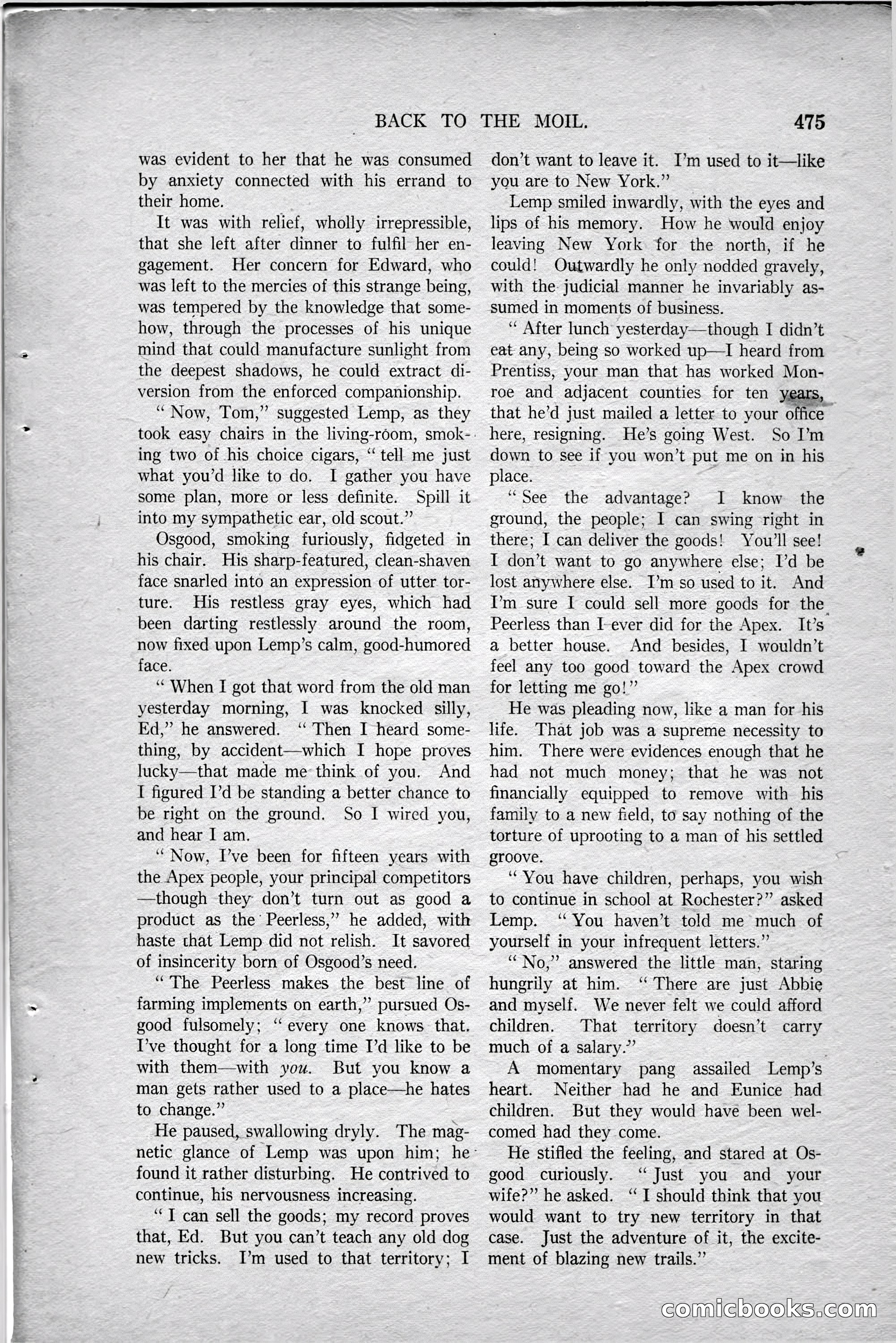
BACK TO THE MOIL. was evident to her that he was consumed by anxiety connected with his errand to their home. It was with relief, wholly irrepressible, that she left after dinner to fulfil her en- gagement. Her concern for Edward, who was left to the mercies of this strange being, was tempered by the knowledge that some- how, through the processes of his unique mind that could manufacture sunlight from the deepest shadows, he could extract di- version from the enforced companionship. “Now, Tom,” suggested Lemp, as they took easy chairs in the living-room, smok-: ing two of his choice cigars, ‘ tel me just what you’d like to do. I gather you have some plan, more or less definite. Spill it into my sympathetic ear, old scout.” Osgood, smoking furiously, fidgeted in his chair. His sharp-featured, clean-shaven face snarled into an expression of utter. tor- ture. His restless gray eyes, which had been darting restlessly around the room, now fixed upon Lemp’s calm, good-humored face. “When I got that word from the old man yesterday morning, I was knocked silly, Ed,” he answered. ‘‘ Then I heard some- thing, by accident—which I hope proves lucky—that made me think of you. And I figured I’d be standing a better chance to be right on the ground. So I wired you, and hear I am, “Now, I’ve been for fifteen years with the Apex people, your principal competitors —though they don’t turn out as good a product as the Peerless,” he added, with haste that Lemp did not relish. It savored of insincerity born of Osgood’s need. “The Peerless makes the best line of farming implements on earth,” pursued Os- good fulsomely; ‘‘ every one knows that. I’ve thought for a long time I’d like to be with them—with you. But you know a man gets rather used to a place—he hates to change.” He paused, swallowing dryly. The mag- netic glance of Lemp was upon him; he: found it rather disturbing. He contrived to continue, his nervousness increasing. ‘‘T can sell the goods; my record proves that, Ed. But you can’t teach any old dog new tricks. I’m used to that territory; I 475 don’t want to leave it. I’m used to it—like you are to New York.” Lemp smiled inwardly, with the eyes and lips of his memory. How he would enjoy leaving New York for the north, if he could! Outwardly he only nodded gravely, with the: judicial manner he invariably as- sumed in moments of business. “ After lunch yesterday—though I didn’t eat any, being so worked up—I heard from Prentiss, your man that has worked Mon- roe and adjacent counties for ten years, that he’d just mailed a letter to your office” here, resigning. He’s going West. So I’m down to see if you won’t put me on in his place. “See the advantage? I know the ground, the people; I can swing right in there; I can deliver the goods! You'll see! I don’t want to go anywhere else; I’d be lost anywhere else. I’m so used to it. And I’m sure I could sell more goods for the. Peerless than I-ever did for the Apex. It’s a better house. And besides, I wouldn’t feel any too good toward the Apex crowd for letting me go!” He was pleading now, like a man for his life. That job was a supreme necessity to him. There were evidences enough that he had not much money; that he was not financially equipped to remove with his family to a new field, to say nothing of the torture of uprooting to a man of his settled groove. ‘You have children, perhaps, you wish to continue in school at Rochester?” asked Lemp. ‘‘ You haven’t told me much of yourself in your infrequent letters.” “No,” answered the little man, staring hungrily at him. ‘‘ There are just Abbie and myself. We never felt we could afford children. That territory doesn’t carry much of a salary.” d A momentary pang assailed Lemp’s heart. Neither had he and Eunice had children. But they would have been wel- comed had they come. He stifled the feeling, and stared at Os- good curiously. ‘Just you and your wife?” he asked. “I should think that you would want to try new territory in that case. Just the adventure of it, the excite- ment of blazing new trails.” comnmiclooolks.conn