
Pulp Fiction, 1919 · page 161 of 196
Argosy and Railroad Man's Magazine — page 161: what you’re looking at
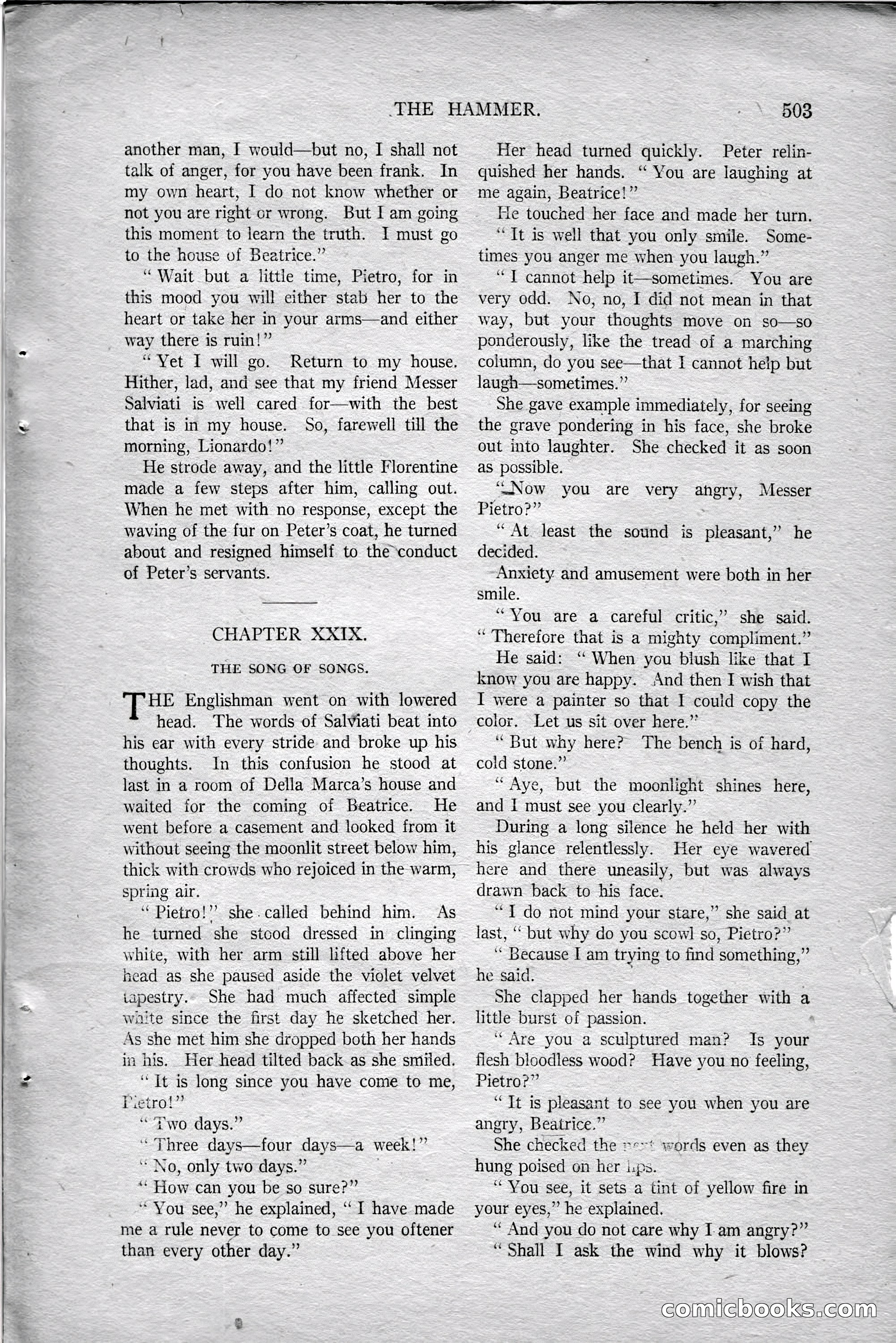
A restored page from Pulp Fiction, 1919. Page through the whole issue in the reader above.
📄 Transcribed text from this page (OCR, searchable)
Machine-transcribed from the original scan — historical spelling and the odd misread are preserved.
¢ hy .THE HAMMER. . 503 another man, I would—but no, I shall not talk of anger, for you have been frank. In my own heart, I do not know whether or not you are right or wrong. But I am going this moment to learn the truth. I must go to the house of Beatrice.” “Wait but a little time, Pietro, for in this mood you will either stab her to the heart or take her in your arms—and either way there is ruin!” “Yet I will go. Return to my house. Hither, lad, and see that my friend Messer Salviati is well cared for—with the best that is in my house. So, farewell till the morning, Lionardo!” He strode away, and the little Florentine made a few steps after him, calling out. When he met with no response, except the waving of the fur on Peter’s coat, he turned about and resigned himself to the conduct of Peter’s servants. CHAPTER XXIX. THE SONG OF SONGS. HE Englishman went on with lowered head. The words of Salviati beat into his ear with every stride and broke up his — thoughts. In this confusion he stood at last in a room of Della Marca’s house and waited for the coming of Beatrice. He went before a casement and looked from it without seeing the moonlit street below him, thick with crowds who rejoiced in the warm, spring air. “Pietro!” she.called behind him. As he turned she stood dressed in clinging white, with her arm still lifted above her head as she paused aside the violet velvet iapestry.. She had much affected simple waite since the first day he sketched her. As she met him she dropped both her hands in his. Her head tilted back as she smiled. “It is long since you have come to me, Pietro!” “two days.” ‘Three days—four days—a week!” “No, only two days.” =e How can you be so sure?” “You see,” he explained, “I have made me a rule never to come to see you oftener than every other day.” @ Her head turned quickly. Peter relin- quished her hands. “ You are laughing at me again, Beatrice!” He touched her face and made her turn. “Tt is well that you only smile. Some- times you anger me when you laugh.” “I cannot help it—sometimes. You are very odd. No, no, I did not mean in that way, but your thoughts move on so—so ponderously, like the tread of a marching column, do you see—that I cannot heip but laugh—sometimes.”’ She gave example immediately, for seeing the grave pondering in his face, she broke out into laughter. She checked it as soon as possible. “Now you are very ahgry, Messer Pietro?” “At least the sound is pleasant,” he decided. Anxiety and amusement were both in her smile. “You are a careful critic,” she said. “ Therefore that is a mighty compliment.” He said: ‘“ When you biush like that I know you are happy. And then I wish that I were a painter so that I could copy the color. Let us sit over here.”’ ‘But why here? The bench is of hard, cold stone.” “ Aye, but the moonlight shines here, and I must see you clearly.” During a long silence he held her with his glance relentlessly. Her eye wavered here and there uneasily, but was always drawn back to his face. “I do not mind your stare,” she said at last, ‘‘ but why do you scowl so, Pietro?” ‘Because I am trying to find something,” he said. She clapped her hands together with a i burst of passion. Are you a sculptured man? Is your flesh bloodless wood? Have you no feeling, Pietro?” “Tt is pleasant to see you when you are angry, Beatrice.” She checked the =°~* hung poised on her ips. “You see, it sets a tint of yellow fire in your eyes,” he explained. ‘And you do not care why I am angry?” “Shall I ask the wind why it blows? words even as they Comniclooolks.comnn