
Pulp Fiction, 1919 · page 180 of 196
Argosy and Railroad Man's Magazine — page 180: what you’re looking at
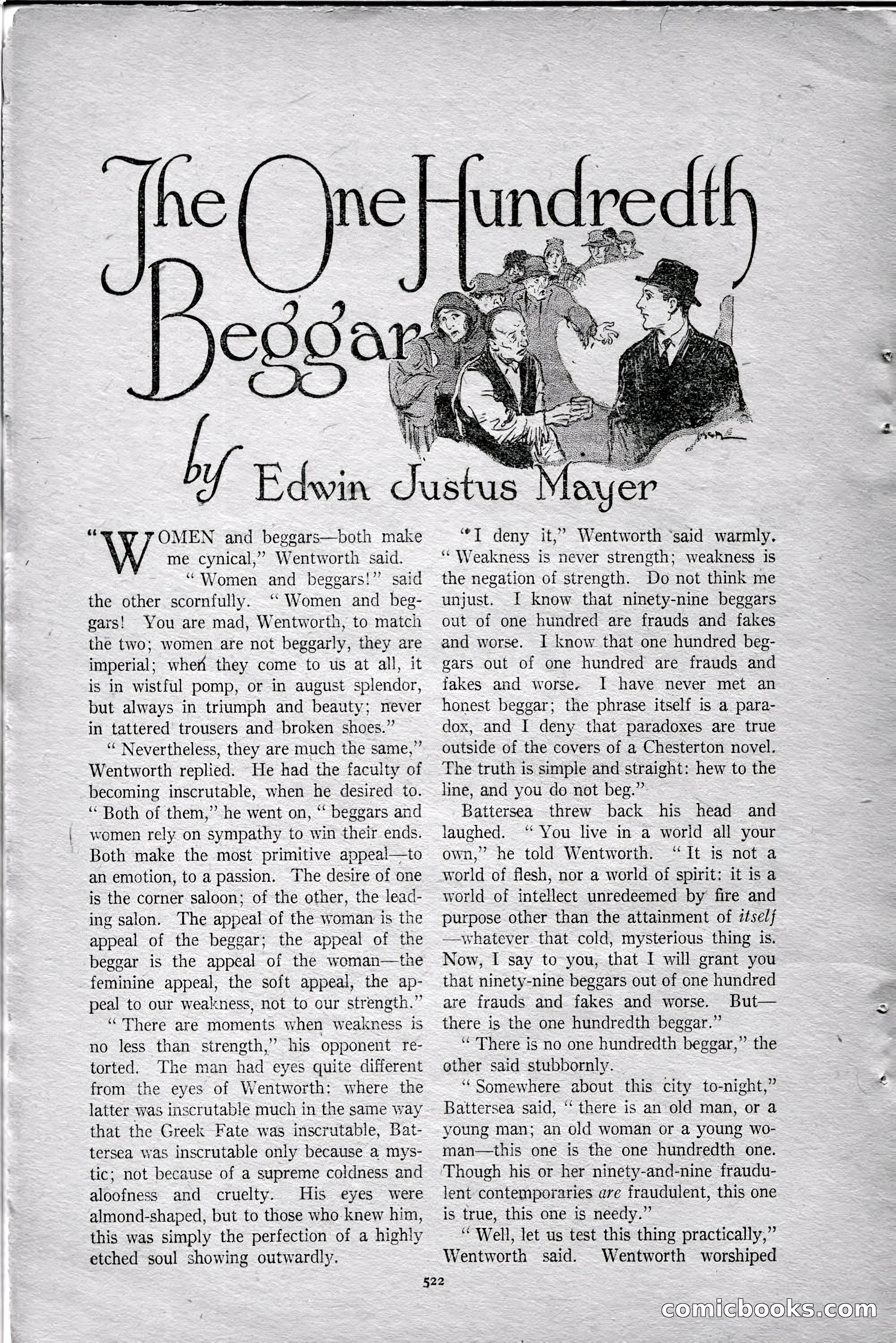
A restored page from Pulp Fiction, 1919. Page through the whole issue in the reader above.
📄 Transcribed text from this page (OCR, searchable)
Machine-transcribed from the original scan — historical spelling and the odd misread are preserved.
by Edwin ee. me cynical,”’ Wentworth said. “Women and beggars!” said the other scornfully. ‘ Women and beg- gars! You are mad, Wentworth, to match the two; women are not beggarly, they are imperial; when they come to us at all, it is in wistful pomp, or in august splendor, but always in triumph and beauty; mever in tattered trousers and broken shoes.” “ Nevertheless, they are much the same,” Wentworth replied. He had the faculty of becoming inscrutable, when he desired to. “Both of them,” he went on, “ beggars and women rely on sympathy to win their ends. Both make the most primitive appeal—to an emotion, to a passion. The desire of one is the corner saloon; of the other, the lead- ing salon. The appeal of the woman is the appeal of the beggar; the appeal of the beggar is the appeal of the woman—the feminine appeal, the soft appeal, the ap- peal to our weakness, not to our strength.” “There are moments when weakness is no less than strength,” his opponent re- torted. The man had eyes quite different from the eyes of Wentworth: where the latter was inscrutable much in the same way that the Greek Fate was inscrutable, Bat- tersea was inscrutable only because a mys- tic; not because of a supreme coldness and aloofness and cruelty. His eyes were almond-shaped, but to those who knew him, this was simply the perfection of a highly etched soul showing outwardly. oe and beggars—both make “IT deny it,” Wentworth ‘said warmly. ** Weakness is never strength; weakness is the negation of strength. Do not think me unjust. JI know that ninety-nine beggars out of one hundred are frauds and fakes and worse. I know that one hundred beg- gars out of one hundred are frauds and fakes and worse. I have never met an honest beggar; the phrase itself is a para- dox, and I deny that paradoxes are true outside of the covers of a Chesterton novel. The truth is simple and straight: hew to the line, and you do not beg.” Battersea threw back his head and laughed. “ You live in a world all your own,” he told Wentworth. “It is not a world of flesh, nor a world of spirit: it is a world of intellect unredeemed by fire and purpose other than the attainment of itself —wwhatever that cold, mysterious thing is. Now, I say to you, that I will grant you that ninety-nine beggars out of one hundred are frauds and fakes and worse. But— there is the one hundredth beggar.” “There is no one hundredth beggar,” the other said stubbornly. “‘Somewhere about this city to-night,” Battersea said, ‘‘ there is an old man, or a young man; an old woman or a young wo- man—this one is the one hundredth one. Though his or her ninety-and-nine fraudu- lent contemporaries ere fraudulent, this one is true, this one is needy.” “Well, let us test this thing practically,” Wentworth said. Wentworth worshiped 522 a << ConniclooolkSaceonn