
Pulp Fiction, 1919 · page 21 of 196
Argosy and Railroad Man's Magazine — page 21: what you’re looking at
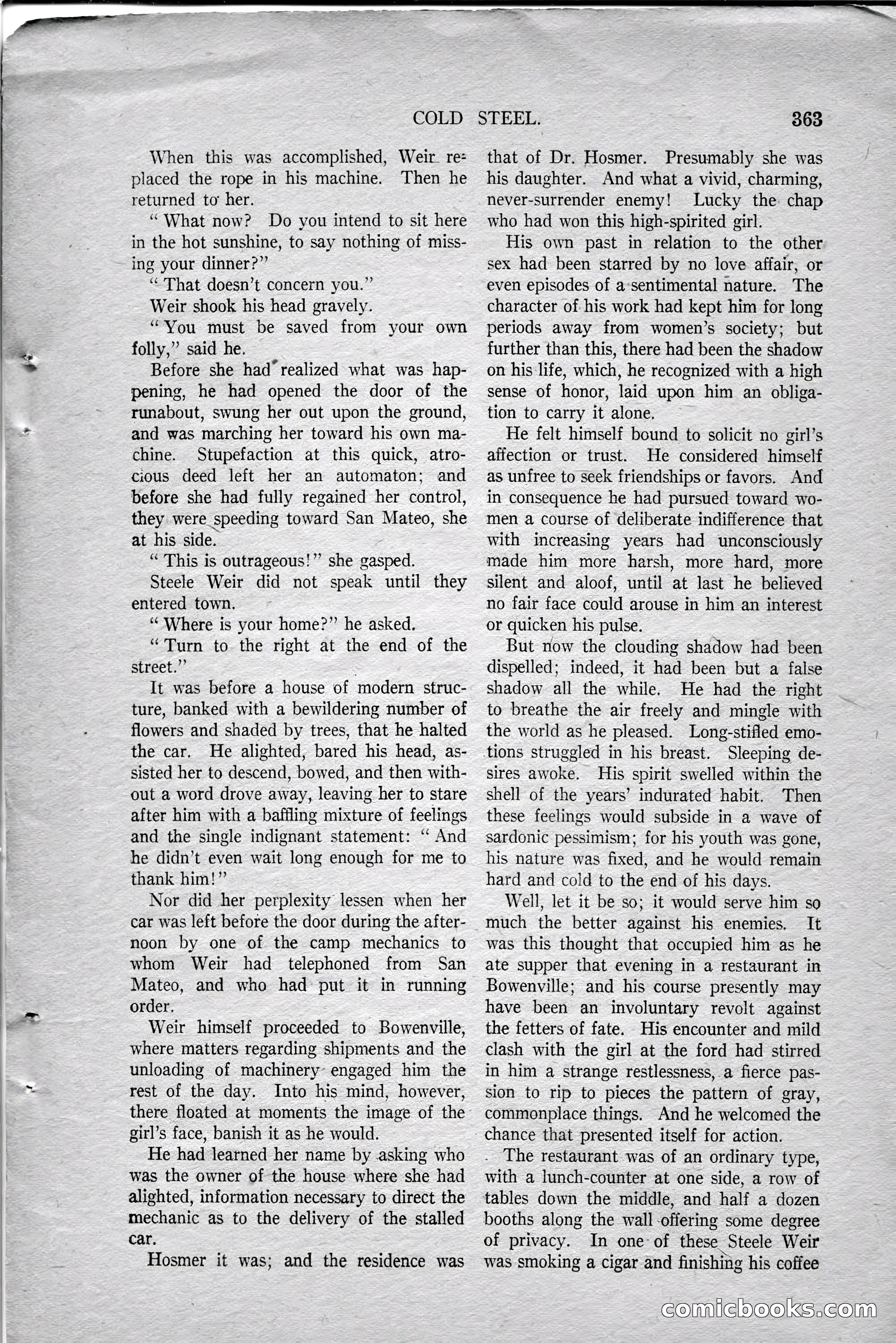
A restored page from Pulp Fiction, 1919. Page through the whole issue in the reader above.
📄 Transcribed text from this page (OCR, searchable)
Machine-transcribed from the original scan — historical spelling and the odd misread are preserved.
COLD STEEL. 363 When this was accomplished, Weir. re: placed the rope in his machine. Then he returned to her. “What now? Do you intend to sit here in the hot sunshine, to say nothing of miss- ing your dinner?” ‘““That doesn’t concern you.” Weir shook his head gravely. “You must be saved from your own folly,” said he. Before she had’ realized what was hap- pening, he had opened the door of the runabout, swung her out upon the ground, and was marching her toward his own ma- chine. Stupefaction at this quick, atro- cious deed left her an automaton; and before she had fully regained her control, they were speeding toward San Mateo, she at his side. “This is outrageous!” she gasped. Steele Weir did not speak until they entered town. “Where is your home?” he asked. “Turn to the right at the end of the street.” : It was before a house of modern struc- ture, banked with a bewildering number of flowers and shaded by trees, that he halted the car. He alighted, bared his head, as- sisted her to descend, bowed, and then with- out a word drove away, leaving her to stare after him with a baffling mixture of feelings and the single indignant statement: ‘“‘ And he didn’t even wait long enough for me to thank him!” Nor did her perplexity lessen when her car was left before the door during the after- noon by one of the camp mechanics to whom Weir had telephoned from San Mateo, and who had* put it in running order. Weir himself proceeded to Bowenville, where matters regarding shipments and the unloading of machinery engaged him the rest of the day. Into his mind, however, there floated at moments the image of the girl’s face, banish it as he would. He had learned her name by asking who was the owner of the house where she had alighted, information necessary to direct the mechanic as to the delivery of the stalled car. Hosmer it was; and the residence was that of Dr. Hosmer. Presumably she was his daughter. And what a vivid, charming, never-surrender enemy! Lucky the chap who had won this high-spirited girl. His own past in relation to the other sex had been starred by no love affair, or even episodes of a:sentimental nature. The character of his work had kept him for long periods away from women’s society; but further than this, there had been the shadow on his life, which, he recognized with a high sense of honor, laid upon him an obliga- tion to carry it alone, He felt himself bound to solicit no girl’s affection or trust. He considered himself as unfree to seek friendships or favors. And in consequence he had pursued toward wo- men a course of deliberate indifference that with increasing years had unconsciously made him more harsh, more hard, more silent and aloof, until at last he believed no fair face could arouse in him an interest or quicken his pulse. But now the clouding shadow had been dispelled; indeed, it had been but a false shadow all the while. He had the right to breathe the air freely and mingle with the world as he pleased. Long-stifled emo- tions struggled in his breast. Sleeping de- sires awoke. His spirit swelled within the shell of the years’ indurated habit. Then these feelings would subside in a wave of sardonic pessimism; for his youth was gone, his nature was fixed, and he would remain hard and cold to the end of his days. Well, let it be so; it would serve him so much the better against his enemies. It was this thought that occupied him as he ate supper that evening in a restaurant in Bowenville; and his course presently may have been an involuntary revolt against the fetters of fate. His encounter and mild clash with the girl at the ford had stirred in him a strange restlessness, a fierce pas- sion to rip to pieces the pattern of gray, commonplace things. And he welcomed the chance that presented itself for action, . The restaurant was of an ordinary type, with a lunch-counter at one side, a row of tables down the middle, and half a dozen booths along the wall-offering some degree of privacy. In one-of these Steele Weir was smoking a cigar and finishing his coffee ConmiclooolkxS.conn