
Pulp Fiction, 1919 · page 27 of 196
Argosy and Railroad Man's Magazine — page 27: what you’re looking at
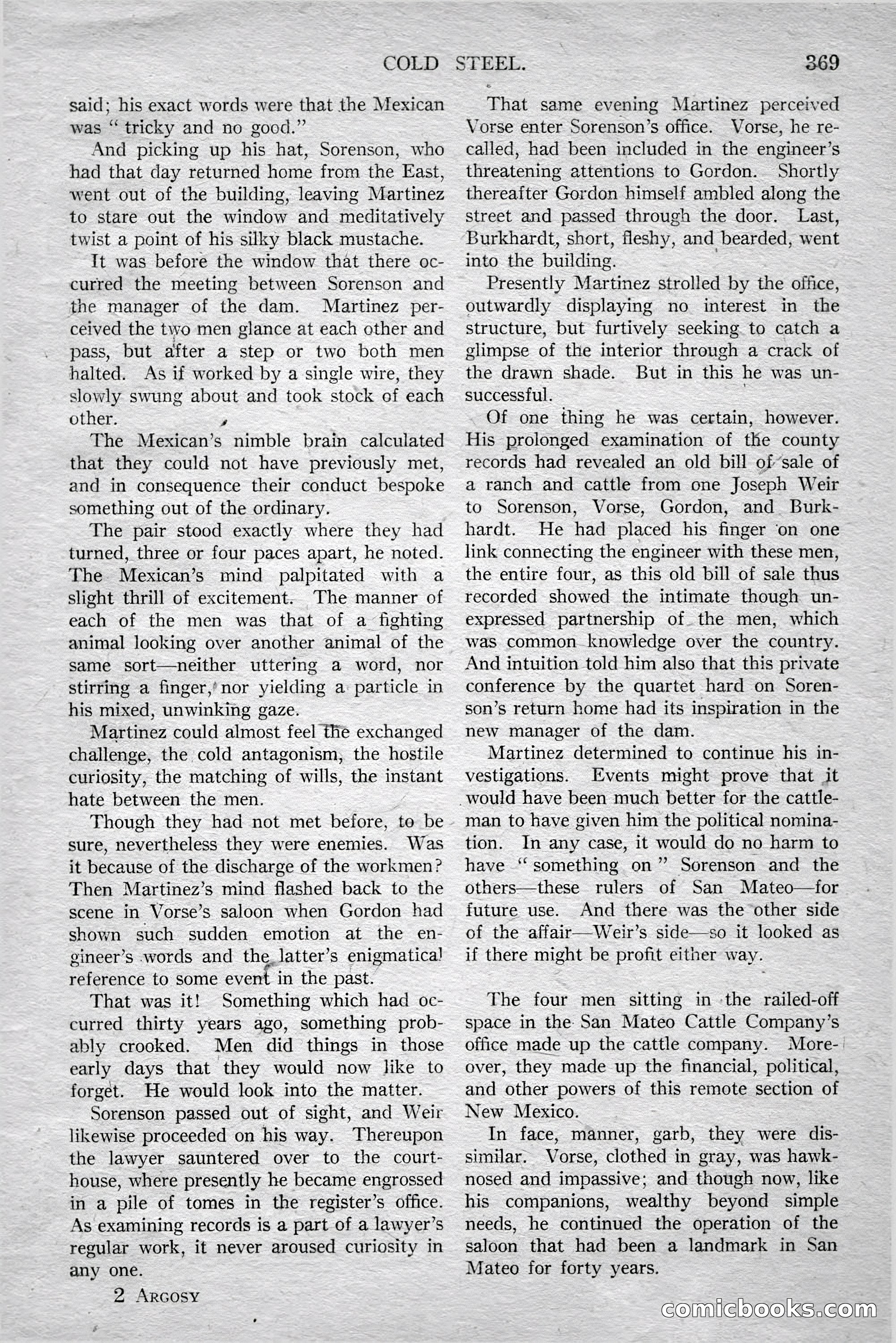
A restored page from Pulp Fiction, 1919. Page through the whole issue in the reader above.
📄 Transcribed text from this page (OCR, searchable)
Machine-transcribed from the original scan — historical spelling and the odd misread are preserved.
COLD said; his exact words were that the Mexican was “tricky and no good.” And picking up his hat, Sorenson, who had that day returned home from the East, went out of the building, leaving Martinez to stare out the window and meditatively twist a point of his silky black mustache. It was before the window that there oc- curred the meeting between Sorenson and the manager of the dam. Martinez per- ceived the two men glance at each other and pass, but after a step or two both men halted. As if worked by a single wire, they slowly swung about and took stock of each other. , The Mexican’s nimble brain calculated that they could not have previously met, and in consequence their conduct bespoke something out of the ordinary. The pair stood exactly where they had turned, three or four paces apart, he noted. The Mexican’s mind palpitated with a slight thrill of excitement. The manner of each of the men was that of a fighting animal looking over another animal of the same sort—neither uttering a word, nor stirring a finger,’nor yielding a particle in his mixed, unwinking gaze. Martinez could almost feel the exchanged challenge, the cold antagonism, the hostile curiosity, the matching of wills, the instant hate between the men. Though they had not met before, to be sure, nevertheless they were enemies. Was it because of the discharge of the workmen? Then Martinez’s mind flashed back to the scene in Vorse’s saloon when Gordon had shown such sudden emotion at the en- gineer’s words and the_latter’s enigmatical reference to some event in the past. That was it! Something which had oc- curred thirty years ago, something prob- ably crooked. Men did things in those early days that they would now like to forget. He would look into the matter. Sorenson passed out of sight, and Weir likewise proceeded on his way. Thereupon the lawyer sauntered over to the court- house, where presently he became engrossed in a pile of tomes in the register’s office. As examining records is a part of a lawyer’s regular work, it never aroused curiosity in any one. 2 ARGOosY STEEL. 369 That same evening Martinez perceived Vorse enter Sorenson’s office. Vorse, he re- called, had been included in the engineer’s threatening attentions to Gordon. Shortly thereafter Gordon himself ambled along the street and passed through the door. Last, Burkhardt, short, fleshy, and bearded, went into the building. ; Presently Martinez strolled by the office, outwardly displaying no interest in the structure, but furtively seeking to catch a glimpse of the interior through a crack of the drawn shade. But in this he was un- successful. Of one thing he was certain, however. His prolonged examination of the county records had revealed an old bill ofsale of a ranch and cattle from one Joseph Weir to Sorenson, Vorse, Gordon, and_ Burk- hardt. He had placed his finger on one link connecting the engineer with these men, the entire four, as this old bill of sale thus recorded showed the intimate though un- expressed partnership of the men, which was common knowledge over the country. And intuition told him also that this private conference by the quartet hard on Soren- son’s return home had its inspiration in the new manager of the dam. Martinez determined to continue his in- vestigations. Events might prove that it _would have been much better for the cattle- man to have given him the political nomina- tion. In any case, it would do no harm to have “something on” Sorenson and the others—these rulers of San Mateo—for future use. And there was the other side of the affair—Weir’s side—so it looked as if there might be profit either way. The four men sitting in -the railed-off space in the: San Mateo Cattle Company’s office made up the cattle company. More-: over, they made up the financial, political, and other powers of this remote section of New Mexico. In face, manner, garb, they were dis- similar. Vorse, clothed in gray, was hawk- nosed and impassive; and though now, like his companions, wealthy beyond simple needs, he continued the operation of the saloon that had been a landmark in San Mateo for forty years. CcomnmiclooolkS.comnn