
Pulp Fiction, 1919 · page 46 of 196
Argosy and Railroad Man's Magazine — page 46: what you’re looking at
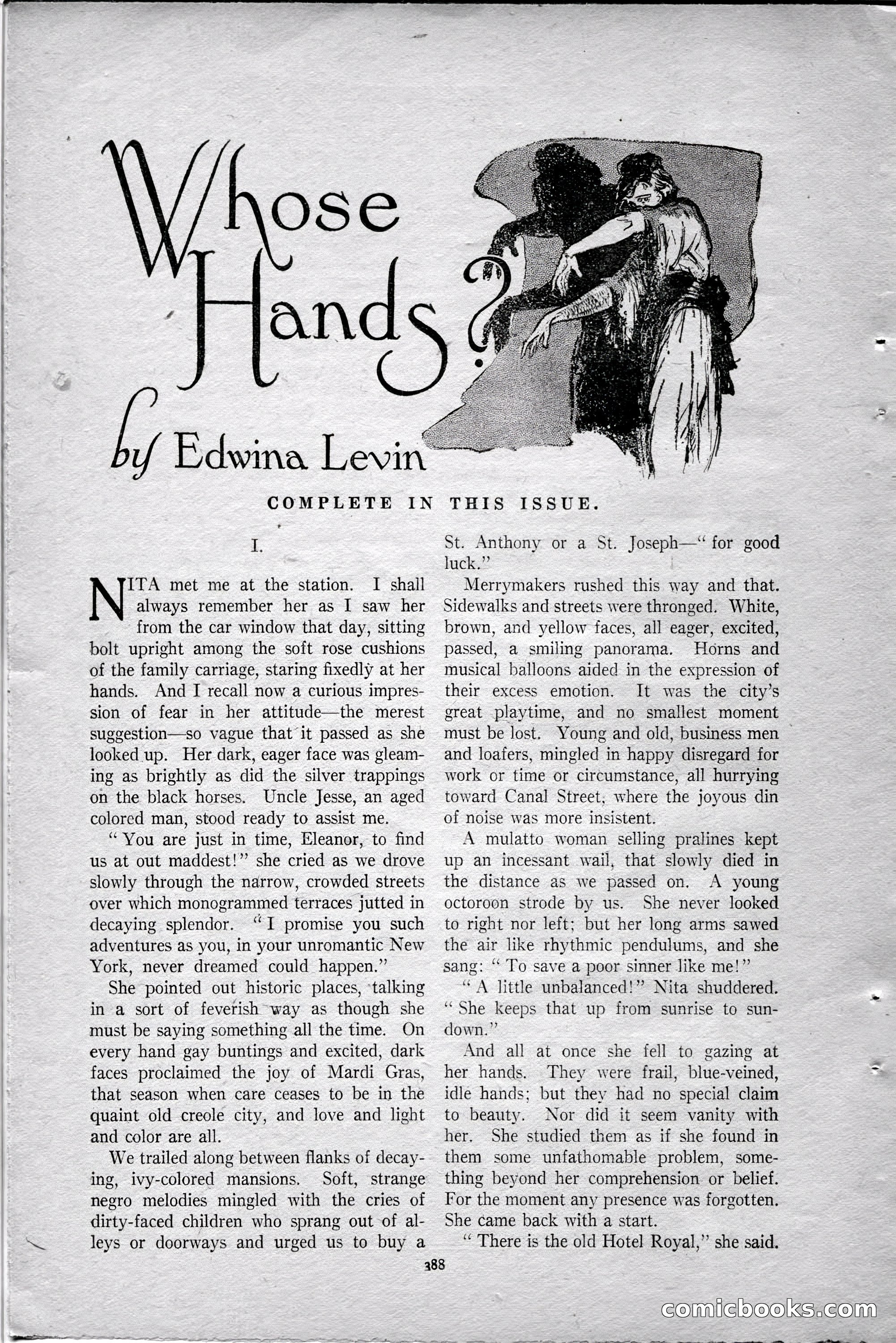
A restored page from Pulp Fiction, 1919. Page through the whole issue in the reader above.
📄 Transcribed text from this page (OCR, searchable)
Machine-transcribed from the original scan — historical spelling and the odd misread are preserved.
OSC Pands g Edwina Levin : COMPLETE IN THIS ISSUE. I. ITA met me at the station. I shall always remember her as I saw her from the car window that day, sitting bolt upright among the soft rose cushions of the family carriage, staring fixedly at her hands. And J recall now a curious impres- sion of fear in her attitude—the merest suggestion—so vague that it passed as she looked up. Her dark, eager face was gleam- ing as brightly as did the silver trappings on the black horses. Uncle Jesse, an aged colored man, stood ready to assist me. “You are just in time, Eleanor, to find us at out maddest!” she cried as we drove slowly through the narrow, crowded streets over which monogrammed terraces jutted in decaying splendor. “I promise you such adventures as you, in your unromantic New York, never dreamed could happen.” She pointed out historic places, ‘talking in a sort of feverish way as though she must be saying something all the time. On every hand gay buntings and excited, dark faces proclaimed the joy of Mardi Gras, that season when care ceases to be in the quaint old creole city, and love and light and color are all. We trailed along between flanks of decay- ing, ivy-colored mansions. Soft, strange negro melodies mingled with the cries of dirty-faced children who sprang out of al- leys or doorways and urged us to buy a St. Anthony or a St. Joseph—“ for good luck.” Merrymakers rushed this way and that. Sidewalks and streets were thronged. White, brown, and yellow faces, all eager, excited, passed, a smiling panorama. Horns and musical balloons aided in the expression of their excess emotion. It was the city’s great playtime, and no smallest moment must be lost. Young and old, business men — and loafers, mingled in happy disregard for work or time or circumstance, all hurrying toward Canal Street; where the joyous din of noise was more insistent. A mulatto woman selling pralines kept up an incessant wail, that slowly died in the distance as we passed on. A young octoroon strode by us. She never looked to right nor left; but her long arms sawed the air like rhythmic pendulums, and she sang: “ To save a poor sinner like me!” “A little unbalanced!” Nita shuddered. “She keeps that up from sunrise to sun- down.” And all at once she fell to gazing at her hands. They were frail, blue-veined, idle hands; but they had no special claim to beauty. Nor did it seem vanity with her. She studied them as if she found in them some unfathomable problem, some- thing beyond her comprehension or belief. For the moment any presence was forgotten. She came back with a start. “There is the old Hotel Royal,” she said. 288 Conmicoool Saco Ser ‘y