
Pulp Fiction, 1919 · page 59 of 196
Argosy and Railroad Man's Magazine — page 59: what you’re looking at
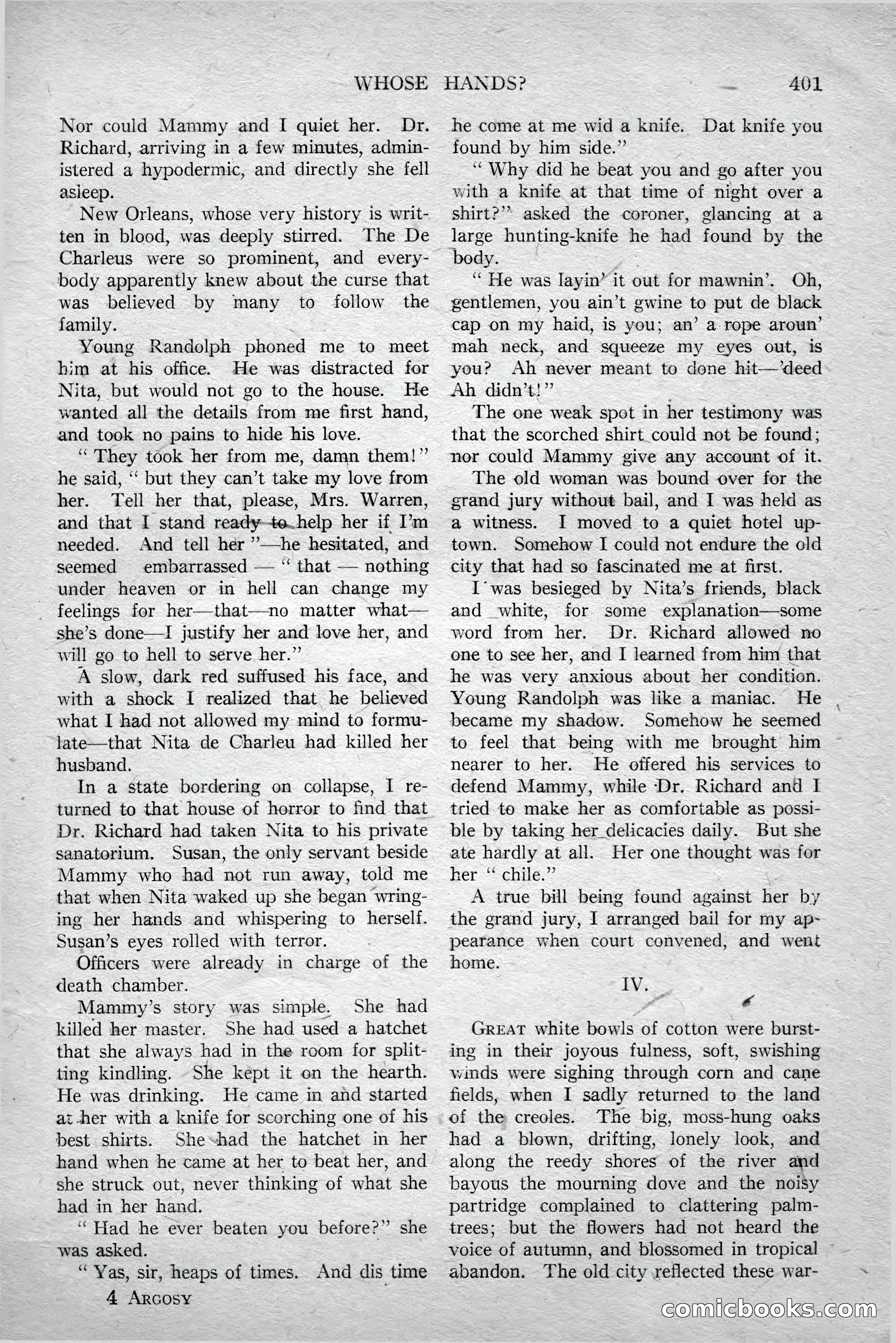
A restored page from Pulp Fiction, 1919. Page through the whole issue in the reader above.
📄 Transcribed text from this page (OCR, searchable)
Machine-transcribed from the original scan — historical spelling and the odd misread are preserved.
WHOSE Nor could Mammy and I quiet her. Dr. Richard, arriving in a few minutes, admin- istered a hypodermic, and directly she fell asieep. New Orleans, whose very history is writ- ten in blood, was deeply stirred. The De Charleus were so prominent, and every- body apparently knew about the curse that was believed by many to follow the family. Young Randolph phoned me to meet him at his office. He was distracted for Nita, but would not go to the house. He wanted all the details from me first hand, and took no pains to hide his love. “They took her from me, damn them!” he said, ‘‘ but they can’t take my love from her. Tell her that, please, Mrs. Warren, and that I stand ready-to_help her if I’m needed. And tell her ”—he hesitated, and seemed embarrassed — “ that — nothing under heaven or in hell can change my feelings for her—that—no matter what— she’s done—I justify her and love her, and will go to hell to serve her.” A slow, dark red suffused his face, and with a shock I realized that he believed what I had not allowed my mind to formu- late—that Nita de Charleu had killed her husband. In a state bordering on collapse, I re- turned to that house of horror to find that Dr. Richard had taken Nita to his private sanatorium. Susan, the only servant beside Mammy who had not run away, told me that when Nita waked up she began wring- ing her hands and whispering to herself. Susan’s eyes rolled with terror. Officers were already in charge of the death chamber. Mammy’s story was simple. She had killed her master. She had used a hatchet that she always had in the room for split- ting kindling. She kept it on the hearth. He was drinking. He came in and started at her with a knife for scorching one of his best shirts. She~had the hatchet in her hand when he came at her to beat her, and she struck out, never thinking of what she had in her hand. “Had he ever beaten you before?” she was asked. “Yas, sir, heaps of times. And dis time 4 Arcosy HANDS? 401 he come at me wid a knife. Dat knife you found by him side.” ‘“ Why did he beat you and go after you with a knife at that time of night over a shirt?’’ asked the coroner, glancing at a large hunting-knife he had found by the body. “He was layin’ it out for mawnin’. Oh, gentlemen, you ain’t gwine to put de black cap on my haid, is you; an’ a rope aroun’ mah neck, and squeeze my eyes out, is you? Ah never meant to done hit—‘deed Ah didn’t!” The one weak spot in her testimony was that the scorched shirt could not be found; nor could Mammy give any account of it. The old woman was bound over for the grand jury without bail, and I was held as a witness. I moved to a quiet hotel up- town. Somehow I could not endure the old city that had so fascinated me at first. I’ was besieged by Nita’s friends, black and white, for some explanation—some word from her. Dr. Richard allowed no one to see her, and I learned from him that he was very anxious about her condition. Young Randolph was like a maniac. He . became my shadow. Somehow he seemed to feel that being with me brought him nearer to her. He offered his services to defend Mammy, while ‘Dr. Richard and I tried te make her as comfortable as possi- ble by taking her delicacies daily. But she ate hardly at all. Her one thought was for her ‘ chile.” A true bill being found against her by the grand jury, I arranged bail for my ap- pearance when court convened, and went home. IV, sn € GREAT white bowls of cotton were burst- ing in their joyous fulness, soft, swishing winds were sighing through corn and cane fields, when I sadly returned to the land of the creoles. The big, moss-hung oaks had a blown, drifting, lonely look, and along the reedy shores of the river and bayous the mourning dove and the noisy partridge complained to clattering palm- trees; but the flowers had not heard the voice of autumn, and blossomed in tropical ~ abandon. The old city reflected these war- Comnmicooolks.conn ~