
Pulp Fiction, 1919 · page 62 of 196
Argosy and Railroad Man's Magazine — page 62: what you’re looking at
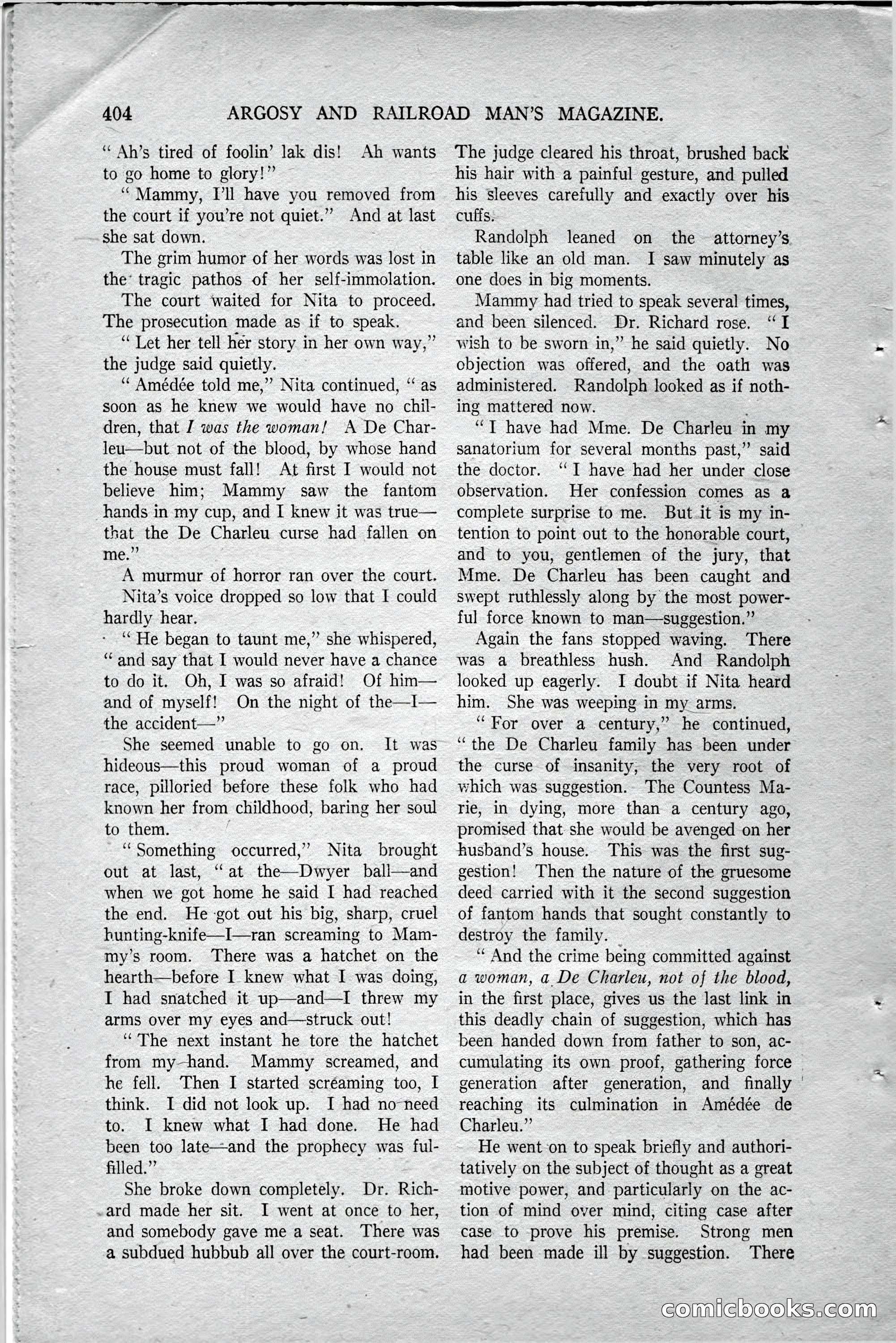
A restored page from Pulp Fiction, 1919. Page through the whole issue in the reader above.
📄 Transcribed text from this page (OCR, searchable)
Machine-transcribed from the original scan — historical spelling and the odd misread are preserved.
404 ARGOSY AND RAILROAD MAN’S MAGAZINE. ‘“* Mh’s tired of foolin’ lak dis! Ah wants to go home to glory!” “Mammy, I'll have you removed from the court if you’re not quiet.” And at last she sat down. The grim humor of her words was lost in the’ tragic pathos of her self-immolation. The court ‘waited for Nita to proceed. The prosecution made as if to speak. “Let her tell her story in her own way,” the judge said quietly. ‘““Amédée told me,” Nita continued, “as soon as he knew we would have no chil- dren, that J was the woman! A De Char- leu—but. not of the blood, by whose hand the house must fall! At first I would not believe him; Mammy saw the fantom hands in my cup, and I knew it was true— that the De Charleu curse had fallen on me.” A murmur of horror ran over the court. Nita’s voice dropped so low that I could hardly hear. ““He began to taunt me,” she whispered, “and say that I would never have a chance to do it. Oh, I was so afraid! Of him— and of myself! On the night of the—I— the accident—” She seemed unable to go on. It was hideous—this proud woman of a proud race, pilloried before these folk who had known her from childhood, baring her soul to them. é “Something occurred,” Nita brought out at last, “at the—Dwyer ball—and when we got home he said I had reached the end. He got out his big, sharp, cruel hunting-knife—I—+ran screaming to Mam- my’s room. There was a hatchet on the hearth—before I knew what I was doing, I had snatched it up—and—I threw my arms over my eyes and—struck out! “The next instant he tore the hatchet from my—hand. Mammy screamed, and he fell. Then I started screaming too, I think. I did not look up. I had no-need to. I knew what I had done. He had been too late—and the prophecy was ful- filled.” : She broke down completely. Dr. Rich- ard made her sit. I went at once to her, and somebody gave me a seat. There was a subdued hubbub all over the court-room. The judge cleared his throat, brushed back his hair with a painful gesture, and pulled his Sleeves carefully and exactly over his cuffs. Randolph leaned on the — attorney’s table like an old man. I saw minutely as one does in big moments. Mammy had tried to speak several times, and been silenced. Dr. Richard rose. “I wish to be sworn in,” he said quietly. No objection was offered, and the oath was administered. Randolph looked as if noth- ing mattered now. : “T have had Mme. De Charleu in my sanatorium for several months past,” said the doctor. “I have had her under close observation. Her confession comes as a complete surprise to me. But-it is my in- tention to point out to the honorable court, and to you, gentlemen of the jury, that Mme. De Charleu has been caught and swept ruthlessly along by the most power- ful force known to man—suggestion.” Again the fans stopped waving. There was a breathless hush. And Randolph looked up eagerly. I doubt if Nita heard him. She was weeping in my arms. “For over a century,” he continued, “the De Charleu family has been under the curse of insanity, the very root of which was suggestion.- The Countess Ma- rie, in dying, more than a century ago, promised that she would be avenged on her kusband’s house. This was the first sug- gestion! Then the nature of the gruesome deed carried with it the second suggestion of fantom hands that sought constantly to destroy the family. “And the crime being committed against a woman, a De Charleu, not of the blood, in the first place, gives us the last link in this deadly chain of suggestion, which has been handed down from father to son, ac- cumulating its own proof, gathering force generation after generation, and finally ¢ reaching its culmination in Amédée de Charleu.” He went-on to speak briefly and authori- tatively on the subject of thought as a great motive power, and particularly on the ac- tion of mind over mind, citing case after case to prove his premise. Strong men had been made ill by suggestion. There ) comicbooks-com