
Pulp Fiction, 1919 · page 91 of 196
Argosy and Railroad Man's Magazine — page 91: what you’re looking at
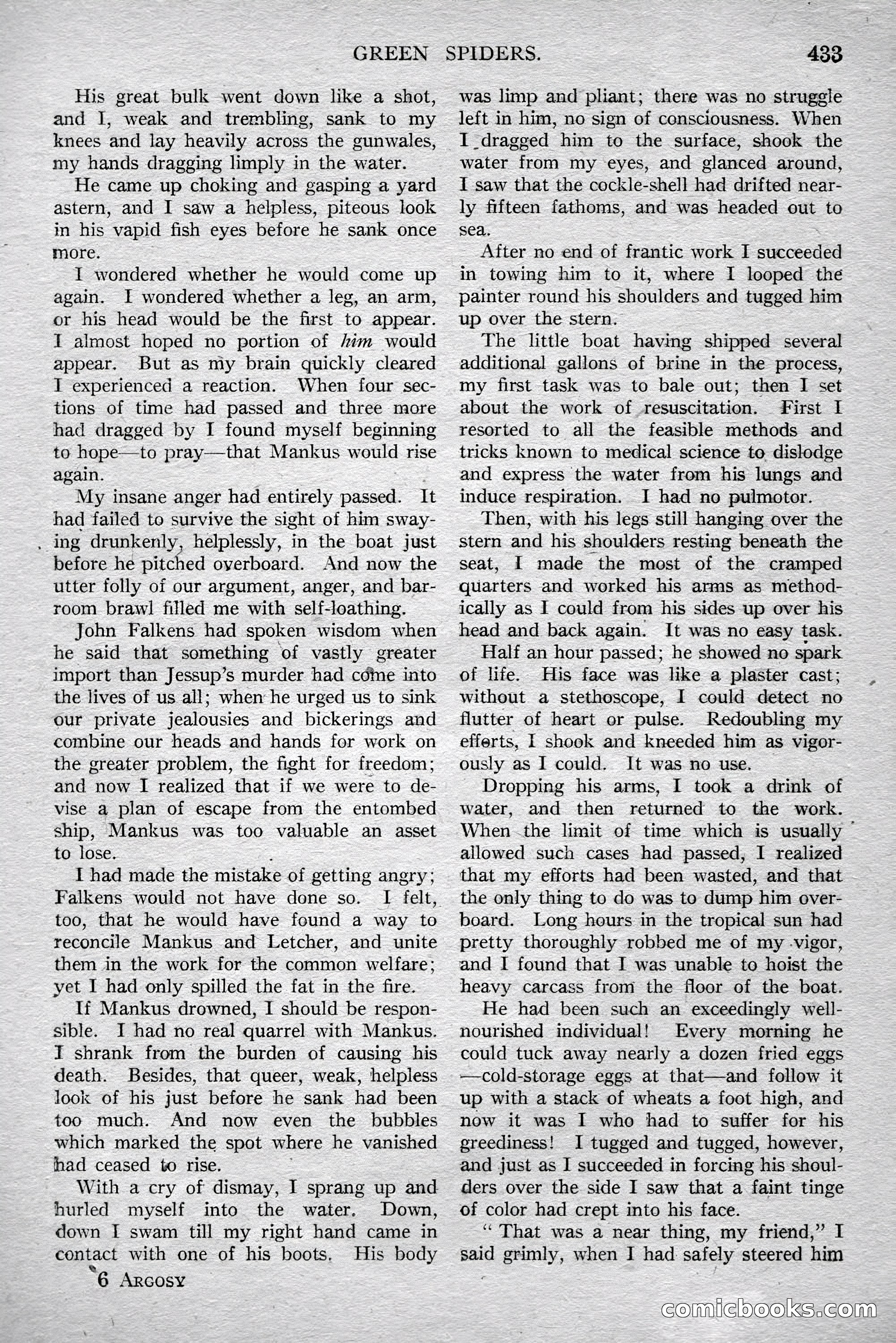
A restored page from Pulp Fiction, 1919. Page through the whole issue in the reader above.
📄 Transcribed text from this page (OCR, searchable)
Machine-transcribed from the original scan — historical spelling and the odd misread are preserved.
GREEN SPIDERS. His great bulk went down lke a shot, and I, weak and trembling, sank to my knees and lay heavily across the gunwales, my hands dragging limply in the water. He came up choking and gasping a yard astern, and I saw a helpless, piteous look in his vapid fish eyes before he sank once more. I wondered whether he would come up again. I wondered whether a leg, an arm, or his head would be the first to appear. I almost hoped no portion of him would appear. But as my brain quickly cleared I experienced a reaction. When four sec- tions of time had passed and three more had dragged by I found myself beginning to hope—to pray—that Mankus would rise again. My insane anger had entirely passed. It had failed to survive the sight of him sway- . ing drunkenly, helplessly, in the boat just before he pitched overboard. And now the utter folly of our argument, anger, and bar- room brawl filled me with self-loathing. John Falkens had spoken wisdom when he said that something of vastly greater import than Jessup’s murder had cdme into the lives of us all; when he urged us to sink our private jealousies and bickerings and combine our heads and hands for work on the greater problem, the fight for freedom; and now I realized that if we were to de- vise a plan of escape from the entombed ship, Mankus was too valuable an asset to lose. : I had made the mistake of getting angry; Falkens would not have done so. too, that he would have found a way to reconcile Mankus and Letcher, and unite them in the work for the common welfare; yet I had only spilled the fat in the fire. If Mankus drowned, I should be respon- sible. I had no real quarrel with Mankus. I shrank from the burden of causing his death. Besides, that queer, weak, helpless look of his just before he sank had been too much. And now even the bubbles which marked the spot where he vanished had ceased to rise. : With a cry of dismay, I sprang up and hurled myself into the water. Down, down I swam till my right hand came in contact with one of his boots. His body “6 ARGOsY I felt, 433 was limp and pliant; there was no strugele left in him, no sign of consciousness. When I _dragged him to the surface, shook the water from my eyes, and glanced around, Isaw that the cockle-shell had drifted near- ly fifteen fathoms, and was headed out to sea. After no end of frantic work I succeeded in towing him to it, where I looped the painter round his shoulders and tugged him up over the stern. The little boat having shipped several additional gallons of brine in the process, my first task was to bale out; then I set about the work of_resuscitation. First I resorted to all the feasible methods and tricks known to medical science to dislodge and express the water from his lungs and induce respiration. I had no pulmotor. Then, with his legs still hanging over the stern and his shoulders resting beneath the seat, I made the most of the cramped quarters and worked his arms as method- ically as I could from his sides up over his head and back again. It was no easy task. Half an hour passed; he showed no spark of life. His face was like a plaster cast; without a stethoscope, I could detect no flutter of heart or pulse. Redoubling my efferts, I shook and kneeded him as vigor- ously as I could. It was no use. Dropping his arms, I took a drink of water, and then returned to the work. When -the limit of time which is usually ~ allowed such cases had passed, I realized that my efforts had been wasted, and that the only thing to do was to dump him over- board. Long heurs in the tropical sun had pretty thoroughly robbed me of my -vigor, and I found that I was unable to hoist the heavy carcass from the floor of the boat. He had been such an exceedingly well- nourished individual! Every morning he could tuck away nearly a dozen fried eggs —cold-storage eggs at that—and follow it up with a stack of wheats a foot high, and now it was I who had to suffer for his greediness! I tugged and tugged, however, and just as I succeeded in forcing his shoul- ders over the side I saw that a faint tinge of color had crept into his face. “That was a near thing, my friend,” I said grimly, when I had safely steered him comiclooolkks.comn