
Pulp Fiction, 1923 · page 139 of 180
Argosy All-Story Weekly — page 139: what you’re looking at
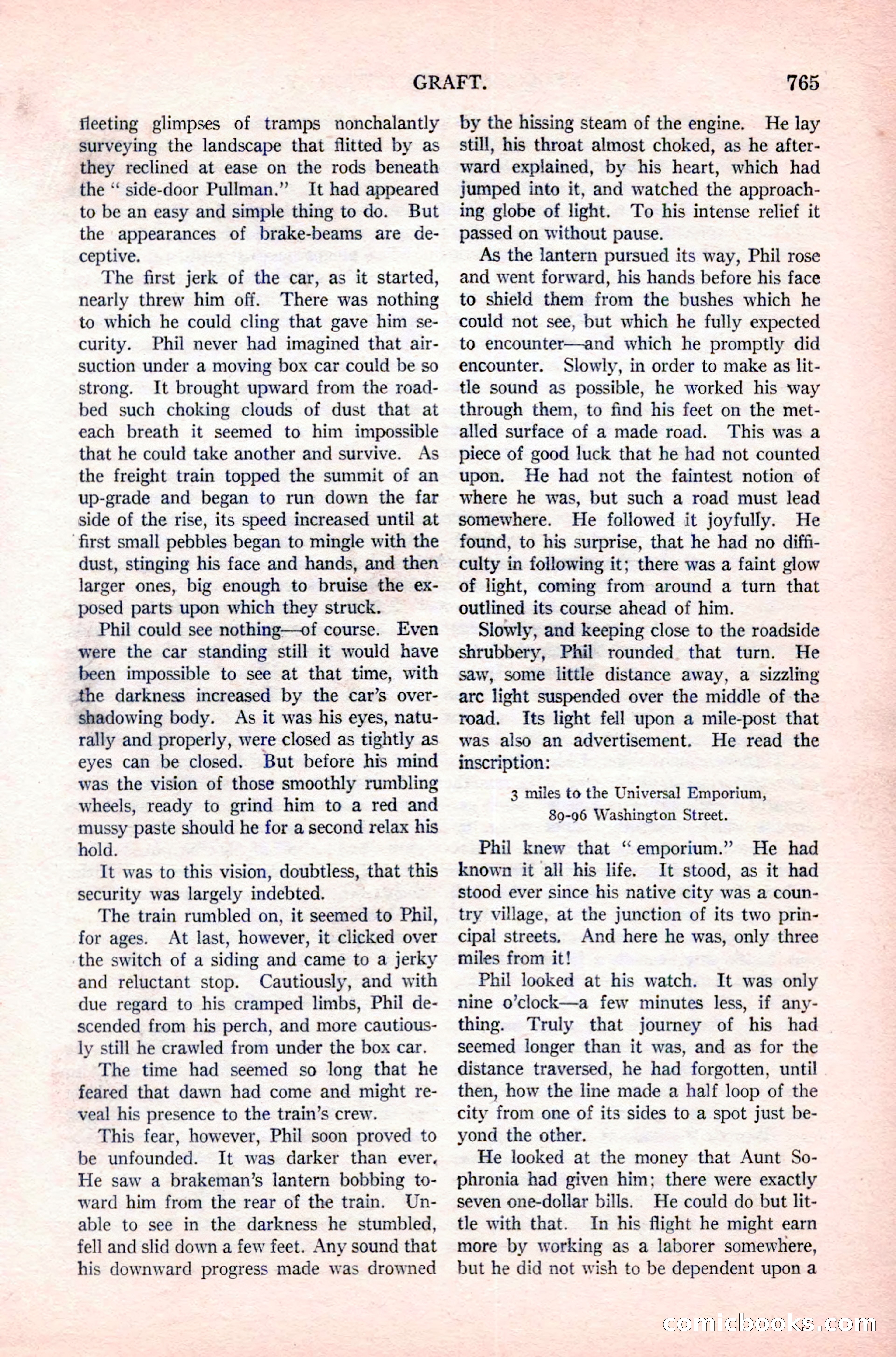
A restored page from Pulp Fiction, 1923. Page through the whole issue in the reader above.
📄 Transcribed text from this page (OCR, searchable)
Machine-transcribed from the original scan — historical spelling and the odd misread are preserved.
GRAFT. fleeting glimpses of tramps nonchalantly surveying the landscape that flitted by as they reclined at ease on the rods beneath the ‘‘ side-door Pullman.” It had appeared to be an easy and simple thing to do. But the appearances of brake-beams are de- ceptive. The first jerk of the car, as it started, nearly threw him off. There was nothing to which he could cling that gave him se- curity. Phil never had imagined that air- suction under a moving box car could be so strong. It brought upward from the road- bed such choking clouds of dust that at each breath it seemed to him impossible that he could take another and survive. As the freight train topped the summit of an up-grade and began to run down the far side of the rise, its speed increased until at first small pebbles began to mingle with the dust, stinging his face and hands, and then larger ones, big enough to bruise the ex- posed parts upon which they struck. Phil could see nothing—of course. Even were the car standing still it would have been impossible to see at that time, with the darkness increased by the car’s over- shadowing body. As it was his eyes, natu- rally and properly, were closed as tightly as eyes can be closed. But before his mind was the vision of those smoothly rumbling wheels, ready to grind him to a red and mussy paste should he for a second relax his hold. It was to this vision, doubtless, that this security was largely indebted. The train rumbled on, it seemed to Phil, for ages. At last, however, it clicked over the switch of a siding and came to a jerky and reluctant stop. Cautiously, and with due regard to his cramped limbs, Phil de- scended from his perch, and more cautious- ly still he crawled from under the box car. The time had seemed so long that he feared that dawn had come and might re- veal his presence to the train’s crew. This fear, however, Phil soon proved to be unfounded. It was darker than ever. He saw a brakeman’s lantern bobbing to- ward him from the rear of the train. Un- able to see in the darkness he stumbled, fell and slid down a few feet. Any sound that his downward progress made was drowned 765 by the hissing steam of the engine. He lay still, his throat almost choked, as he after- ward explained, by his heart, which had jumped into it, and watched the approach- ing globe of light. To his intense relief it passed on without pause. As the lantern pursued its way, Phil rose and went forward, his hands before his face to shield them from the bushes which he could not see, but which he fully expected to encounter—and which he promptly did encounter. Slowly, in order to make as lit- tle sound as possible, he worked his way through them, to find his feet on the met- alled surface of a made road. This was a piece of good luck that he had not counted upon. He had not the faintest notion of where he was, but such a road must lead somewhere. He followed it joyfully. He found, to his surprise, that he had no diffi- culty in following it; there was a faint glow of light, coming from around a turn that outlined its course ahead of him. Slowly, and keeping close to the roadside shrubbery, Phil rounded that turn. He saw, some little distance away, a sizzling arc light suspended over the middle of the road. Its light fell upon a mile-post that was also an advertisement. He read the inscription: 3 miles to the Universal Emporium, 89-96 Washington Street. Phil knew that “emporium.” He had known it all his life. It stood, as it had stood ever since his native city was a coun- try village, at the junction of its two prin- cipal streets. And here he was, only three miles from it! Phil looked at his watch. It was only nine o’clock—a few minutes less, if any- thing. Truly that journey of his had seemed longer than it was, and as for the distance traversed, he had forgotten, until then, how the line made a half loop of the city from one of its sides to a spot just be- yond the other. He looked at the money that Aunt So- phronia had given him; there were exactly seven one-dollar bills. He could do but lit- tle with that. In his flight he might earn more by working as a laborer somewhere, but he did not wish to be dependent upon a Go VOOKS AMG (C@