
Pulp Fiction, 1923 · page 140 of 180
Argosy All-Story Weekly — page 140: what you’re looking at
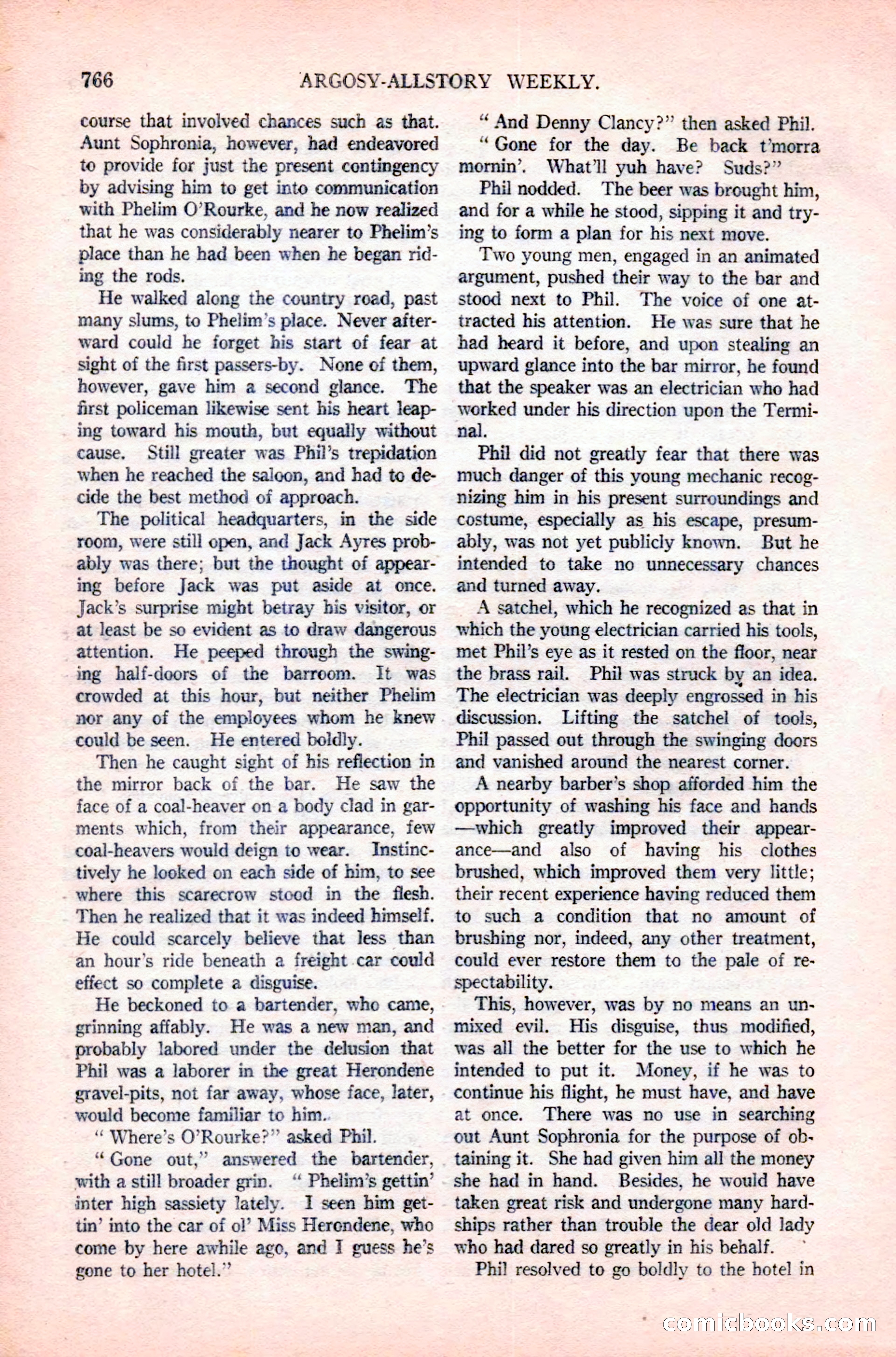
A restored page from Pulp Fiction, 1923. Page through the whole issue in the reader above.
📄 Transcribed text from this page (OCR, searchable)
Machine-transcribed from the original scan — historical spelling and the odd misread are preserved.
766 course that involved chances such as that. Aunt Sophronia, however, had endeavored to provide for just the present centingency by advising him to get into communication with Phelim O’Rourke, and he now realized that he was considerably nearer to Phelim’s place than he had been when he began rid- ing the rods. He walked along the country road, past many slums, to Phelim’s place. Never after- ward could he forget his start of fear at sight of the first passers-by. None of them, however, gave him a second glance. The first policeman likewise sent his heart leap- ing toward his mouth, but equally without cause. Still greater was Phil’s trepidation when he reached the saleon, and had to de- cide the best method of approach. The political headquarters, in the side room, were still open, and Jack Ayres prob- ably was there; but the thought of appear- ing before Jack was put aside at once. Jack’s surprise might betray his visitor, or at least be so evident as to draw dangerous attention. He peeped through the swing- ing half-deors ef the barroom. It was crowded at this hour, but neither Phelim nor any of the employees whom he knew could be seen. He entered boldly. Then he caught sight of his reflection in the mirror back of the bar. He saw the face of a coal-heaver on a body clad in gar- ments which, from their appearance, few coal-heavers would deign to wear. Instinc- tively he looked on each side of him, to see - where this scarecrow steed in the flesh. Then he realized that it was indeed himself. He could scarcely believe that less than an hour’s ride beneath a freight car could effect so complete a disguise. He beckoned to a bartender, who came, grinning affably. He was a new man, and probably labored under the delusion that Phil was a laborer in the great Herondene gravel-pits, not far away, whose face, later, would become familiar to him.. ‘“'Where’s O’Rourke?” asked Phil. “Gone out,” answered the bartender, with a still broader grin. “ Phelim’s gettin’ inter high sassiety lately. I seen him get- tin’ mto the car of ol’ Miss Herendene, who come by here awhile ago, and I guess he’s gone to her hotel.” ARGOSY-ALLSTORY WEEKLY. “And Denny Clancy?” then asked Phil. “Gone for the day. Be back t’morra mornin’. What’ll yuh have? Suds?” Phil nodded. The beer was brought him, and for a while he stood, sipping it and try- ing to form a plan for his next move. Two young men, engaged in an animated argument, pushed their way to the bar and stood next to Phil. The voice of one at- tracted his attention. He was sure that he had heard it before, and upon stealing an upward glance into the bar mirror, he found that the speaker was an electrician who had worked under his direction upon the Termi- nal. Phil did not greatly fear that there was much danger of this young mechanic recog- nizing him in his present surroundings and costume, especially as his escape, presum- ably, was not yet publicly known. But he intended to take no unnecessary chances and turned away. A satchel, which he recognized as that in which the young electrician carried his tools, met Phil’s eye as it rested on the floor, near the brass rail. Phil was struck by an idea. The electrician was deeply engrossed in his discussion. Lifting the satchel of tools, Phil passed out through the swinging doors and vanished around the nearest corner. A nearby barber’s shop afforded him the opportunity of washing his face and hands —which greatly improved their appear- ance—and also of having his clothes brushed, which improved them very little; their recent experience having reduced them to such a condition that no amount of brushing nor, indeed, any other treatment, could ever restore them to the pale of re- spectability. This, however, was by no means an un- mixed evil. His disguise, thus modified, was all the better for the use to which he intended to put it. Money, if he was to continue his flight, he must have, and have at once. There was no use in searching out Aunt Sophronia for the purpose of ob- taining it. She had given him all the money she had in hand. Besides, he would have taken great risk and undergone many hard- ships rather than trouble the dear old lady who had dared so greatly in his behalf. — Phil resolved to go boldly to the hotel in * eCoOmicoookxs (C@