
Pulp Fiction, 1923 · page 141 of 180
Argosy All-Story Weekly — page 141: what you’re looking at
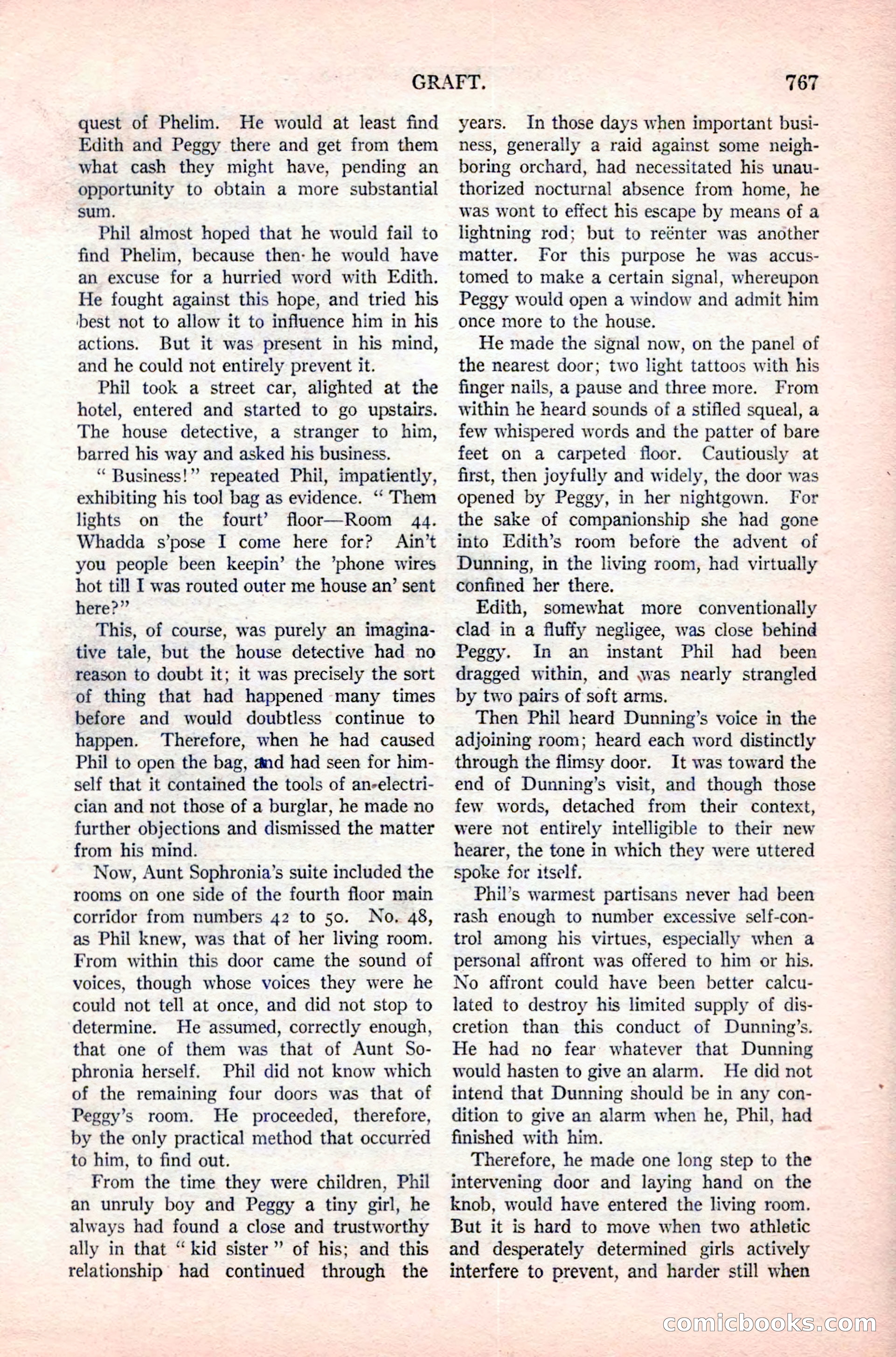
A restored page from Pulp Fiction, 1923. Page through the whole issue in the reader above.
📄 Transcribed text from this page (OCR, searchable)
Machine-transcribed from the original scan — historical spelling and the odd misread are preserved.
GRAFT, quest of Phelim. He would at least find Edith and Peggy there and get from them what cash they might have, pending an opportunity to obtain a more substantial sum. Phil almost hoped that he would fail to find Phelim, because then: he would have an excuse for a hurried word with Edith. He fought against this hope, and tried his ‘best not to allow it to influence him in his actions. But it was present in his mind, and he could not entirely prevent it. Phil took a street car, alighted at the hotel, entered and started to go upstairs. The house detective, a stranger to him, barred his way and asked his business. “Business!” repeated Phil, impatiently, exhibiting his tool bag as evidence. ‘‘ Them lights on the fourt’ floor—Room 44. Whadda s’pose I come here for? Ain't you people been keepin’ the ’phone wires hot till I was routed outer me house an’ sent here?” | | This, of course, was purely an imagina- tive tale, but the house detective had no reason to doubt it; it was precisely the sort of thing that had happened many times before and would doubtless continue to happen. Therefore, when he had caused Phil to open the bag, and had seen for him- self that it contained the tools of an-electri- cian and not those of a burglar, he made no further objections and dismissed the matter from his mind. Now, Aunt Sophronia’s suite included the rooms on one side of the fourth floor main corridor from numbers 42 to 50. No. 48, as Phil knew, was that of her living room. From within this door came the sound of voices, though whose voices they were he could not tell at once, and did not stop to determine. He assumed, correctly enough, that one of them was that of Aunt So- phronia herself. Phil did not know which of the remaining four doors was that of Peggy’s room. He proceeded, therefore, by the only practical method that occurred to him, to find out. From the time they were children, Phil an unruly boy and Peggy a tiny girl, he always had found a close and trustworthy ally in that “kid sister” of his; and this relationship had continued through the 767 years. In those days when important busi- ness, generally a raid against some neigh- boring orchard, had necessitated his unau- thorized nocturnal absence from home, he was wont to effect his escape by means of a lightning rod; but to reénter was another matter. For this purpose he was accus- tomed to make a certain signal, whereupon Peggy would open a window and admit him once more to the house. He made the signal now, on the panel of the nearest door; two light tattoos with his finger nails, a pause and three more. From within he heard sounds of a stifled squeal, a few whispered words and the patter of bare feet on a carpeted floor. Cautiously at first, then joyfully and widely, the door was opened by Peggy, in her nightgown. For the sake of companionship she had gone into Edith’s room before the advent of Dunning, in the living room, had virtually confined her there. Edith, somewhat more conventionally clad in a fluffy negligee, was close behind Peggy. In an instant Phil had been dragged within, and was nearly strangled by two pairs of soft arms. Then Phil heard Dunning’s voice in the adjoining room; heard each word distinctly through the flimsy door. It was toward the end of Dunning’s visit, and though those few words, detached from their context, were not entirely intelligible to their new hearer, the tone in which they were uttered spoke for itself. Phil’s warmest partisans never had been rash enough to number excessive self-con- trol among his virtues, especially when a personal affront was offered to him or his. No affront could have been better calcu- lated to destroy his limited supply of dis- cretion than this conduct of Dunning’s. He had no fear whatever that Dunning would hasten to give an alarm. He did not intend that Dunning should be in any con- dition to give an alarm when he, Phil, had finished with him. Therefore, he made one long step to the intervening door and laying hand on the knob, would have entered the living room. But it is hard to move when two athletic and desperately determined girls actively interfere to prevent, and harder still when COMMICLOOOkKS (C@